

Evans reported in early 2025 that our best model of particle physics is bursting at the seams as it struggles to contain all the weirdness in the universe. Now, it seems more likely than ever that it might pop, thanks to a series of strange events in Antarctica.
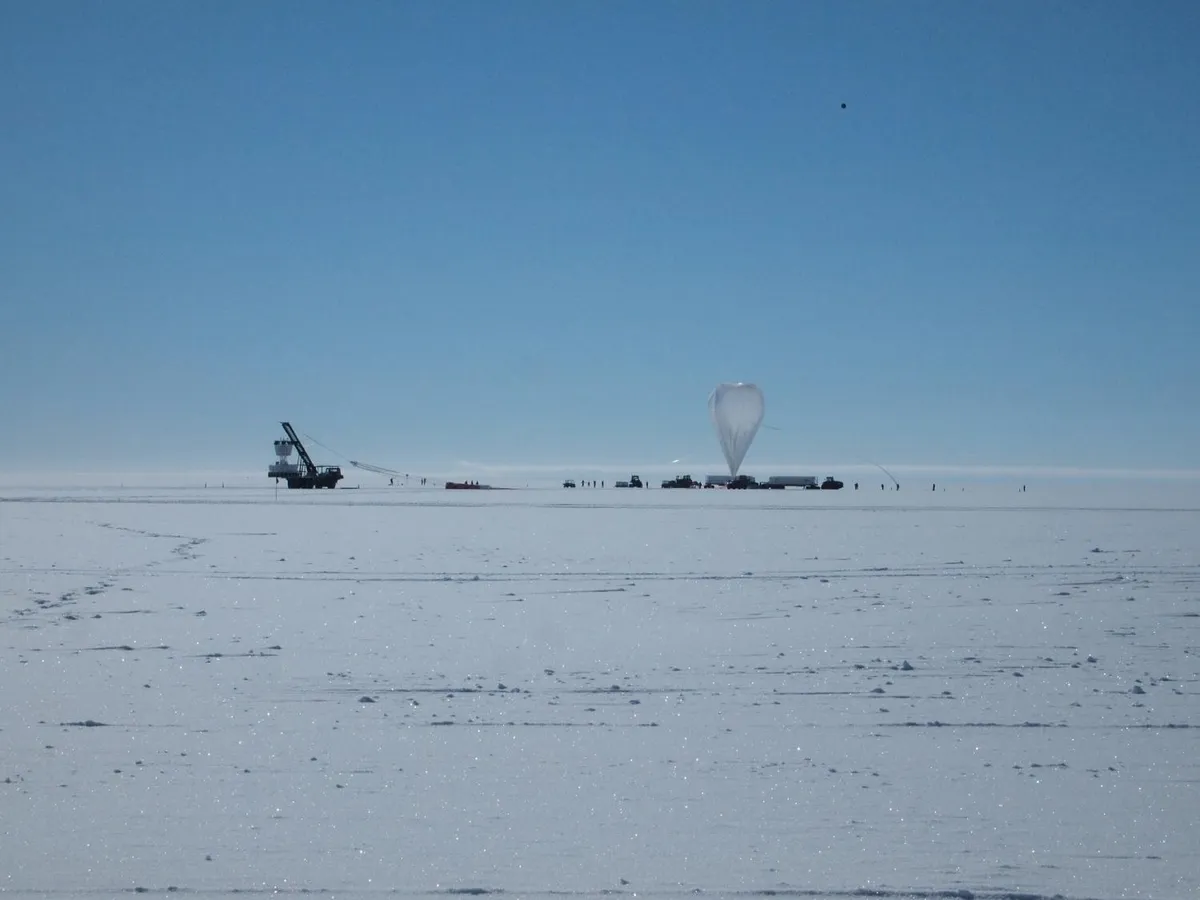 The radio pulses were detected by the Antarctic Impulsive Transient Antenna
(ANITA) experiment, designed to detect radio waves from cosmic rays hitting
the atmosphere from balloons high above Antarctica.
Credit: Stephanie Wissel / Penn State (CC BY-NC-ND 4.0)
The Antarctic Impulsive Transient Antenna (ANITA) experiment floats a range of instruments above Antarctica using a stratospheric balloon. The experiment is aimed at detecting cosmic neutrinos, tiny particles which only interact via gravity and the weak force, originating from distant astrophysical sources as they interact with the ice.
“We have these radio antennas on a balloon that flies 40 kilometers above the ice in Antarctica,” Stephanie Wissel, associate professor of physics, astronomy and astrophysics at Penn State University explained in a statement. “We point our antennas down at the ice and look for neutrinos that interact in the ice, producing radio emissions that we can then sense on our detectors.”
While detecting neutrinos is odd enough, the team was recently met with particularly unusual radio signals, which appear to defy our current understanding of particle physics. According to the team, two "anomalous" radio pulses came from below the horizon, underneath the ice.
“The radio waves that we detected were at really steep angles, like 30 degrees below the surface of the ice,” Wissel added.
According to Wissel, the team's calculations showed that for the radio pulse to be detected, it must have had to pass through 6,000-7000 kilometers (3,700-4300 miles) of rock. But after traveling through the rock, it should have interacted and been absorbed, leaving it undetectable.
“It’s an interesting problem because we still don't actually have an explanation for what those anomalies are, but what we do know is that they're most likely not representing neutrinos," Wissel said.
As tau neutrinos hit the ice, they interact and produce radio emissions, known as "ice showers". But they also produce a secondary particle, known as a tau lepton, which goes on to decay as it travels, with the resulting emission known as "air showers". By analyzing the signals, researchers can determine properties of the particle that created it and attempt to trace it back to its source. But in this case, there is a problem in that the angle of the radio pulse is much sharper than models predict.
Looking at data from other neutrino observatories – the IceCube Experiment and the Pierre Auger Observatory – the team found that they had not seen similar upward-traveling air showers, nor anything that could explain what ANITA had detected.
"These events show strong horizontal polarization, but without the polarity inversion expected for reflected pulses from UHECR showers," the team explains in their paper.
"They could be induced by air showers developing in the upward direction, as could be expected from tau lepton decays produced in ultrahigh-energy tau-neutrino interactions below the surface. However, the direction of the observed pulses implies that the neutrinos would need to travel about 6000–7000 km through the Earth before interacting below the ice surface. This corresponds to about 8–10 interaction lengths at the required neutrino energy
Managed & Built by I2M Consulting, LLC | © 2010-
