

Sutherland reported in early 2025 that the field of study of rare-earth element (REE) adsorption by metal–organic frameworks (MOFs) has emerged relatively recently. Recovering REEs from industrial, mining, and end-of-life electronics recycling effluents offers a sustainable approach to mitigating their unrestricted release into the environment.
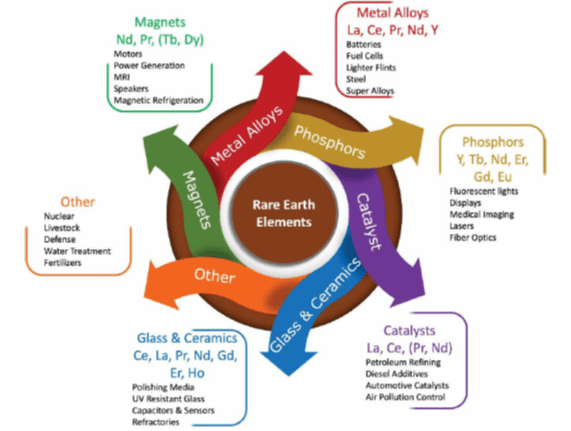 Key applications of rare earth elements. MRI, magnetic resonance imaging.
The research conducted thus far on the adsorption of REEs by MOFs has significantly advanced our understanding and laid a solid foundation for broader applications. Functionalization and combination of MOFs have proven effective in enhancing adsorbent capacity, stability, adsorption rate, and reusability. While the average time to reach equilibrium was approximately 4.5 h, some adsorbents achieved equilibrium in under 30 min.
In most instances, isothermal and kinetic data followed the Langmuir and pseudo-second-order models. Compared to other adsorbents, MOFs demonstrated favorable adsorption capacities for REEs. Notably, the 3D-agaric-like core–shell U6N@ZIF-8-20 MOF, MOF-bonded silica amine and polymer, and phosphonic acid–functionalized ZIF-67@SiO2 exhibited adsorption capacities of 341.0, 426.0, and 342.5 mg/g for Er3+, Y3+, and Ce3+, respectively.
Only a fraction of the reviewed studies explored thermodynamic analysis. Among those, the reactions were generally spontaneous and varied between endothermic and exothermic. The primary reported mechanisms for REE attachment were electrostatic attraction and chemical sorption. The selectivity of MOFs for target REEs was extensively studied, with mono- and divalent competing ions having negligible effects, while trivalent ions were only slightly competitive. The reusability of MOFs was also well investigated, identifying efficient eluents such as HCl, HNO3, and acetonitrile and demonstrating that some MOFs could achieve five adsorption–desorption cycles with negligible decreases in adsorption efficiency.
Most studies focused on single-contaminant systems at the laboratory batch scale. To advance this technology, future research should emphasize reducing equilibrium time, exploring a broader range of REEs, conducting fixed-bed column studies, performing MOF–REE cost analysis, evaluating real-world wastewater, and investigating the safe disposal of spent MOFs.
Managed & Built by I2M Consulting, LLC | © 2010-
