

Wang and 8 co-authors reported in 2013 that tetravalent uranium is commonly assumed to form insoluble species, resulting in the immobilization of uranium under reducing conditions. Here we present the first report of mobile U(IV)-bearing colloids in the environment, bringing into question this common assumption.
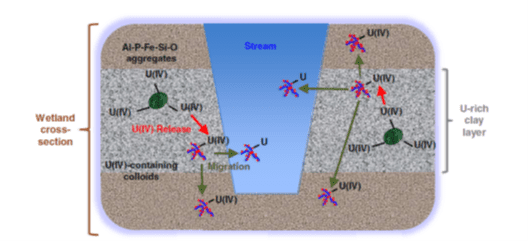
The above graphic illustrates the proposed Model of U release. The Fe- and OM-rich colloids are transported to the U-rich clay layer where some U(IV) is transferred from the Al-P-Fe-Si aggregates in soil to the porewater colloids, because this form of U(IV) is labile. Migration of mobile porewater colloids into the stream water then leads to the release of U from the wetland into the stream.
The authors investigated the mobility of uranium in a mining-impacted wetland in France harboring uranium concentrations of up to 14,000 p.p.m. As an apparent release of uranium into the stream passing through the wetland was observable, the authors examined soil and porewater composition as a function of depth to assess the geochemical conditions leading to this release.
The analyses show the presence of U(IV) in soil as a non-crystalline species bound to amorphous Al-P-Fe-Si aggregates, and in porewater, as a distinct species associated with Fe and organic matter colloids. These results demonstrate the lability of U(IV) in these soils and its association with mobile porewater colloids that are ultimately released into surface water.
Managed & Built by I2M Consulting, LLC | © 2010-
