

Pidchenko and three co-authors reported in 2013 that a wet chemical method to determine uranium (U) oxidation states in geological material has been developed and tested. The problem faced in oxidation-state determinations with wet chemical methods is that U redox state may change when extracted from the sample material, thereby leading to erroneous results.
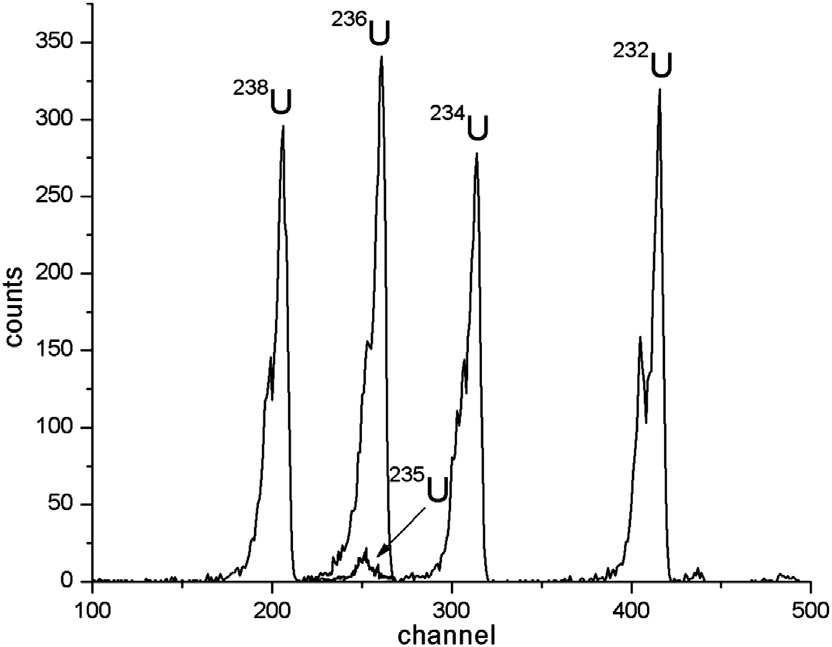 U isotopes a-spectrum of U(IV) fraction extracted from 500 mg of DL-1a. Both
redox tracers 236U and 232U can be seen in the spectrum.
In order to quantify and monitor U redox behavior during the acidic extraction in the procedure, an analysis of added isotopic redox tracers, 236U(VI) and 232U(IV), and of variations in natural uranium isotope ratio (234U/238U) of indigenous U(IV) and U(VI) fractions was performed.
Two samples with varying redox activity, U bearing rock and U-rich clayey lignite sediment, were used for the tests. The Fe(II)/Fe(III) redox-pair of the mineral phases was postulated as a potentially disturbing redox agent. The impact of Fe(III) on U was studied by reducing Fe(III) with ascorbic acid, which was added to the extraction solution.
The authors measured 234U/238U ratio in U(IV) and U(VI) fractions in the sediment samples provided a unique tool to quantify U oxidation caused by Fe(III). Annealing (sample heating) to temperatures above 500°C was supposed to heal ionizing radiation induced defects in the material that can disturb U redox state during extraction. Good agreement between two independent methods was obtained for DL-1a material: an average 38% of U(IV) determined by redox tracer corrected wet chemistry and 45% for XANES.
Managed & Built by I2M Consulting, LLC | © 2010-
