

Kelly and 8 co-authors reported in 2007 that the success of sequestration-based remediation strategies depend on detailed information, including the predominant U species present as sources before biostimulation and the products produced during and after in situ biostimulation.
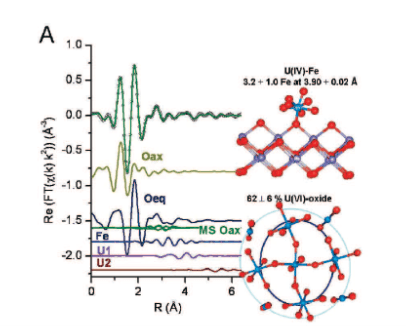
Real part of the Fourier transform of the U LIII-edge
EXAFS spectrum (open symbols) and the EXAFS model (green
line), with the components of the model offset under the EXAFS
spectrum. The major U species are depicted next to each
spectrum.
The authors used X-ray absorption spectroscopy (in 2007) to determine the valence state and chemical speciation ofUin sediment samples collected at a variety of depths through the contaminant plume at the Field Research Center at Oak Ridge, TN, before and after approximately 400 days of in situ biostimulation, as well as in duplicate bioreduced sediments after 363 days of resting conditions.
The results indicate that U(VI) in subsurface sediments was partially reduced to 10–40% U(IV) during biostimulation. After biostimulation, U was no longer bound to carbon ligands and was adsorbed to Fe/Mn minerals. Reduction of U(VI) to U(IV) continued in sediment samples stored under anaerobic
condition at <4°C for 12 months, with the fraction of U(IV) in sediments more than doubling and U concentrations in the aqueous phase decreasing from 0.5-0.74 to <0.1 μM.
A shift of uranyl species from uranyl bound to phosphorus ligands to uranyl bound to carbon ligands and the formation of nanoparticulate uraninite occurred in the sediment samples during storage.
Managed & Built by I2M Consulting, LLC | © 2010-
