

Dostal and two co-authors reported in 1976 that uhe U content of major rock-forming minerals in a suite of calc-alkaline volcanic rocks from Sardinia is very low and their partition coefficient of U (D c =CS/C l') is smaller than 0.1.
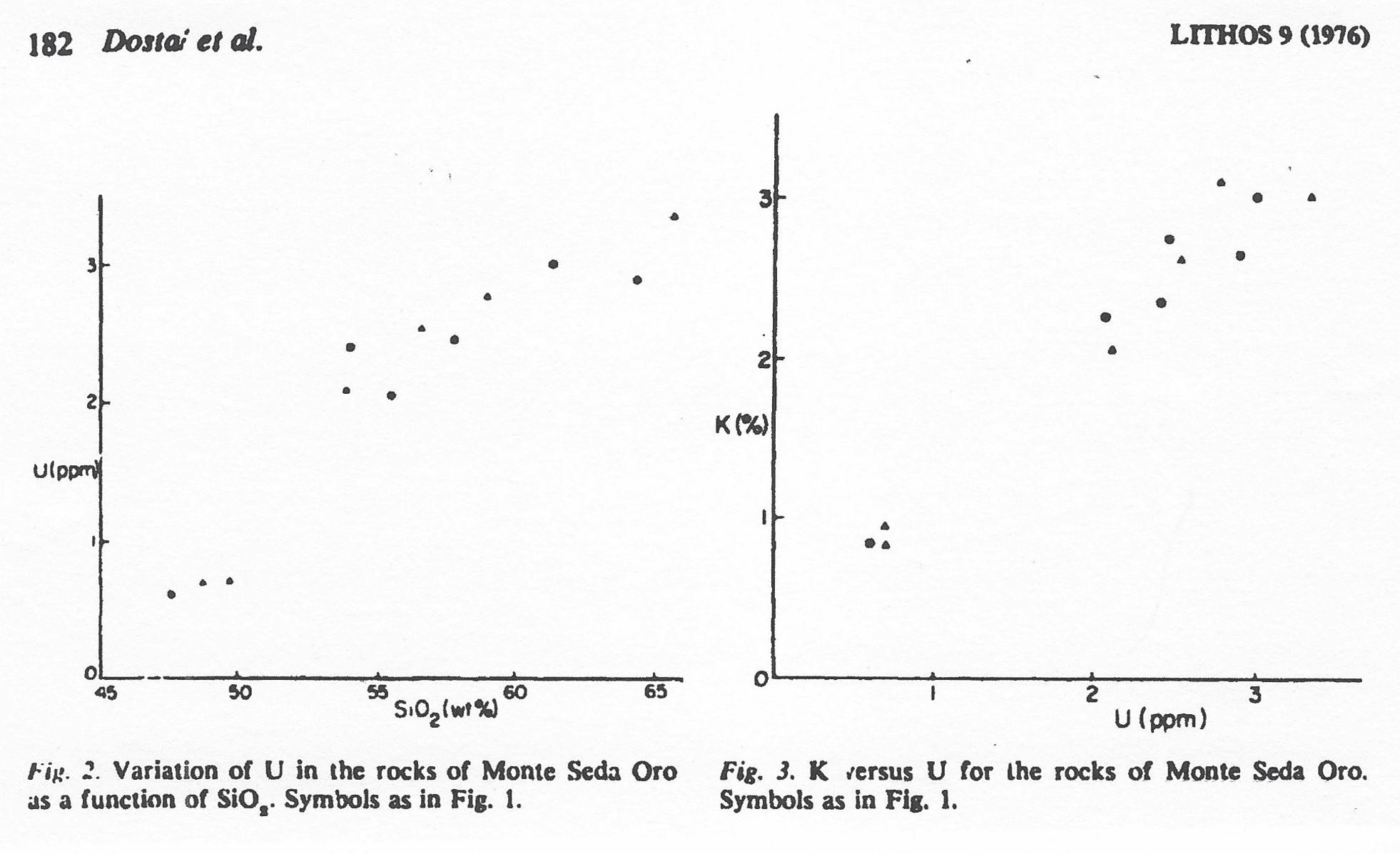
The values of D U of the mineral phases decrease from basalt to dacite and, in all rocks, the bulk of U and K is present in the groundmass. The apparent close association between K and U in basic and intermediate rocks probably reflects the fact that most of their rock-forming minerals are relatively 'inert' with respect to both of these elements.
They concluded that the close association between K and U observed in Monte Seda Oro is relatively well established for basic rocks in general (Heier & Rogers 1963, Heier et al. 1965) although the geochemical properties of these two elements, including their partitioning among coexisting phases, are very different. For example, among major mineral phases of basalts, clinopyroxene has the highest U content while plagioclase has the highest content of K. Thus, it seems that the predominant reason for this association of K and U is the fact that most rock-forming minerals in basic and intermediate rocks are relatively 'inert' with respect to both of them and consequently they are both strongly enriched in the residual liquid.
The generally lower K/U ratio of acid rocks as compared to basic rocks (Heier et al. 1965) can be due to a different degree of enrichment of these elements when fractional crystallization with the separation of K-feldspar and/or biotite takes place. Both these minerals have DU~l (Dostal & Capedri 1975) while DK> 1 (Philpotts & Schnetzler 1970) and thus their crystallization leads to a decrease of the K/U ratio in the residual liquids.
[Also see Campbell, M. D., 1974, A Review of Potassium - Uranium Systematics: Geologic Implications of Moon- Earth - Meteorite Origins," (here)]
Managed & Built by I2M Consulting, LLC | © 2010-
