
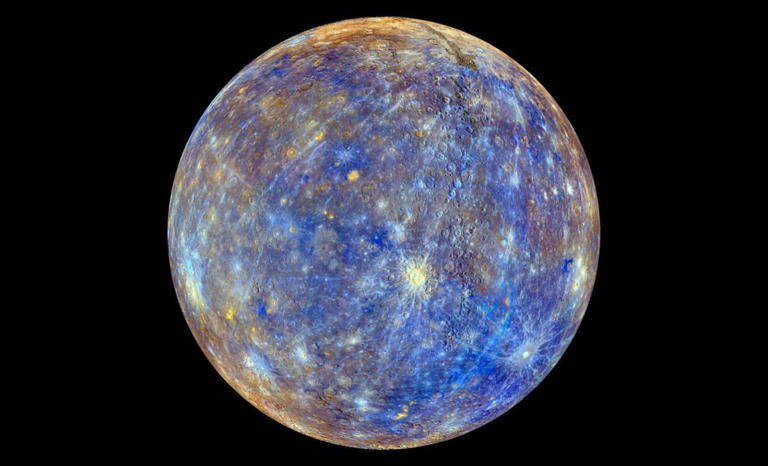
Amazouz reported in April 2025 that Mercury, the smallest and innermost planet in our solar system, may be home to a dazzling secret hidden beneath its scorched surface—a diamond layer up to 11 miles thick.
The Daily Galaxy --Great Discoveries Channel © Daily Galaxy US
A groundbreaking study, led by planetary materials expert Dr. Yanhao Lin and published in Nature Communications, suggests that under Mercury’s extreme conditions, carbon deep within the planet’s mantle could have transformed into diamond, forming a dense, crystalline shell around its metallic core.
Carbon-Rich Origins and Diamond Formation
Mercury’s surface is scattered with graphite, an allotrope of carbon, indicating that the planet’s crust once floated atop a carbon-rich magma ocean. As this ocean cooled, lighter carbon materials floated upward, while denser carbon sank deeper into the planet. Under pressures exceeding 5.5 GPa and temperatures approaching 3,600°F, researchers showed that this submerged carbon could convert into diamond at Mercury’s core–mantle boundary.
“Many years ago, I noticed that Mercury’s extremely high carbon content might have significant implications,” Dr. Lin said. “It made me realize that something special probably happened within its interior.”
Their high-pressure experiments also factored in the influence of sulfur, which lowers the melting point of Mercury’s magma ocean and facilitates diamond formation. Under these conditions, diamond becomes stable enough to sink and accumulate, forming a distinct shell that could extend up to 18 kilometers (11 miles) thick around the core.
A Potential Key to Mercury’s Magnetic Field
Unlike other small planetary bodies, Mercury still has a sturdy magnetic field, which surprised scientists given its size. According to Lin, diamond’s high thermal conductivity could explain this mystery. As carbon cools and forms diamond, it enhances heat transfer from Mercury’s core to its mantle, maintaining the thermal gradients necessary to power the planet’s magnetic dynamo.
“Diamond’s high thermal conductivity helps transfer heat effectively from the core to the mantle,” Lin explained. “That affects convection in the core and helps sustain the magnetic field.”
This mechanism makes Mercury’s internal dynamics unique and may offer insights into magnetic fields on other rocky worlds, including exoplanets.
What This Means for Planetary Science
The implications of a diamond-rich Mercury go far beyond its aesthetic appeal. While Earth, Venus, and Mars have lost much of their surface carbon through geological processes, Mercury appears to have retained and concentrated its carbon content, creating a chemically distinct planetary body.
“It also could be relevant to the understanding of other terrestrial planets, especially those with similar sizes and compositions,” Lin added.
The study proposes that such diamond layers might exist on other planetary bodies—or even carbon-rich asteroids—if similar conditions occurred during their formation.
These findings may eventually reshape our understanding of planetary evolution, especially for smaller, rocky planets orbiting close to their stars.
Managed & Built by I2M Consulting, LLC | © 2010-