

Johnson and three co-authors reported in 2010 that uranium in-situ recovery (ISR) operations extract uranium via enhanced dissolution of solid-phase uranium in groundwater of sands often used as drinking water aquifers. This changes the pre-existing groundwater geochemistry and makes uranium and other radionuclides and trace elements of concern more mobile in solution.
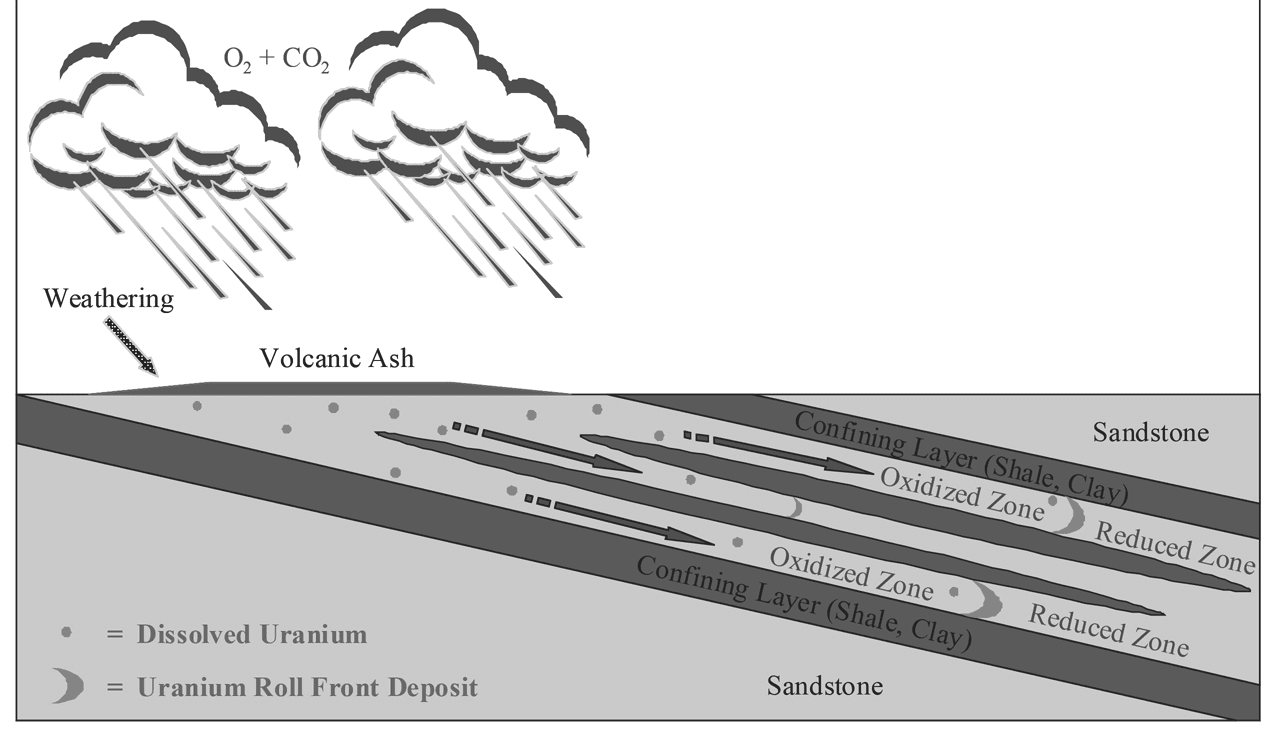 Concept of the Uranium Roll-Front Mineralization in Sands
These zones often within known aquifers often do not produce suitable drinking-water supplies becasue of natural processes that concentrate uranium in a reduced environment, but surrounding aquifer zones can be of drinking water quality. Local groundwater users are concerned about how nearby in-situ recovery operations (either existing or proposed) might impact the quality of their groundwater.
For this research, the authors proposed strategies for addressing the following questions:
1) How well do identified aquitards limit groundwater flow between aquifers?
2) What is the groundwater quality at the end of mining after restoration efforts are complete? and
3) What is the long-term fate and transport of any groundwater contaminants away from the mined zone?
in order to address these questions, a number of predictive modeling steps should be taken to determine how surrounding groundwater quality may or may not be affected by in-situ recovery operations.
- First, understanding the basic hydrogeologic and geochemical system is critical,
- Second, predictive modeling using reactive transport models can be used to simulate future groundwater conditions (during mining and post-restoration),
- Third, predictive modeling can be used to evaluate how well surrounding groundwater quality is protected under the proposed mine plan design and to evaluate possible design alternatives. and
- Fourth, model shortcomings should be evaluated to provide a reasonable range of prediction uncertainties.
While these steps are generally applicable to any uranium in-situ operations, they will be applied and tested at a proposed uranium in-situ recovery site near Edgemont, South Dakota. The goal of this research is to provide predictive modeling strategies for better understanding the most probable fate and transport of uranium and other dissolved constituents during and after in-situ recovery operations. This information will assist mining companies, permitting agencies, and local groundwater users in making more informed decisions on final mine designs/operations and closure strategies that maximize protection of groundwater quality.
Managed & Built by I2M Consulting, LLC | © 2010-
