

Kurmanseiit and five co-authors reported in 2023 that reactive transport modeling is known to be computationally intensive when applied to 3D problems. Transforming sequential computing on the computer processor units (CPU) into parallelized computation on the high-performance parallel-graphic processor units (GPU) is a classical approach to increasing computational performance.
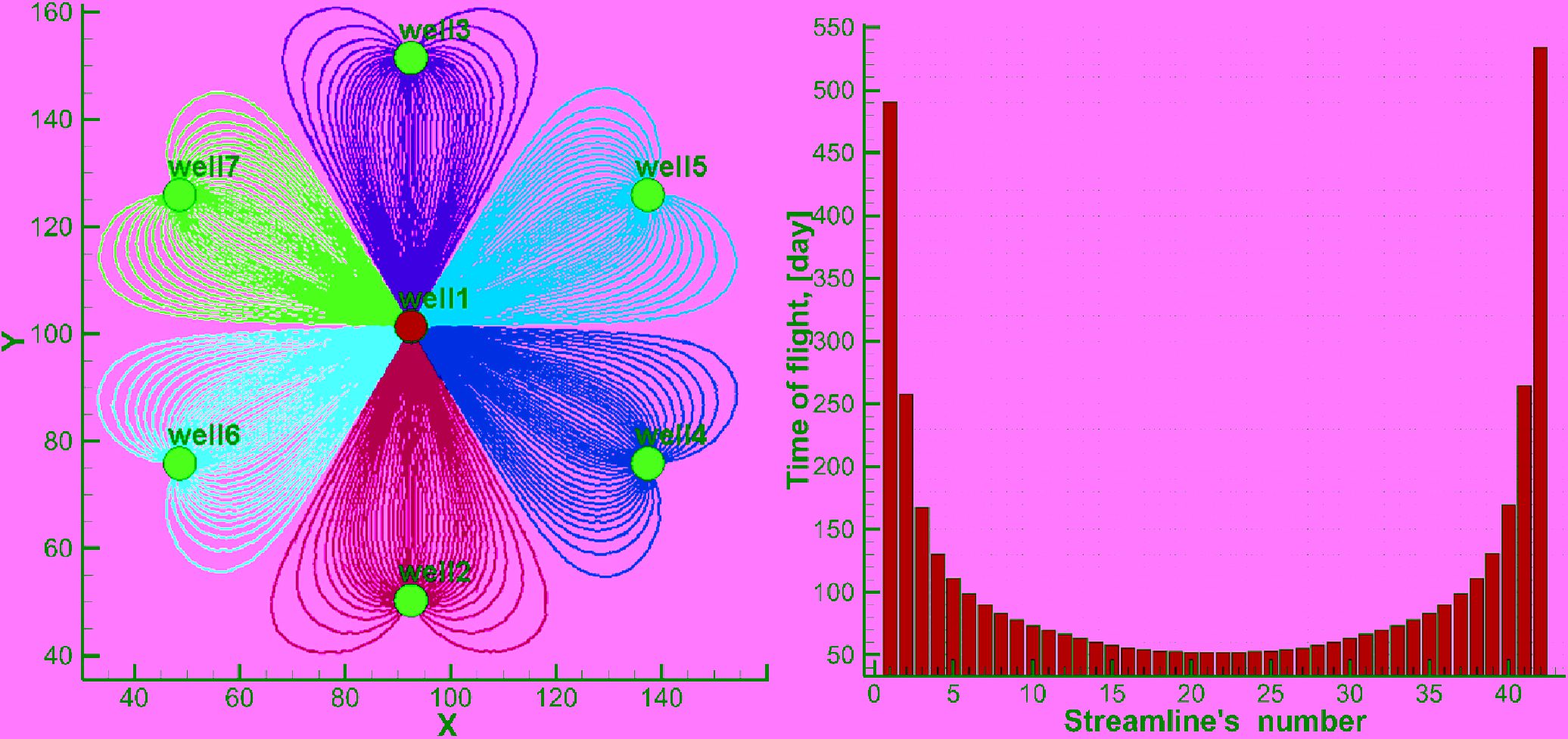
(a) Top view of streamlines colored by Injectors, from the Injection wells
to the Production well.
(b) Times of flight (aka migration) (TOF(M)) for all streamlines from Injector
2 to Productor 1.
Another complementary approach is to decompose a complex 3D modeling problem into a set of simpler 1D problems using streamline approaches which can be easily parallelized, therefore reducing computation time.
The authors investigated the possible solutions to the equations governing dissolution and transport using streamlines coupled with a parallelization approach. In addition, an analytical solution to the dissolution and transfer equations of uranium describing the In-Situ Leaching (ISL) recovery is found using an approximation series to the 2nd order.
The analytical solution is compared to the 1D numerical resolution along the streamlines and to the 3D simulation results superimposed on the streamline. Both approaches give similar results with a relative error of <2 % (2%). The proposed methodology is then applied to a case study in which the classical 3D resolution is compared to the newly suggested streamline solution, demonstrating that the streamline approach increases computational performances by a factor ranging from hundred to thousand depending on the complexity of the grid-block model.
Streamline simulation can reduce the computation time by a factor ranging between hundred and thousand, depending on the computational grid. Although the analytical solution can only be used to quickly predict the process of uranium mining, the numerical study along the streamlines has a significant advantage in terms of calculation time compared to other methods. These faster simulation approaches pave the way for online exploitation simulation, better recovery, and less consumption of acid reagent during the exploitation of ore deposits mined using in-situ recovery methods by accounting for rapid changes in exploitation conditions.
[Kazakhstan operations have reportedly been having serious supply-chain problems with obtaining surfuric acid. U.S. operations use only oxygen and H2O2 in their operations for acceptable recovery of uranium.]
Managed & Built by I2M Consulting, LLC | © 2010-
