

Richard and 6 co-authors reported in 2012 that giant uranium deposits were formed during the Mesoproterozoic era, 1.6–1.0 Gyr ago, in both Canada and Australia. The deposits are thought to have formed from large-scale circulation of brines at temperatures of 120–200°C that percolated between sedimentary basins and underlying crystalline basement rocks. However, the precise conditions for transport of the uranium in these brines are poorly understood.
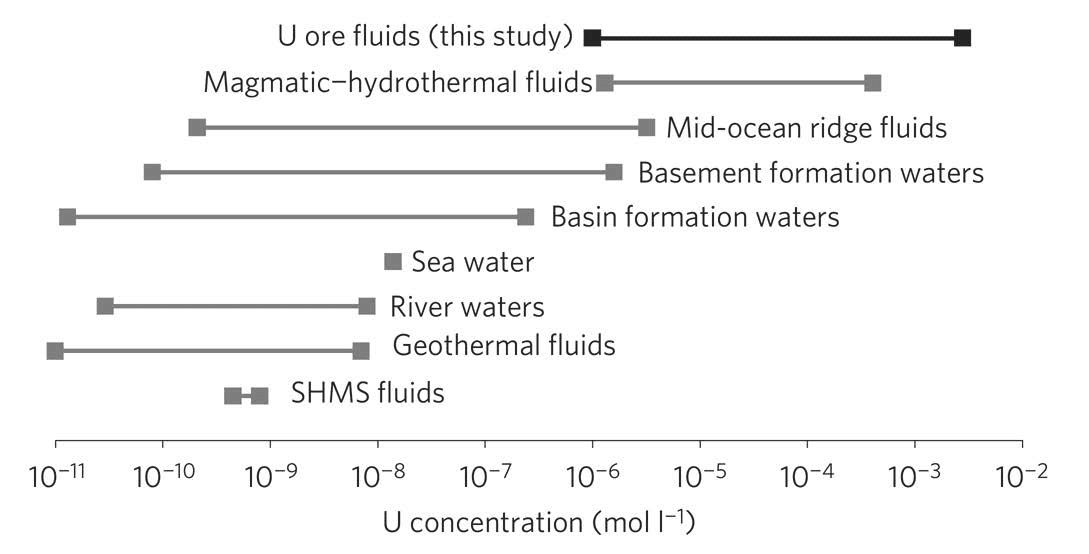 Comparison of U concentrations in Athabasca U ore fluids (this study)
with U concentration in various crustal fluids. Most crustal fluids have U
concentrations below 10−6 mol l−1 except for fluids related to the magmatic–
hydrothermal activity around granitic intrusions (T > 400°C), and U ore fluids
(this study), which have U concentrations up to three orders of magnitude
above any other geological fluids. Full references, U concentrations, temperature,
pH and salinity data for the fluids shown here are provided in Supplementary Table S3.
SHMS fluids, sedimentary-hosted massive sulphide mineral deposit fluids.
In this paper, the authors used mass spectrometry to analyse the uranium content of brines preserved in naturally occurring fluid inclusions in ore deposits
from the Athabasca Basin, Canada. We measure concentrations of uranium in the range 1.0 × 10⁻⁶ –2.8 × 10⁻³ mol l−1 These concentrations are three orders of magnitude above any other common crustal fluids. Experimentally, we measure the solubility of uranium as a function of NaCl content and pH, in mixtures that are analogous to ore-forming brines at 155°C. To account for the high uranium content observed in the Athabasca deposits, that authors found that the brines must have been acidic, with a pH between 2.5 and 4.5.
The results strongly suggest that the world’s richest uranium deposits formed from highly concentrated uranium-bearing acidic brines. The authors concluded that these conditions are a necessary requirement for the formation of giant uranium deposits in relatively short periods of time of about 0.1–1 Myr, similar to other world-class deposits of lead–zinc and gold.
Managed & Built by I2M Consulting, LLC | © 2010-
