

Gawad and 7 co-authors reported in early 2025 that their investigation focused on identifying Th-, Nb-Ta-, Zr-, and REE-bearing minerals with a multivariate statistical approach in alkaline syenite to evaluate their radiological risks, at Nikeiba, Egypt. Through microchemical analyses, by utilizing electron probe microanalysis, horite, microlite, monazite, zircon, columbite, and fergusonite were shown to bear uranium and thorium.
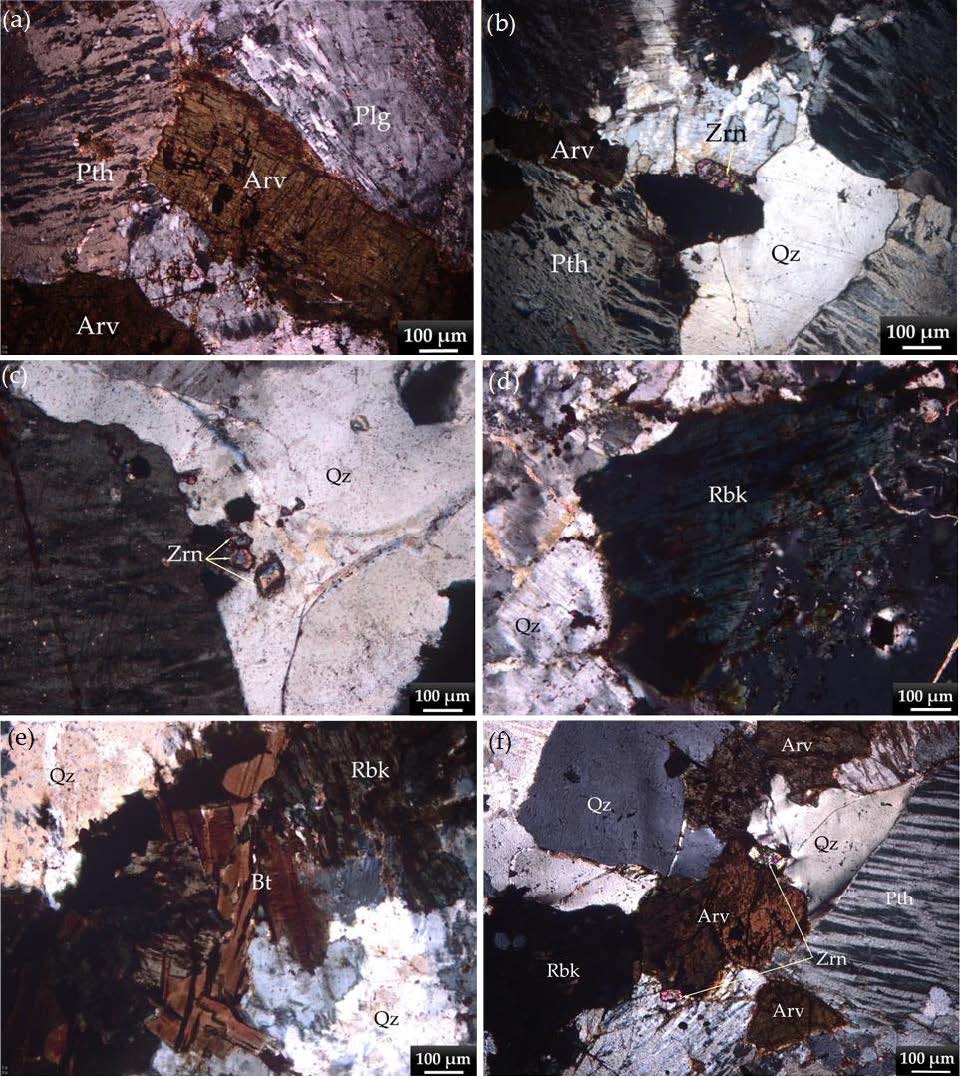 Photomicrographs in the investigated alkaline syenite at Nikeiba, SED of Egypt.
(a) Pale green arfvedsonite associated with perthite and antiperthite;
(b) Zoned zircon crystal adjacent to opaques;
(c) Zircon crystals coated with iron oxides enclosed in quartz;
(d) Dark bluish color of corroded riebeckite crystal;
(e) Association of corroded burned biotite, pale bluish riebeckite, and quartz crystals;
(f) Zircon crystals occurred along peripheries of arvedsonite crystal.
Abbreviations: Pth, perthite; Plg, plagioclase; Qz, quartz; Arv, arfvedsonite;
Rbk, riebeckite; Bt, Biotite; Zrn, zircon.
These minerals have played an important role in higher radioactive zones in the studied alkaline syenite. REE-minerals comprising bastnäsite, monazite, and fluorite and apatite are well recorded. The total rare earth elements (TREE2O3) reveal higher concentrations in bastnäsite than monazite, with averages 74.87 and 63.8 wt%. Ce is considered the most predominant LREE in the analyzed bastnäsite and monazite.
The mean values of radionuclide activity concentrations of 238U, 232Th, and 40K are 108 ± 20 Bq/kg, 107 ± 9 Bq/kg, and 1255 ± 166 Bq/kg, respectively. Radiological assessments revealed a radium equivalent activity of 357 Bq/kg, below global limits, but an air-absorbed dose rate (166 nGy/h) and annual effective doses (0.81 mSv/y indoors, 0.20 mSv/y outdoors) exceeding safe thresholds.
Additionally, the excess lifetime cancer risk (ELCR) was calculated at 0.00071, surpassing the acceptable limit of 0.00029, making these rocks unsafe for construction use. Statistical analyses further underscored the relationships between radionuclide concentrations and associated risks, highlighting the necessity for continuous monitoring and mitigation.
Managed & Built by I2M Consulting, LLC | © 2010-
