

Cech and 4 co-authors reported in 1988 that concern is mounting over possible adverse health effects associated with direct exposure to elevated alpha radiation levels in dometic water (Bean et al., 1982); Petersen et al., 1966; Lyman et al., 1985; Cothern, 1987). Radon released during domestic use of ground water is one of the potential routes of such exposure.
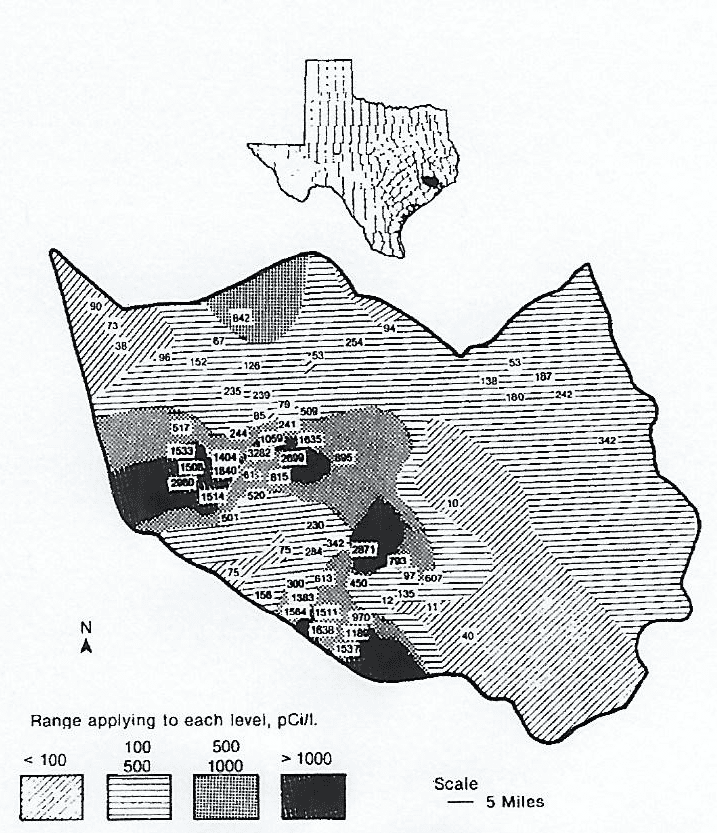 Concentrations of radon-222 in domestic-water supplies on the Upper
Gulf Coast in Harris County. Note: tap water in southeastern Harris County
is from the surface source, Lake Houston; because concentrations were
uniformly low and water is from the same surface reservoir, only a limited
number of samples were collected in this part of the study area. All
observations of elevated radon were associated with ground water and in
this category with medium-to-deep wells (from 100 to 600 meters).
However, relatively little is known worldwide about the distribution of alpha-emitting radioisotopes in ground-water supplies. In Texas, deposits of uranium occur, rich enough to be mined commercially, and the possibility existed that significant concentrations of uranium disintegration products may have been present in ground-water supplies.
Cech et al. (1987a) identified two regions with anomalously high concentrations of radium-226: in the Gulf Coast, downdip from uranium deposits, and
in west-central Texas, on the periphery of an igneous uplift. Radium-226 is a parent of radon-222 which is a focus of the present paper. Concentrations of radon up to 3300 pCi/l were observed in several domestic-water supplics.
This study suggests that it may be external sources (interaction of Tertiary aquifers with salt domes, leaky faults, and uranium-bearing volcanic ashes that imparts uranium to the ground water) and not the bulk mineralogy of the aquifers as suggested by King and Connor (1988), which cause anomalous concentrations of alpha-emitting radioisotopes in groundwater sampled at domestic and municipal or MUD well sites. The distinction is important, as it offers the possibility of avoiding high risk areas when selecting water well-drilling locations.
Managed & Built by I2M Consulting, LLC | © 2010-
