

Fishman and two co-authors reported in 1982 that the uranium deposits in the Lamprecht and Felder mines are parts of a continous roll-type orebody in the Miocene Oakville Sandstone, Ray Point uranium district, Live Oak County, south Texas.
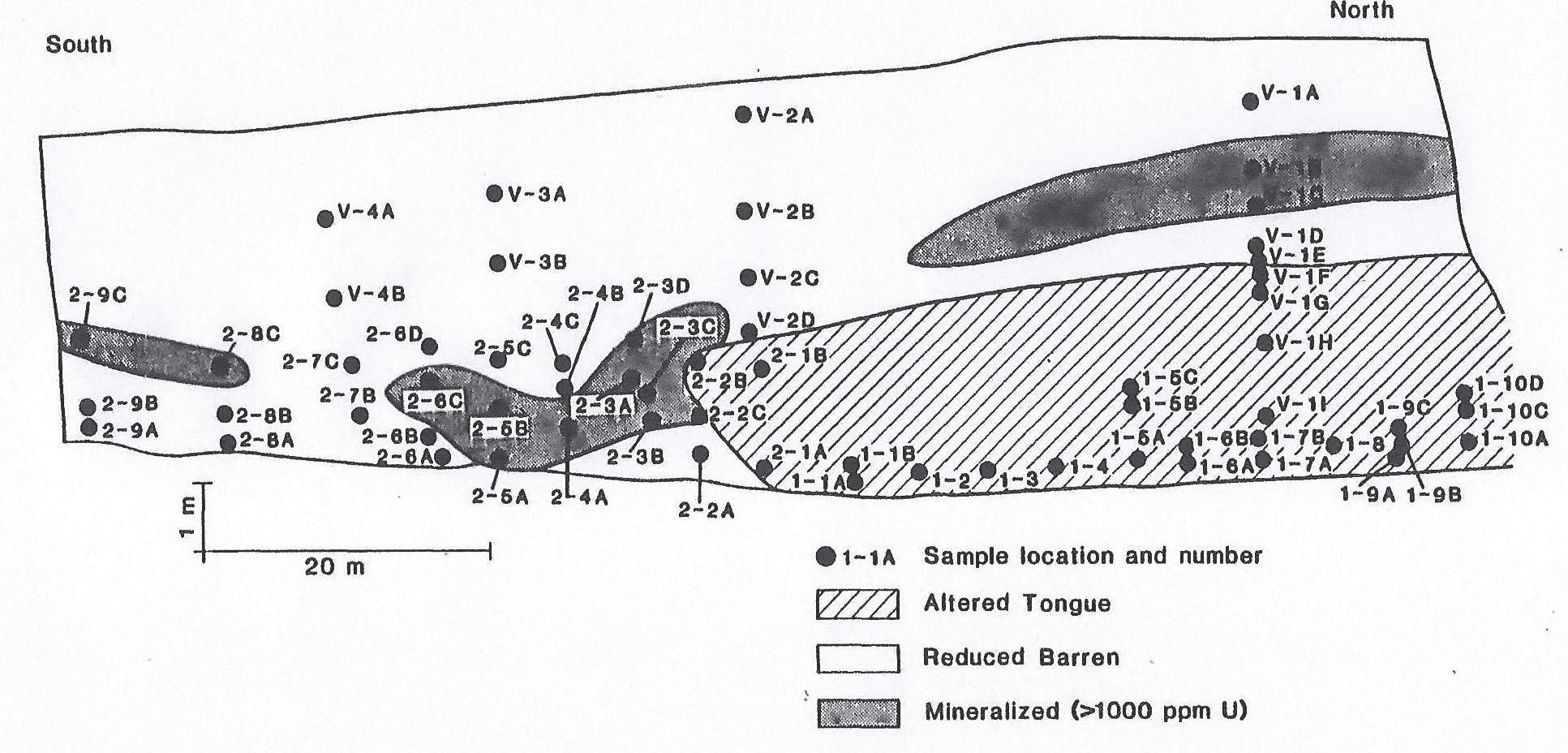 Cross section of pit 4B in the Felder deposit showing samplinglocations,
sample numbers, and major geochemical zones. Mineralized ground is
arbitrarily defined as that containing greater than 1000 ppm uranium.
Published studies of these deposits (Klohn and Pickens, 1970; Galloway, 1977; Galloway and others, 1979; Goldhaber and others, 1979, 1982; Reynolds and others, 1980, 1982; Ludwig and others, 1982) have focused primarily on depositional environment of the host beds, on stratigraphic and structural settings, on the geochemistry of modern ground water, on abundances, distribution, and textures of the iron disulfide (FeS£) minerals, on uranium-lead and sulfur isotope systematics, and on sulfidization and mineralization processes. Genetic models for uranium mineralization of the Felder and Lamprecht deposits are given by Galloway (1981) and by Goldhaber and others (1982).
We present here the full data set of geochemical analyses and mineralogic data for samples from the Lamprecht and Felder deposits. These analyses were
made in the Analytical Laboratories of the U.S. Geological Survey, in Denver, or in commercial laboratories. Analyses from commercial laboratories were
made available to us by the Wyoming Mineral Corporation (WMC). In addition, the relative abundances of pyrite and marcasite are listed for all samples
from the Felder deposit and most samples from the Lamprecht deposit.
This report complements our earlier studies of the Felder and Lamprecht deposits which summarize some of the analytical data but which, for the most part, donot contain complete data sets of the analytical results. In particular, this report is intended to supplement the paper by Goldhaber and others (1982) in which the origin of the uranium deposits in the Ray Point district is discussed.
Managed & Built by I2M Consulting, LLC | © 2010-
