

Qafoku and 7 co-authors reported in 2009 that samples of a naturally bioreduced, U-contaminated alluvial sediment were characterized with various microscopic and spectroscopic techniques and wet chemical extraction methods. The objective was to investigate U association and interaction with minerals of the sediment.
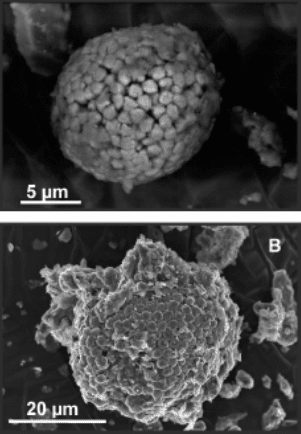 Micrographs (secondary electron images) of two
representative framboidal pyrites found in the <53
µm fraction of the naturally bioreduced sediment,
including a spheroidal (A) and an irregular (B)
framboidal structure with uranium.
Bioreduced sediment comprises ∼10% of an alluvial aquifer adjacent to the Colorado River, in Rifle, CO, that was the site of a former U milling operation.
Past and ongoing research has demonstrated that bioreduced sediment is elevated in solid-associated U, total organic carbon, and acid-volatile sulfide, and depleted in bioavailable Fe(III) confirming that sulfate and Fe(III) reduction have occurred naturally in the sediment. SEM/EDS analyses demonstrated
that framboidal pyrites (FeS2) of different sizes (∼10-20 µm in diameter), and of various microcrystal morphology, degree of surface weathering, and internal porosity were abundant in the <53 µm fraction (silt + clay) of the sediment and absent in adjacent sediments that were not bioreduced. SEM-EMPA, XRF, EXAFS, and XANES measurements showed elevated U was present in framboidal pyrite as both U(VI) and U(IV).
This result indicates that U may be sequestered in situ under conditions of microbially driven sulfate reduction and pyrite formation. Conversely, such pyrites in alluvial sediments provide a long-term source of U under conditions of slow oxidation, contributing to the persistence of U of some U plumes.
These results may also help in developing remedial measures for U-contaminated aquifers.
Managed & Built by I2M Consulting, LLC | © 2010-
