

Gough reported January 31, 2025 that though it's a cold, dead planet, Mars still has its own natural beauty about it. The image below shows us something we'll never see on Earth.
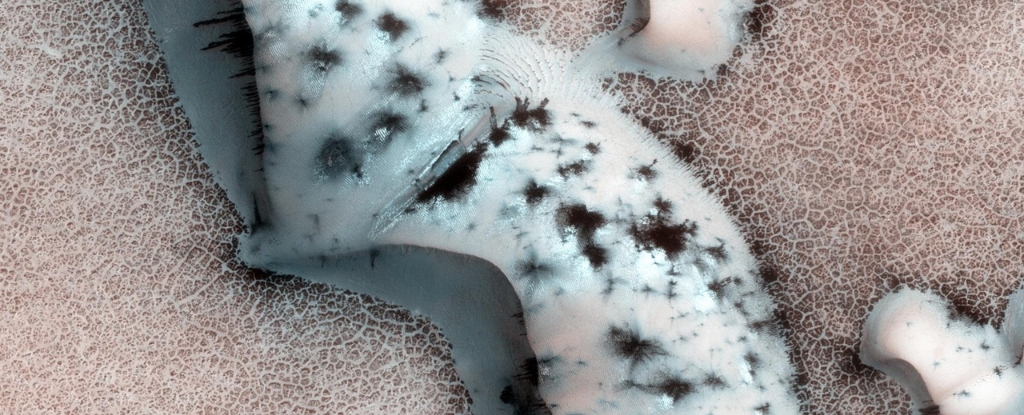 Dark shapes and bright spots on sand dunes in Mars’ North Pole region.
(Harvard University's John A. Paulson School Of Engineering And Applied Sciences)
Mars has only a thin, tenuous atmosphere, and most of it (95%) is carbon dioxide. When Martian winter arrives, CO2 freezes and forms a thick coating on the ground in the polar regions. It lies there dormant for months. As spring approaches, temperatures gradually warm. Sunlight passes through the translucent frozen layer of CO2, warming the ground beneath it.

The warming ground sublimates frozen CO2 into vapour that accumulates under the solid CO2. Eventually, the gas escapes through weak spots in the ice. It can erupt into geysers that spread darker material out onto the frozen surface.

Artist's impression of geysers at the Martian south polar icecap as southern
spring begins. (NASA/JPL-Caltech/Arizona State University/Ron Miller)
The HiRISE camera on NASA's Mars Reconnaissance Orbiter captured this image of these geysers on Mars in October 2018. It has also captured other images of Martian CO2 geysers.
Read on. Oustanding article (here).
Managed & Built by I2M Consulting, LLC | © 2010-
