

A report, dated November 15, 2024, was prepared by business personnel at the Texas A&M University-Kingsville for the Texas Commission of Environmental Quality (TCEQ) and this report concludes by indicating that since its original development in the 1940s, nuclear energy used to generate electricity has been studied with great interest.
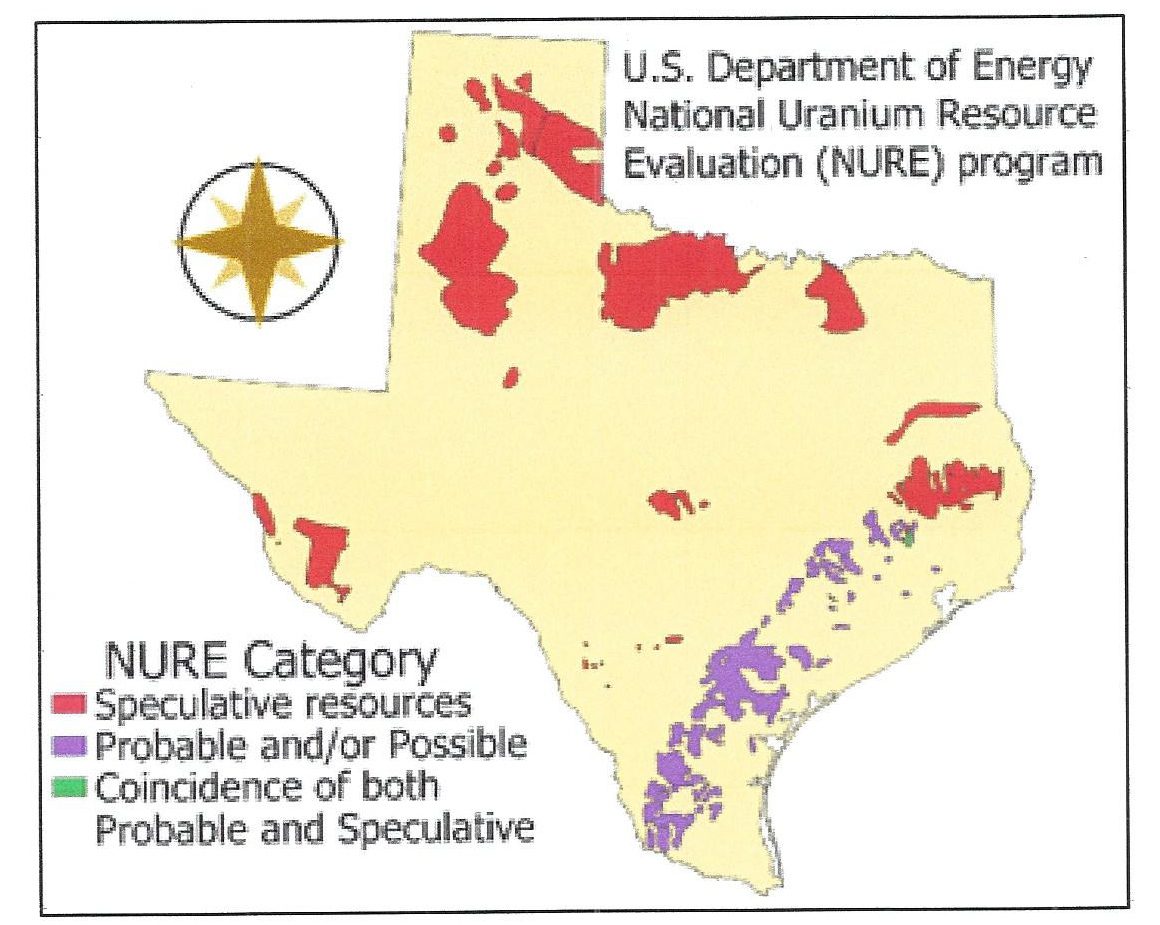
National Uranium Resource Evaluation (NURE) areas
for Texas, as provided by the US Department of Energy (EIA, 2020a).
The first demonstration project for a nuclear reactor capable of electricity generation was successfully developed in 1951 by the Argonne National Laboratory. The first commercial reactor was designed by Westinghouse Corporation and started operations in 1960 (WNA, 2020). Since then, commercial nuclear reactors have grown significantly all over the world. Reducing the dependence of the United States (US) on foreign uranium from World War
II to the 1970s, domestic uranium was purchased by the government for national security and weapon production. Some decline was experienced during the 1980s and 1990s, but development of a new generation of reactors after the year 2000 and concern with climate change has generated resurgence in this industry.
As a new generation of smaller and more efficient and modular nuclear reactors is under development, it is expected that an increase in nuclear energy generation capacity will be experienced in the near future (DOE, 2023a). Additional information about Small Modular Reactors (SMR) is provided in a further section of this report.
According to the Power Reactor Information System, in 2022, there were 415 nuclear reactors located in 31 countries, with the United States hosting the largest number of them with 94 reactors (IAEA, 2024). Nuclear reactors currently generate more than 18% of the electric power in the U.S. and make up almost 10% of electric generation all over the world (IAEA, 2024; WNA, 2024a).
These reactors provided 373,257 gigawatts (GW) of electricity-generating capacity globally in 2022, and 57 new reactors were reported to be under construction in multiple countries, with a potential additional electricity-generating capacity of 59,200 GW (IAEA, 2024).
The enormous size of the nuclear industry across the world, and particularly in the US, highlights the great need to generate a secure and stable supply of the elements and materials required for the operation of this essential sector. One of the most critical elements required for continuous operation of nuclear reactors is the enriched uranium used as fuel in these facilities. For this reason, uranium mining and its processing has been closely linked with the nuclear industry from the beginning.
As nuclear energy grew in the US, the mining of uranium increased in diverse locations, while increasingly more efficient and beneficial technologies were applied. However, its performance has been uneven in the US as the nuclear mining industry decreased its growth during the last two decades of the twentieth century and the imported supply of uranium from international locations increased. This caused local mining operations to decline significantly across the US and in Texas.
Considering the recent restriction of global supply and continuing interest in growing electricity generation from nuclear energy, there has been a noticeable interest to increase uranium production across the US, and particularly in Texas (EIA, 2023f).
This report will explore the historical development of the uranium mining industry, specifically in Texas, and will assess the existing uranium resources and supply over time. Existing resources in the state will be evaluated with regard to emerging technologies and challenges for both the global and local nuclear industry and uranium mining sector. This assessment will lead to the development of recommendations for Texas to incentivize the development of the uranium mining industry and its processing to become fuel adequate for current and future nuclear reactors.
Geopolitical changes in international locations for uranium supply have generated uncertainty on the availability of this critical resource. Therefore, incentivizing local uranium production and processing will generate a resilient domestic uranium supply chain system capable of supporting current nuclear industry needs and the significant growth expected in Texas and across the US.
[More on the use of the NURE Program in the 1970s (here)].
Managed & Built by I2M Consulting, LLC | © 2010-
