

Kuebler reported January 16 2025 that Nuclear advocates are pushing for controversial nuclear energy to play a greater role in global plans to mitigate climate change. Is that likely? [Nuclear power is controversial only to supporters of wind and solar energy. Nuclear power has the longest and best safety record of all the major energy sources, including wind and solar].
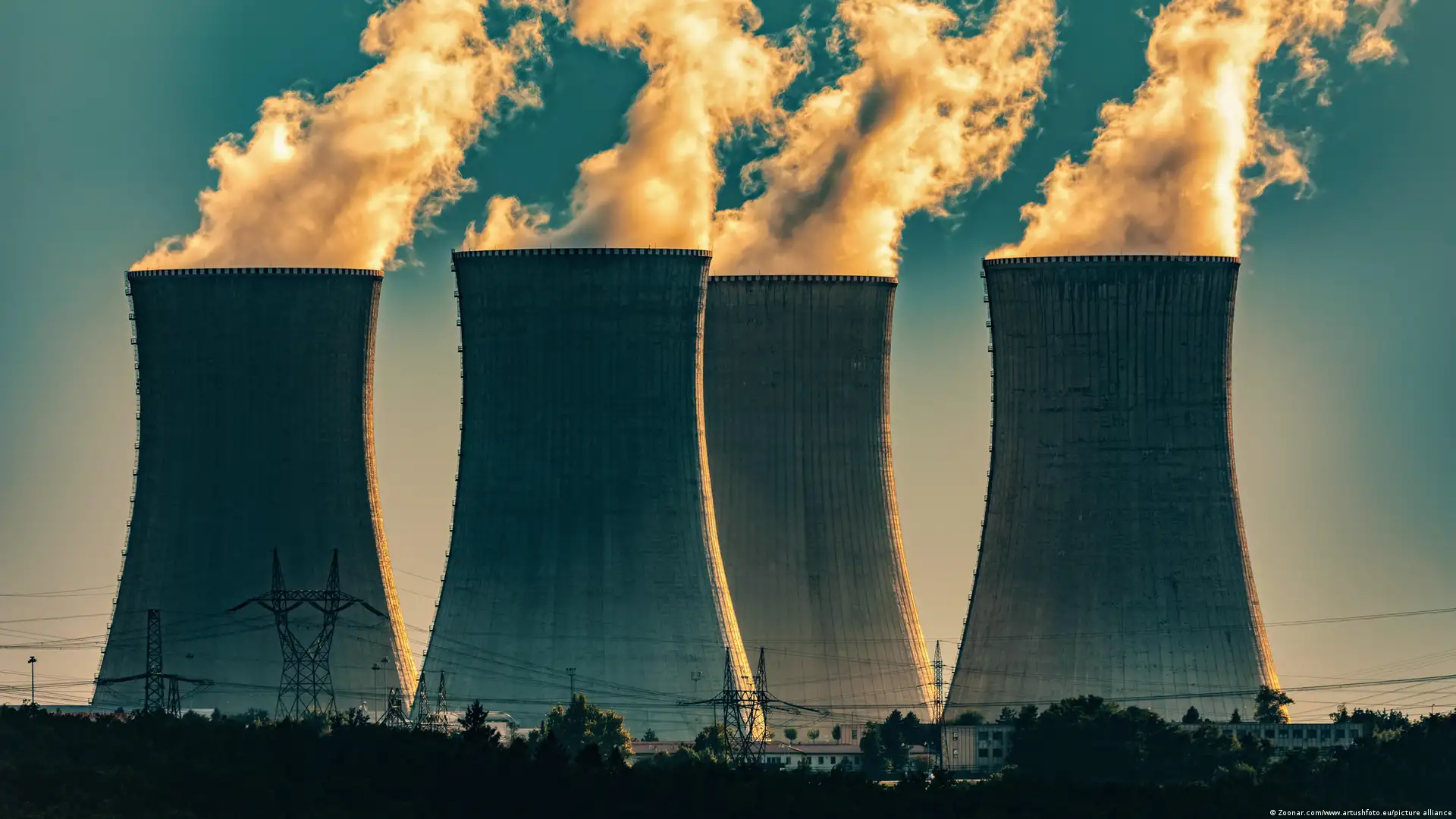 Image: Zoonar.com/www.artushfoto.eu/picture alliance
Nuclear power releases no carbon emissions during operation and has been touted as a solution to power the world's rapidly growing energy needs. Though it doesn't pollute in the same way as fossil fuels, nuclear energy comes with its own set of environmental problems: among them, indirect emissions from uranium mines, contaminated water, radioactive waste and the risk of a Chernobyl-style disaster. [Note: Bias Alert: 1. Only surface uranium mines have "indirect" emissions, not the current ISR operations, 2. contaminted waste? from an "indirect" plant accident?, and 3. the Chernobyl plant was a Soviet Union bad design].
Despite the risks, nuclear is expected to make up nearly 10% of global electricity production in 2025, according to new data from the International Energy Agency — a 30-year high. Fatih Birol, the IEA's executive director, said that growth was bring led by China, boosted in part by the huge energy demand of technologies like artificial intelligence and data centers.
In recent months, tech giants Meta, Amazon, Microsoft and Google have all announced plans to invest in nuclear power under the banner of carbon neutrality — despite earlier pledges to rely solely on renewable energy. And with the clock ticking on curbing greenhouse gas emissions to keep global heating in check, some policymakers and financial backers have also come out in favor of a renewed push for nuclear energy.
Is nuclear energy a realistic climate solution?
Nearly two years after Germany shut down its last nuclear reactors, the country's conservative CDU/CSU opposition has called for more research into nuclear technology. The parties also want to examine the possibility of bringing decommissioned nuclear power plants back online. With an eye to the German federal election in February 2024, the CDU/CSU election manifesto says nuclear energy "has an important role to play, particularly with regard to climate targets and security of supply."
Friedrich Merz, the CDU's candidate for chancellor, has described Germany's withdrawal from nuclear as a "strategic mistake" but says it's unrealistic to think that the last of the nation's reactors to be shut down could be brought back online.
The far-right Alternative for Germany party is also pushing for a return to nuclear energy as part of a "sustainable, serious energy mix," with chancellor candidate Alice Weidel claiming in a recent interview with German broadcaster ZDF that it has "a CO2 footprint of zero."
The governing coalition of the center-left Social Democrats and Greens, meanwhile, have both ruled out a return to nuclear, which is also connected to indirect emissions from the long and complex construction process of reactors.

Was shutting down nuclear energy a mistake?
Henry Preston, a spokesperson for the World Nuclear Association (WNA), believes policymakers have become more "pragmatic" in recent years, balancing energy security and the climate emergency while weighing the increased cost and construction timeline with the potential for a "huge amount" of clean energy. But environmental groups have consistently pointed out that costly new nuclear projects, which typically take around a decade to build after all the planning and permitting, won't come online fast enough to help meet climate goals. [But the new SMRs will be constucted much faster].
"A rapid transition requires the use of existing technologies and solutions which can most quickly be rolled out such as renewables, primarily solar and wind, energy efficiency, and system flexibility," said global climate campaigners Climate Action Network Europe in an online fact check.
"Renewable energies consistently outperform nuclear power in terms of cost and deployment speed and are therefore chosen over nuclear power in most countries," said the 2024 World Nuclear Industry Status Report (WNISR), which called plans to boost nuclear capacity in the coming decades "unrealistic." [But wind and solar are not reliable and will serve during the transition to and ramp up to SMRs and large nuclear power plants].
Are small modular reactors a safer alternative?
In the United States, Amazon and Google plan to buy power from small modular reactors (SMRs), advanced nuclear plants with a capacity of less than 300 MW, roughly a third of a standard nuclear plant. The tech giants have said nuclear will help power the huge energy needs of artificial intelligence and data centers, while also meeting their net-zero climate pledges. Data centers and AI today consume between 1% to 3% of the world's energy supply — a share that some analysts expect to double by 2030.
"Data centers need an abundance of energy that is carbon-free and reliable every hour of every day, and nuclear plants are the only energy sources that can consistently deliver on that promise," said Joe Dominguez, the CEO of Constellation Energy in the US, announcing a 20-year nuclear energy supply deal with Microsoft in September.
Proponents have said SMRs will be safer, cheaper and quicker to bring online than traditional reactors and can be built on the sites of former fossil fuel plants. The US partnerships with Amazon and Google are projected to be operational by the early 2030s. But Climate Action Network has argued against the "empty promises" of SMRs, pointing out that "the technology has not been tested yet at commercial scale." [The development of SMRs are underway by many companies, and the Climate Action Network supports wind and solar, without providing basis for claim].
Globally, only two SMR projects have been built so far, each with reactors of different Russian and Chinese designs. They were connected to the grid in 2019 and 2021, respectively.
The WNISR report, funded in part by Germany's Environment Ministry, pointed out that both projects ran into significant construction delays, taking two or three times longer to build than initially planned. They also went over budget and have so far underperformed on power generation.[Of course, that was new technology].
The nuclear industry, however, has said the delays weren't a surprise as the first SMRs built in Russia and China were pilot projects. Future projects now in the planning stages could "potentially come online quicker," said Preston of the WNA, speaking to DW from London. But Mycle Schneider, a [suposedly] independent nuclear policy analyst and publisher of the WNISR report, said in an email that this would only be possible with the "reproduction of identical or virtually identical units," and not SMRs of varying designs, like in Russia and China. [There is still major movement toward the SMR market in few years]
Schneider said the rapidly increasing production of solar panels, grid-connected batteries and wind turbines, of which tens of thousands of units are built each year, represented "truly modular manufacturing" allowing those industries to innovate and rapidly lower costs.
"The nuclear industry has learned from the SMR pilots in China and Russia that nobody wants to reproduce them, and there are no attempts to get them licensed in any Western country," said Schneider. [Schneider knows this claim is untrue.]
Do we need nuclear energy to meet climate goals?
At the 2023 climate summit in Dubai, nuclear energy was for the first time listed among the low-emission technologies needed to achieve the "deep, rapid and sustained reductions in greenhouse gas emissions." The UN's Intergovernmental Panel on Climate Change 2022 report also mentioned nuclear, saying it was "unlikely that all low-carbon energy systems around the world will rely entirely on renewable energy sources." While conceding that wind and solar are expected to play a major role in the push to replace fossil fuels [i.e., in transion to nuclear power], energy analysts have often spoken of the unreliability of renewable energy, which depends on the availability of sun and wind [but there are also other problems with wind (wind turbine-blade and gear-box failures, and short lifetimes, weather issues, and increasing and unanticipated operations and maintence costs, and with solar, also weather issues, hail, wind, and O&M costs.]
Further Information
[Nuclear Power: (here)]
[Solar (here)]
Managed & Built by I2M Consulting, LLC | © 2010-
