

Rackley reported in 1976 that the Colorado Plateau is the "home" of the uranium industry in the United States. Many uranium-vanadium deposits in sandstone occur there and these occurrences constitute a geologic type of ore deposit recognized in other areas of the world. Toe uranium deposits in the Wyoming basins are geologically similar to those of the Colorado Plateau in tectonic history and source-rock type, sedimentation, sedimentary environment, paleoclimate, mineralization, and alteration.

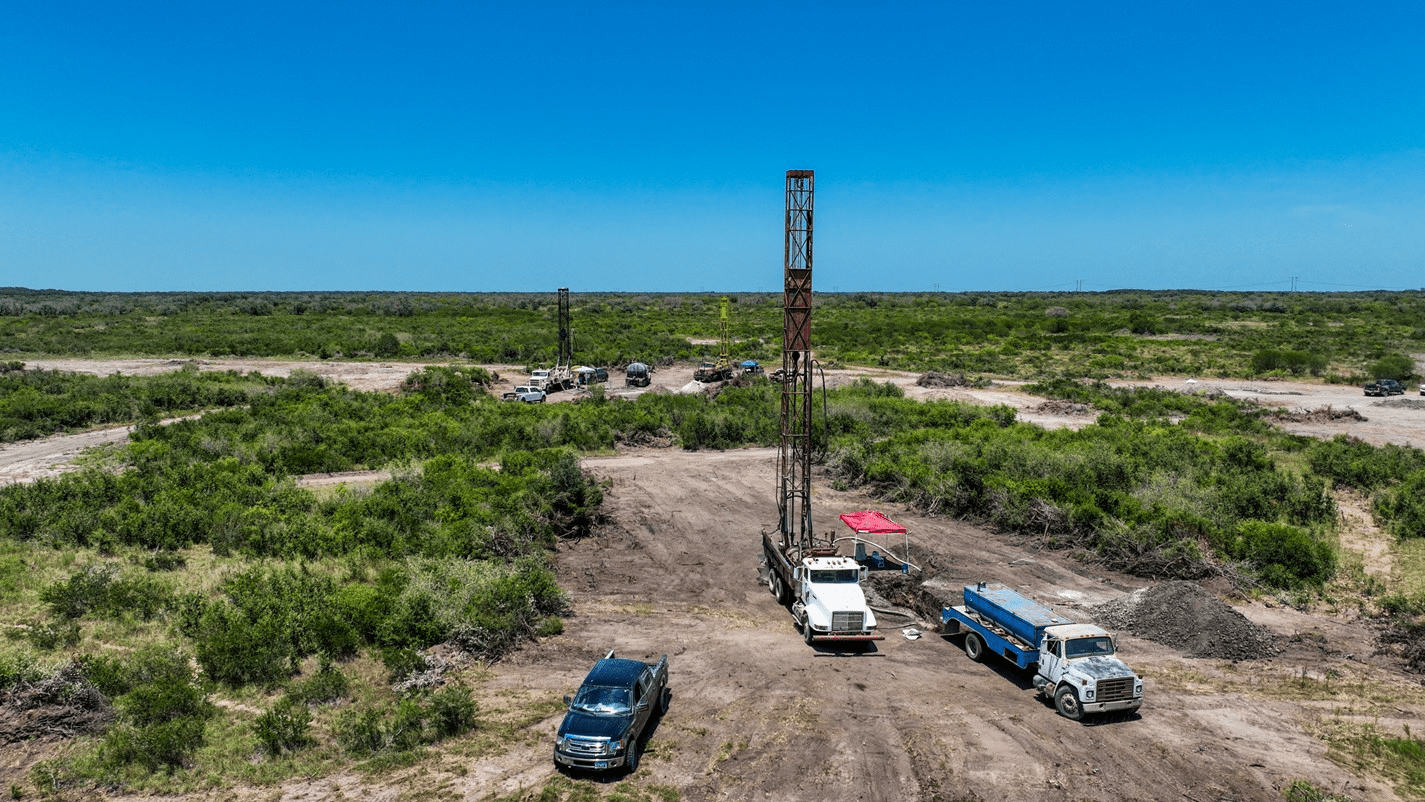 Drilling in South Dakota
This type of uranium deposit has been referred to as camotite type, sandstone type, or western-states type. Because the bulk of reserves are non-carnotite and other types of uranium occurrences can also occur in sandstone, the use of the term western-states type is preferred for area and type recognition. The uranium occurrences in Cretaceous formations of the Black Hills of Wyoming and South Dakota are of this type (Renfro, 1969). Uranium occurrences in the Permian sandstones of Europe also demonstrate many similarities (Barthel, I 974). The Texas uranium deposits are similar in ore-body configuration and in some of the elements present, but differ in sedimentary environment and in some aspects of uranium source (Eargle and Weeks, 1973).
While there is and probably will continue to be differences of opinion concerning the similarities and differences, there is an increasing awareness that the similarities in the sedimentology and ore-forming processes far outweigh the differences in details of shape, size and elements present (Gruner, 1956a and Fischer, 1970 and 1974). These deposits have provided over 90% of the United States domestic production of uranium and vanadium and will continue to be the principal source of domestic uranium for some time to come.
The importance of this type in the U.S. production and reserve picture indicates it constitutes approximately one fourth of the free-world reserves. This type of deposit possibly contributes a much higher portion of the total world supply, depending on the east-European and USSR reserves. No major uranium deposits of other types are known in the United States. Fig. 1 is a location map of the principal' uranium-producing districts. Grutt (1972) provides an excellent review of the U.S. uranium occurrences. The uranium deposits are epigenetic in the sense that they were formed in their present position after the enclosing sediment was deposited. How much later than the deposition of the host is one question yet to be answered. The deposits are also epigenetic in the sense used by Perel'man (1967) to indicate geological processes originating at or near the surface of the earth at low temperatures and pressures. In many respects, the ore deposits are similar to strata-bound supergene enrichments but have horizontal scales measured in miles. This implies that the metals were present in the sediment in small quantities, but in readily leachable form. Some geologists will not admit this possibility and some contradictory evidence has been presented. While more knowledge is being accumulated, this intrinsic source should be considered at least as a possible alternative because it requires the simplest process. These uranium deposits are considered to be the product of a physical-chemical trap, such as the hydrogen sulfide, reducing geochemical barrier for V, Fe, Cu, Co, As, Se, Ag, Ni, Zn, Cd, Hg, Pb, and U (Perel'man, 1967), which precipitates ore minerals from solutions on the basis of their concentration in solution, their sensitivity to changes in Eh and pH and their affinity for sulfur.
The most significant fact in the geological mobilization, transportation and deposition of uranium is that uranium has two naturally occurring valence states. In the hexavalent oxidized state, uranium can be taken into solution by acidic, neutral or basic water and transported infinitely. In the tetravalent reduced state uranium is practically insoluble.
Therefore, the uplift and erosion of any provenance will take place under conditions favorable for the oxidation and mobilization of its uranium content. The accumulation of uranium from this or any other source can only take place in sediment in an environment in which reducing conditions are sufficiently developed to reduce it to the tetravalent state and precipitate it.
Managed & Built by I2M Consulting, LLC | © 2010-
