

Shavit reported December 10 2024 that Earth’s mantle hides secrets of a cosmic collision. Geoscientists have revealed that continent-sized anomalies (called LLVPs) may be remnants of Theia, reshaping their understanding of planetary formation.
 Earth’s LLVPs may be remnants of Theia’s mantle.
(CREDIT: Deng Hongping and Hangzhou Sphere Studio)
Seismic imaging has uncovered two immense regions in Earth’s mantle that challenge the geoscientists' understanding of its composition and history. These continent-sized anomalies, known as large low-velocity provinces (LLVPs), rest near the planet's core, beneath Africa and the Pacific Ocean.
They are distinguished by their unique composition and their slower transmission of seismic waves, marking them as enigmatic features in Earth's interior.
While their origins have puzzled geologists for decades, a groundbreaking study has offered a stunning hypothesis: these subterranean giants may be remnants of Theia, a lost planet that collided with Earth billions of years ago.
 Geophysicists, using the Earth's own seismic whisperings, unveiled the existence
of two behemoths lurking near the heart of our planet. (CREDIT: Hernán Cañellas)
The Moon-forming impact between Earth and Theia is a cornerstone of planetary science, explaining not only the Moon’s formation but also Earth’s early evolution. However, Theia’s fate after the collision has remained elusive. Geoscientists now propose that its remnants were absorbed into Earth’s mantle, forming the LLVPs. This theory, published in the journal Nature, has the potential to revolutionize how geoscientists view planetary formation and evolution.
The LLVPs, rich in iron, are thought to be denser than the surrounding mantle by 2-3.5%, a difference that explains their stability in Earth’s lower mantle. According to the study, led by Caltech researchers, the anomalies likely formed when fragments of Theia’s mantle survived the impact and sank to the base of Earth’s mantle. The research team, which includes geologists, geophysicists, and geochemists (all geoscientists), used advanced simulations to model the cataclysmic collision. These models reveal that much of Theia’s mantle material was incorporated into Earth, while the rest contributed to the Moon’s formation.
Qian Yuan, a key researcher on the project, was inspired by a 2019 lecture on the giant-impact hypothesis. During the talk, he wondered whether the LLVPs could be the remnants of Theia, triggering a deep investigation.
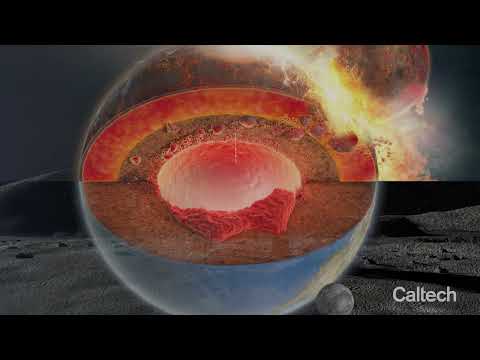
Working with experts across disciplines, Yuan helped simulate the collision, examining the dynamics of impact, the properties of Theia’s mantle, and the subsequent evolution of the debris. The results were striking: Theia’s mantle material, after being injected into Earth’s, segregated into dense, stable regions that could persist for billions of years.
These findings answer a lingering question: why didn’t Theia’s material disperse evenly within Earth? The simulations suggest that the cooler, lower mantle was shielded from the full intensity of the collision’s energy, allowing iron-rich fragments of Theia to remain intact. These fragments gradually sank and aggregated, forming the LLVPs geoscientists (i.e., geophysicists) observe today. In contrast, if the lower mantle had been more energetically disrupted, Theia’s remnants would have mixed more uniformly with Earth’s mantle.
The implications of this discovery extend beyond Earth’s history. If Theia’s remnants shaped the LLVPs, similar mantle heterogeneities may exist in other planetary bodies that experienced giant impacts during their formation.
 Illustration of the location of the two large, dense "blobs" of
iron-rich material near the Earth's core. One is underneath
the African continent while the other is across the globe beneath
the Pacific Ocean. Each blob is nearly twice the size of the Moon.
Earth's core is illustrated as a gray sphere.
(CREDIT: Edward Garnero)
Understanding these structures can shed light on the broader processes of planetary evolution, including the development of tectonic activity and the formation of continents. The study also invites a reexamination of the LLVPs' role in Earth’s geodynamic history. If these structures are indeed ancient relics of Theia, they could have influenced processes like plate tectonics, the rise of continents, and even the planet’s magnetic field.
Paul Asimow, one of the study’s authors, highlights the need to explore how these deep-mantle structures have shaped Earth’s evolution over billions of years.

Schematic diagram illustrating the giant-impact origin of the LLVPs. (CREDIT: Nature)
This research marks a significant step in unraveling the mysteries of Earth’s interior and its violent beginnings. By linking the Moon-forming impact to the LLVPs, geoscientists have bridged the gap between Earth’s early chaos and its current structure.
The story of Theia and the LLVPs is not just a tale of destruction but one of transformation, providing a clearer picture of how cosmic collisions shape planets. As geoscientists continue to probe Earth’s interior, the LLVPs stand as not-so-silent witnesses to an ancient cosmic event that has altered the planet in the past but even now. Their presence reminds geoscientists of the interconnectedness of planetary processes, from the fiery origins of the Moon to the hidden layers of our world.

The search for answers continues, but for now, the LLVPs offer a remarkable glimpse into the Earth’s tumultuous past, reshaping how geoscientists understand our place in the cosmos.
[Note: Even a preliminary study of the Potassium-Uranium systematics of the available geochemical data from lunar sampling by the mid 1970s suggested two planetary bodies were present within the Earth, some of the material made up the Moon (here).]
Managed & Built by I2M Consulting, LLC | © 2010-
