

OilPrice.com reported in late November 2024 that one of the best investments on the planet right now could be a little-known critical strategic critical metal that has exploded 200% this year. It’s the metal that wins wars, and China has banned its export with the intent of stripping the U.S. war machine of its capabilities.
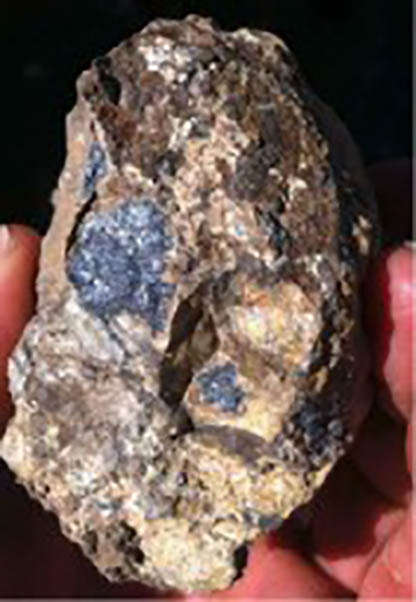 Photo: Michael D. Campbell (2014)
[Note: Let's see who is on the ball. In the late 1970s, the Senior Editor of the I2M Web Portal was requested to investigate a small antimony mine in western Montana. Forty years later, he was preparing a 43-101 report in 2014 for an Australian client. During the field visit some 600 miles west of Charters Towers, he came across a vein of massive stibnite (antimony sulfide) in an outctop (photo taken of hand sample). If anyone wishes to follow-up, he (and his family) would appreciate a finders fee of 5% NSR upon development of either sites. See the reports in his CV, or give him a call. See bottom of this record for details].

During WWII, antimony was the hero of the day. It’s a critical element in the production not only of fire-retardant military uniforms and tents, but also in the mass production of many of our means of modern warfare, from bullets and artillery shells to night vision googles, nuclear weapons and anti-tank missiles. Without Antimony, the U.S. could be rendered defenseless in the face of its enemies.
It’s an opportunity that North America-based Military Metals (CSE: MILI, OTCQB: MILIF) is pouncing on with a series of strategic acquisitions of past-producing antimony mines and new discoveries from North America to Europe. That’s why prices skyrocketed this year when China, which controls nearly half the world’s production and three-quarters of its refining, cut the U.S. out of the Antimony supply chain.
The price of antimony doubled in July, 2024, according to S&P Global, hitting a then-record $22,750 per metric ton (antimony ingots 99.65% FOB) by August 6th. By November 15th, the price had hit $25,000 a ton, according to Forbes, for a 212% surge YTD. The supply squeeze and the 200% price boost has netted investors triple-digit returns this year, first in Australia, where ASX-listed miners have been reaping huge rewards for investors.
Australian media is calling it an “antimony party”, with Larvotto Resources Ltd. (ASX:LRV) up over 800%, most of that gained in the past six months after China restricted antimony exports. Now, everyone’s watching the junior miners to see who is next to benefit from the bounty of Chinese restrictions, and the next one to pop could be Military Metals who have made a number of acquisitions over the past few months inserting themselves firmly into the picture.
Where the Opportunities Lie
“The surge in prices, which industry participants expect to persist, underscores the West's vulnerability in relying on top producer China for key minerals and could also force end-users to find alternatives for some applications,” according to Reuters, opening the door wide open for ambitious new entrants to the highly exclusive antimony club.
Miners are rushing the space. In the span of only two days in October alone, we saw Felix Gold Ltd announce plans to take “several steps” toward the goal of establishing a 5,000-metric-ton-per-year antimony mine by the end of 2025. One of the best investments on the planet right now could be a little-known critical strategic critical metal that has exploded 200% this year. It’s the metal that wins wars, and China has banned its export with the intent of stripping the U.S. war machine of its capabilities.
During WWII, antimony was the hero of the day. It’s a critical element in the production not only of fire-retardant military uniforms and tents, but also in the mass production of many of our means of modern warfare, from bullets and artillery shells to night vision googles, nuclear weapons and anti-tank missiles. Without Antimony, the U.S. could be rendered defenseless in the face of its enemies.
It’s an opportunity that North America-based Military Metals is pouncing on with a series of strategic acquisitions of past-producing antimony mines and new discoveries from North America to Europe. That’s why prices skyrocketed this year when China, which controls nearly half the world’s production and three-quarters of its refining, cut the U.S. out of the Antimony supply chain.
Now, everyone’s watching the junior miners to see who is next to benefit from the bounty of Chinese restrictions, and the next one to pop could be Military Metals who have made a number of acquisitions over the past few months inserting themselves firmly into the picture. Australia’s Larvotto, which holds Australia’s biggest antimony deposit, owns the Hillgrove gold-antimony project near Armidale, New South Wales, and that ship has already sailed.
But new entrants like Military Metals could be the next big surge winners, with Forbes now calling this space “the latest to generate short-term profits of more than 100% on money invested”. The company has two big cards to play right now, following its recent purchase of two Antimony mines and one Tin project.
One card is a triple set of assets in Slovakia in Central Europe, where antimony shortages are making the wider European Union very anxious. By the time China implemented antimony export restrictions in September, having announced the move in August, Europe was already in a critical metals panic. China had already put export restrictions on rare earth minerals gallium and germanium, along with battery metal graphite, in 2023 and 2024, and European refiners have been seeking alternative supplies from Tajikistan, Vietnam and Myanmar while the U.S. is trying to tap India.
Military Metals is hoping to provide a new source of antimony for Europe in Slovakia and for the U.S. in Canada’s Nova Scotia, at a past-producing mine that was the country’s largest during WWI. The Trojarova asset is part of its recent Slovakian acquisition and is one of the European Union’s largest Antimony deposits with a historical resource of over 60,998 tons of Antimony that has a in-situ value of $2 billion at today’s spot prices.
"This acquisition strategically positions Military Metals as a leading explorer and developer of antimony,"CEO Scott Eldridge said in a press release, describing the Slovakian antimony projects as offering “significant potential for rapid advancement, particularly given Slovakia's strong mining infrastructure and history”. “We see this as a perfect alignment with the European Union's Critical Raw Materials Act, opening the door to potential EU funding sources as we advance these projects toward production,” Eldridge added.
In late September 2024, Military Metals moved to acquire the West Gore past-producing antimony/gold mine in Nova Scotia, Canada, conjuring up the ghosts of WWI who also saw demand for antimony soar in a time of global conflict. Just a month later, on October 24, 2024, Military Metals Corp. moved to consolidate additional territory around West Gore, where historical drilling results from Canada’s biggest antimony mine showing over 7 meters of 10.6 gpt gold and 3.4% antimony.
The Pentagon makes Antimony a Top Priority
For U.S. national security, things will have to move quickly, shifting important focus to junior miners willing to bet big on the next market-rattling supply crunch. It can’t happen fast enough. Germany has essentially been demilitarized, with its own defense ministry estimating it has about 2 days of ammunition if there is a war with Russia, which it fully expects to happen within the next few years at most.
In March 2024, the European Union allocated 500,000,000 euro under the Act in Support of Ammunition Production (ASAP) to boost output capacity to 2 million shells annually by the end of 2025. But the Western militaries have a major problem.
The U.S. Army, for its part, has set its industrial war room in motion because it was already dealing with an artillery shell supply crunch. It’s planning a major ramp-up in the output of “legacy munitions”, including anti-tank missiles, Stingers and artillery shells. The goal is to increase production of the 155-millimeter artillery shell from 40,000 units/month today to 100,000 units/month by the end of the year. That means a massive ramp-up of antimony supplies that can no longer come from China.
This is a junior miner playing field at its best, making antimony one of the best investment theses of this year and next, and China is feeding the price and supply frenzy with export restrictions. And the news flow for anything antimony is expected to be a media frenzy, with new entrants exponentially picking up the pace of deal-making in this unique space.
Other resource companies to watch:
Piedmont Lithium (NASDAQ: PLL)
Piedmont Lithium is a development-stage company focused on establishing a fully integrated lithium hydroxide business in the United States. Their core operation centers around the Carolina Tin-Spodumene Belt in North Carolina, a region with a history of lithium production. Piedmont aims to be a key supplier of lithium hydroxide, a crucial component in electric vehicle batteries and energy storage systems, to the burgeoning U.S. market.
This company matters because they are addressing a critical need for domestically sourced lithium. The U.S. currently relies heavily on imports for its lithium supply, creating potential vulnerabilities in the supply chain. Piedmont's operations contribute to a more secure and resilient domestic supply of this essential mineral, which is vital for the production of advanced batteries used in defense applications such as electric vehicles, drones, and communication systems.
Furthermore, Piedmont Lithium's commitment to responsible mining and environmental sustainability aligns with the growing emphasis on ethical sourcing of critical minerals. By adhering to high environmental standards and engaging with local communities, Piedmont contributes to a more sustainable and socially responsible domestic lithium supply chain, which is crucial for ensuring that the production of lithium for defense applications is conducted in an ethical and environmentally conscious manner.
Lithium Americas (NYSE: LAC)
Lithium Americas is a resource company dedicated to developing lithium projects in Argentina and the United States. Their flagship project, Thacker Pass in Nevada, is poised to be one of the largest lithium mines in North America. Thacker Pass is expected to produce lithium carbonate, a key ingredient in lithium-ion batteries, catering to the growing demand for electric vehicles and renewable energy storage.
This company is important because they are contributing significantly to the diversification of the global lithium supply chain. Currently, a significant portion of lithium production is concentrated in China, creating potential geopolitical risks and supply chain vulnerabilities. Lithium Americas' projects, particularly Thacker Pass, aim to reduce this dependence by increasing North American lithium production, thereby strengthening the resilience of the U.S. defense industrial base and ensuring a more stable supply of this critical mineral for defense applications.
Moreover, Lithium Americas is committed to sustainable development and responsible mining practices. Their approach emphasizes environmental protection, community engagement, and the responsible management of water resources. This commitment is crucial for ensuring the long-term viability of their operations and the ethical sourcing of lithium for defense and other critical applications.
Vale S.A. (NYSE: VALE)
Vale S.A. is a Brazilian multinational corporation and one of the world's largest producers of iron ore and nickel. Iron ore is a key ingredient in steelmaking, while nickel is a crucial component in stainless steel and various alloys used in aerospace, defense, and other high-performance applications. Vale operates globally, with significant mining and production facilities in Brazil, Canada, and other countries.
This company is important because they are a major player in the global mining and metals industry, providing essential raw materials for various sectors, including the defense industry. Vale's production of iron ore and nickel contributes to the global supply of these critical minerals, which are essential for the manufacturing of military equipment, infrastructure, and advanced technologies.
Vale's commitment to sustainable mining practices and social responsibility is also noteworthy. The company has implemented various initiatives to reduce its environmental impact, promote biodiversity, and support local communities. This commitment is crucial for ensuring the responsible sourcing of critical minerals and minimizing the environmental footprint of mining operations, which is particularly important for national security and the long-term sustainability of the defense industrial base.
Uranium Energy Corp (NYSE American: UEC)
Uranium Energy Corp is a U.S.-based uranium mining and exploration company with a focus on in-situ recovery (ISR) mining projects in Texas, Wyoming, and New Mexico. ISR mining is a less invasive and more environmentally friendly method of uranium extraction compared to traditional open-pit mining. Uranium Energy Corp has a portfolio of permitted and development-stage ISR projects, positioning them to be a significant contributor to the U.S. uranium supply.
This company is important because they are contributing to the revitalization of the U.S. uranium mining industry. After a period of decline, the U.S. is increasingly recognizing the importance of securing a domestic supply of uranium for both energy security and national security purposes. Uranium Energy Corp's ISR projects offer a more sustainable and environmentally responsible approach to uranium mining, which is crucial for ensuring the long-term viability of the industry and minimizing the environmental impact of uranium production.
Furthermore, Uranium Energy Corp's focus on U.S. uranium production helps to reduce dependence on foreign sources of this strategically important material. This is crucial for national security, as it ensures that the U.S. has access to a reliable supply of uranium for its nuclear power plants and its nuclear deterrent, without being subject to the geopolitical dynamics or potential disruptions associated with relying on foreign suppliers.
Steel Dynamics (NASDAQ: STLD)
Steel Dynamics is one of the largest domestic steel producers and metals recyclers in the United States. The company produces a wide range of high-quality steel products, including flat roll steel, structural steel, and rail, which are essential for various industries, including the defense sector. From the construction of military vehicles and ships to the building of infrastructure and manufacturing of critical components, steel remains a foundational material for national defense.
A strong and resilient domestic steel industry is vital for ensuring national security. Steel Dynamics' production capacity and commitment to technological advancement contribute to the stability and self-reliance of the U.S. defense industrial base. By sourcing steel from domestic producers like Steel Dynamics, the U.S. can reduce its dependence on foreign suppliers and ensure that it has access to the necessary materials to support its defense needs in times of crisis or geopolitical instability.
Furthermore, Steel Dynamics' focus on sustainable practices and environmental stewardship is important for ensuring the long-term viability of the domestic steel industry. By investing in energy-efficient technologies and minimizing its environmental impact, the company contributes to a more sustainable and resilient defense industrial base. This is crucial for national security, as it ensures that the production of steel for defense applications is conducted in a manner that is both environmentally responsible and economically sustainable.
MP Materials (NYSE: MP)
MP Materials owns and operates Mountain Pass, the only integrated rare earth mining and processing site in North America. Rare earth elements are essential for a wide range of technologies, including defense applications such as guidance systems, lasers, and radar. MP Materials' role in securing a domestic supply of these critical minerals is vital for reducing dependence on foreign sources, particularly China, which currently dominates the rare earth market.
The concentration of rare earth production in China poses a potential risk to national security, as it creates a vulnerability to supply chain disruptions or geopolitical tensions. MP Materials' operations at Mountain Pass contribute to diversifying the rare earth supply chain and ensuring that the U.S. has access to these critical materials for its defense needs. This reduces reliance on potentially adversarial nations and strengthens the resilience of the U.S. defense industrial base.
Furthermore, MP Materials' commitment to environmental responsibility and sustainable mining practices is important for ensuring the long-term viability of its operations and the responsible sourcing of rare earth elements. By minimizing its environmental impact and adhering to high ethical standards, MP Materials contributes to a more secure and sustainable defense supply chain.
Compass Minerals International (NYSE: CMP)
based in Overland Park, Kansas, is a leading provider of essential minerals, including salt, sulfate of potash, magnesium chloride, and even sustainable lithium. The company's diversified product mix serves a wide range of markets, including agriculture, consumer deicing, water conditioning, and various industrial applications.
Beyond its current offerings, Compass Minerals is investing in new technologies and methods to enhance the efficiency and environmental sustainability of its operations. The company's focus on innovation is particularly evident in its approach to lithium extraction, where it aims to capitalize on the growing demand in the electric vehicle market. This strategic direction not only diversifies their portfolio but also positions Compass Minerals as a key player in the transition to a more sustainable global economy.
Freeport-McMoRan Inc. (NYSE: FCX)
Freeport-McMoRan Inc., based in Phoenix, Arizona, is one of the world's leading mining companies, with significant reserves of copper, gold, and molybdenum. The company's sizeable asset base includes the Grasberg minerals district in Indonesia, one of the world's largest copper and gold deposits, and significant mining operations in the Americas. With copper being a critical material in renewable energy and electric vehicle technologies, Freeport-McMoRan stands to benefit from the global push towards greener economies.
Freeport-McMoRan is also actively involved in community engagement and environmental stewardship. The company has implemented various initiatives aimed at reducing its environmental footprint and promoting sustainable mining practices. These efforts include water management, biodiversity conservation, and emission reduction strategies. By focusing on responsible mining, Freeport-McMoRan is not only ensuring compliance with environmental standards but is also contributing to the broader goal of sustainable development in the regions it operates.
_______
I2M Consulting, LLC, a subsidiary of The I2M Corporation (Texas) (Private Corporation)
See note at top of this record.
Another article on subject, see: (here).
Managed & Built by I2M Consulting, LLC | © 2010-
