

Law and 6 co-authors reported in 2011 that under anaerobic conditions, uranium solubility is significantly controlled by the microbially mediated reduction of relatively soluble U(VI) to poorly soluble U(IV). However, the reaction mechanism(s) for bioreduction are complex with prior sorption of U(VI) to sediments significant in many systems, and both enzymatic and abiotic U(VI) reduction pathways potentially possible.
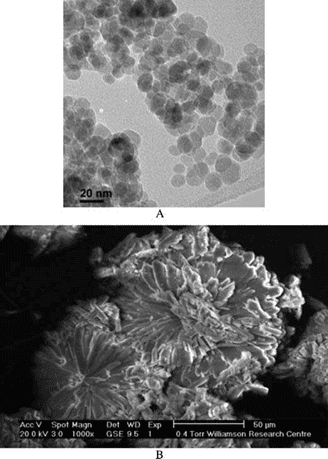 Morphology of biominerals. (A) TEM image of magnetite; (B) ESEM
image of vivianite. Scale bars are included on each image.
The authors described results from sediment microcosm and Fe(II)-bearing biomineral experiments designed to assess the relative importance of enzymatic vs. abiotic U(VI) reduction mechanisms and the longterm fate of U(IV). In oxic sediments representative of the UK Sellafield reprocessing site, U(VI) was rapidly and significantly sorbed to surfaces and during microbially-mediated bioreduction, XAS analysis showed that sorbed U(VI) was reduced to U(IV) commensurate with Fe(III)-reduction.
Additional control experiments with Fe(III)-reducing sediments that were sterilized after bioreduction and then exposed to U(VI), indicated that U(VI) reduction was inhibited, implying that enzymatic as opposed to abiotic mechanisms dominated in these systems. Further experiments with model Fe(II)-bearing biomineral phases (magnetite and vivianite) showed that significant U(VI) reduction occurred in co-precipitation systems, where U(VI) was spiked into the biomineral precursor phases prior to inoculation with Geobacter sulfurreducens.
In contrast, when U(VI) was exposed to pre-formed, washed biominerals, XAS analysis indicated that U(VI) was recalcitrant to reduction. Reoxidation experiments examined the long-term fate of U(IV). In sediments, air exposure resulted in Fe(II) oxidation and significant U(IV) oxidative remobilization. By contrast, only partial oxidation of U(IV) and no remobilization to solution occurred with nitrate mediated bio-oxidation of sediments.
Magnetite was resistant to biooxidation with nitrate. On exposure to air, magnetite changed from black to brown in color, yet there was limited mobilization of uranium to solution and XAS confirmed that U(IV) remained dominant in the oxidized mineral phase. Overall these results highlight the complexity of uranium biogeochemistry and highlight the importance of mechanistic insights into these reactions if optimal management of the global nuclear legacy is to occur.
Managed & Built by I2M Consulting, LLC | © 2010-
