

Kiernan and Marx reported in mid-2024 that Mankind has mined the earth’s surface for thousands of years. Now there’s a furious race to find even more metal that will enable the world’s energy transition away from fossil fuels. In Papua New Guinea, one company is digging what may become the world’s first operational deep-sea mining site. Videographer Edward Kiernan and special correspondent Willem Marx
And few comments from the video:
Geoff Bennett:
Mankind has mined the Earth's surface for thousands of years, searching for the metals and minerals that have made it possible to build our cities, arm our militaries and develop new technologies.
Now there's a furious race to find even more metal that will enable the world's energy transition away from fossil fuels. And that furious race leads mining operators to hunt for deposits in increasingly remote locations, none more so than the floor of the distant Bismarck Sea in Papua New Guinea, where one company this summer started to dig at what may become the world's first operational deep-sea mining site.
Videographer Edward Kiernan and special correspondent Willem Marx traveled there to witness firsthand this extraordinary new industry, difficult and complex, but also dangerous and controversial.
Willem Marx:
On the island of New Ireland, getting out to sea can sometimes prove a struggle. A new jetty's construction, the completion of nearby buildings remain projects for the future.
But beneath these waves, there's a new kind of treasure rush for copper and gold that may one day soon help to fund them. This quiet pebbly beach on a remote Pacific archipelago may not look like much, but just over the horizon, a group of sailors and engineers are engaged in a series of scientific tests.
And the wealthy investors behind them hope that one day this lonely beach might become a gateway to a multibillion-dollar industry. A smoke-belching catamaran approaches, our ride across the Bismarck Sea, named for a long-ago chancellor in Germany, which once colonized this region.
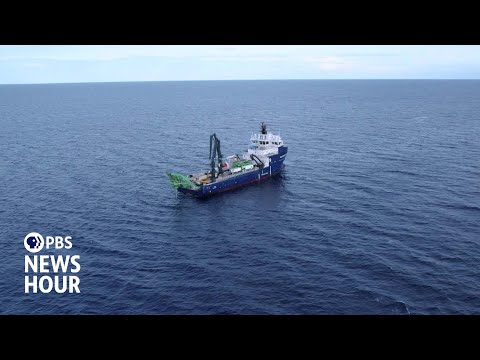
Two hot, rolling hours later, in the distance, our destination appears, the MV Coco. Prow to stern, it measures 270 feet, a triumph of maritime technology, now 14,000 miles from home. Several stories' high, strong thrusters keep this ship entirely stationery for days at a time 20 miles offshore, and on top of its target site, a mile beneath the surface.
Owned by a Danish firm, OCT Offshore, it's been leased and refitted by a company called Magellan, with more than a decade of deep-sea expertise. Yet journalists have never before been allowed on board to document this kind of work deep-sea mining. Inside a darkened room, over 12-hour shifts, a pilot and co-pilot steer a remotely operated vehicle, or ROV, far below their cockpit seats.
John Matheson, ROV Supervisor, Magellan:
You just need to come back to a safer heading.
Willem Marx:
They're supervised by John Matheson.
We're talking about an ROV that's around a mile deep right now?
John Matheson:
Yes.
Willem Marx:
I see 1,500 meters there.
John Matheson:
The pressure that's under, the weight of the water, can be massive. So…
Willem Marx:
And so what's its job?
John Matheson:
It's basically the eyes, isn't it? That's all we are, and supplying the power.
Willem Marx:
An umbilical cord and a separate cable connect the surface vessel to both the ROV and a 12-ton grabbing mechanism far below. The ROV transmits power to the grab and guides its movements as it punches and claws through the seafloor's surface, then scoops up the resulting rocks.
It deposits most of these spoils in a nearby stockpile, but twice a day hauls some up to the ship far above. With help from the crew, high up on the bridge and an operator perched above the vast rear deck, where the enormous winch and perpetual motion is central to this ship's mission.
Underwater mapping experts monitor what's already been excavated and where, while also planning the next day's digging. These waters hardly seem to challenge the team from Magellan, since it sometimes operates at four times these depths. The relatively calm surface here allow this massive mining experiment to continue, almost uninterrupted, 24/7, for more than two months.
How difficult is this kind of work compared to other stuff you have done in the past?
John Matheson:
Operationally, it's as easy as we could probably get. But it takes a lot of strain on the ROV, I would say.
For the rest of the transcript, see the link below.
Managed & Built by I2M Consulting, LLC | © 2010-
