

Walton-Day, and 5 co-authors, reported in 2022 that geoenvironmental models were formulated by the U.S. Geological Survey in the 1990s to describe "potential" environmental effects of extracting different types of ore deposits in different geologic and climatic regions. This paper presents a geoenvironmental model for roll-front (roll-type) uranium deposits in the southern Texas Coastal Plain.
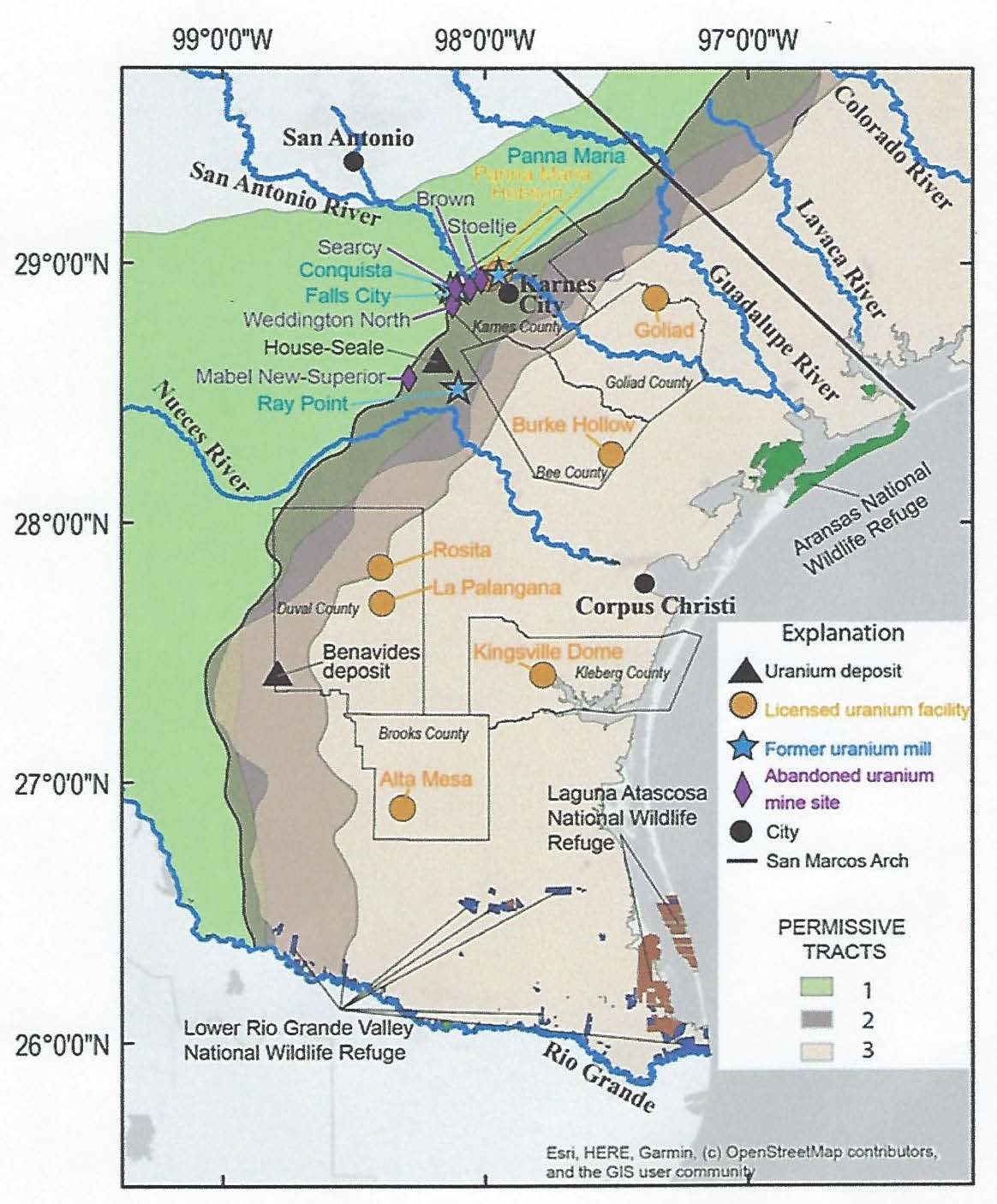 Locations of uranium deposits, licensed uranium facilities, former
uranium mills, abandoned uranium mines, and wildlife refuges
mentioned in this report.
The model reviews descriptive and quantitative information derived from environmental studies and existing databases to depict existing conditions and "potential environmental concerns" associated with mining this deposit type.
This geoenvironmental model describes how features of the deposits including host rock; ore and gangue mineralogy; geologic, hydrologic, and climatic settings; and mining methods (legacy open-pit and in situ recovery [ISR]) influence potential environmental effects from mining. Element concentrations in soil and water are compared to regulatory thresholds to depict ambient surface water and groundwater conditions.
Although most open-pit operations in this region have been reclaimed, "concerns" remain about groundwater quality at three of the four former mills that supported former open-pit mines and are undergoing closure activities.
The primary environmental concerns with ISR mining are:
1) radon gas at active ISR operations,
2) radiation or contaminant leakage during production and transport of ISR resin or yellowcake,
3) uranium excursions into groundwater surrounding active ISR operations, and
4) contamination of groundwater after ISR mining.
Although existing regulations attempt to address these "concerns," some "problems remain." Researchers suggest that reactive transport modeling and a better understanding of geology, stratigraphy, and geochemistry of ISR production areas could minimize excursions [What and Where?] into surrounding aquifers and improve results of groundwater restoration. [This is a plea for additional USGS funding on subjects already well known by industry geologists!]
[Note: A full review of this USGS report will be presented here after I2M review]
Managed & Built by I2M Consulting, LLC | © 2010-
