

Sweatman reported in 2024 that Göbekli Tepe, an archaeological site in southern Turkey, features several temple-like enclosures adorned with many intricately carved symbols. It is located centrally among a group of Taş Tepeler pre-pottery Neolithic sites which include Karahan Tepe and Sayburç.
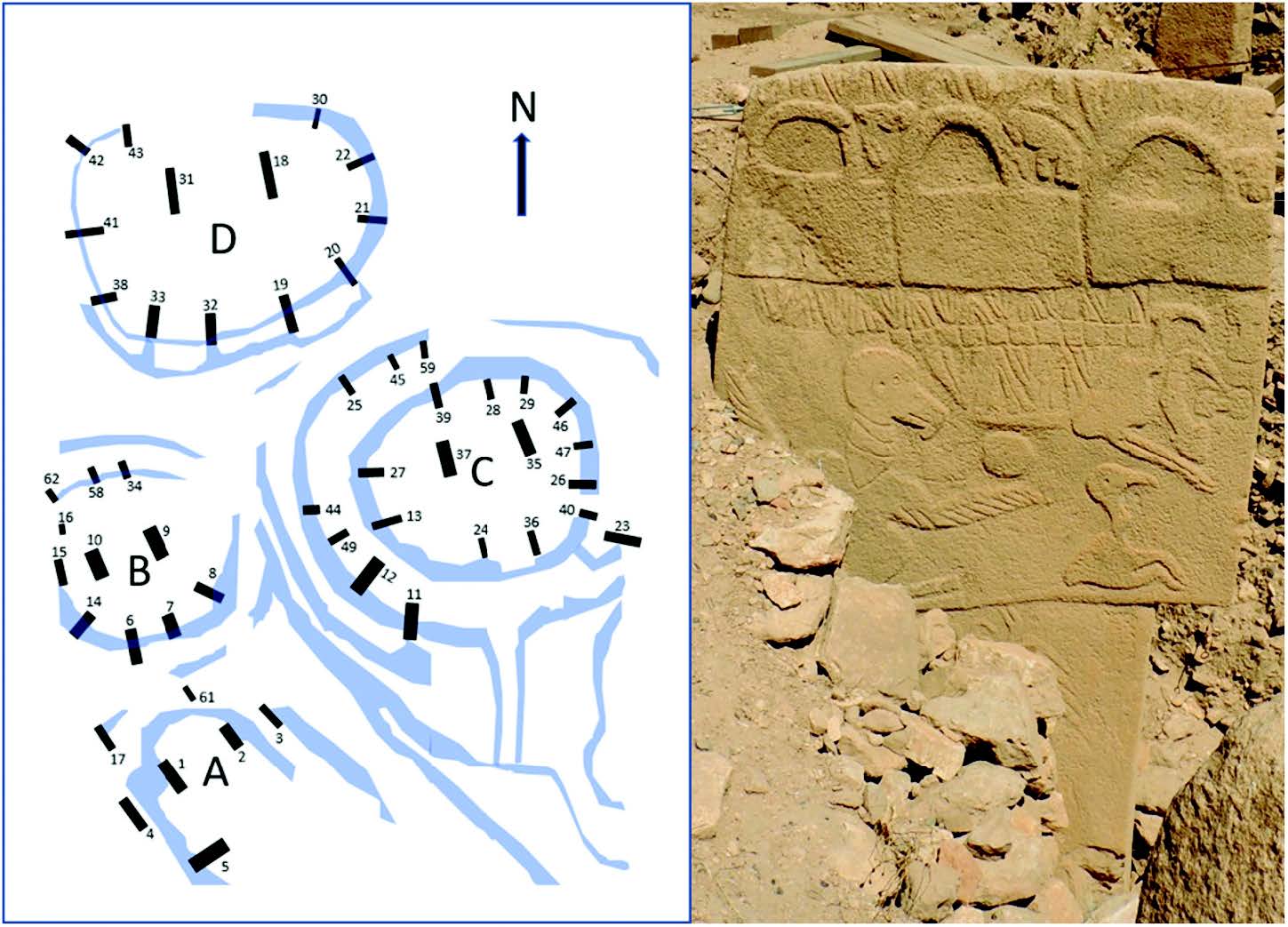 Pillar 43 at Göbekli Tepe, EnclosureD. Image courtesy of Alistair Coombs.
TIME AND MIND 3
Here, an earlier astronomical interpretation for Gobekli Tepe’s symbolism is supported and extended by showing how V-symbols on Pillar 43 in Enclosure D can be interpreted in terms of a lunisolar calendar system with 11 epagomenal days, which would make it the oldest known example of its type. Furthermore, it is shown how Göbekli Tepe’s 11-pillar enclosures and a megalithic 11-pillar pool structure at nearby Karahan Tepecan also can be interpreted in terms of the same lunisolar calendar system.
Other V-symbols at Göbekli Tepe are also interpreted in astronomical terms, and it is shown how the UrfaMan statue, a wall carving at Sayburç and a statue at Karahan Tepe that display V-symbol necklaces can be interpreted as time-controlling or creator deities. Symbolic links with later cultures from the Fertile Crescent are explored. Throughout,links are made with the Younger Dryas impact and Cauvin’s theory for the origin of the Neolithic revolution in the Fertile Crescent.
The author concluded in part that the presented discussion highlights likely continuity of some Palaeolithic artistic symbolism through into the ancient Near East and even into modern times. The vector for this continuity appears to be the (largely) unchanging stellar sky and the regular motion of the moon and sun, i.e. astronomy, and a desire to understand the cosmos so that seasonal resources can be optimized and important communal activities scheduled.
Archaeoastronomy, as a discipline, seeks to understand this phenomenon. Earlier work provided an astronomical interpretation for animal symbols on the broad sides of pillars at Göbekli Tepe that involved knowledge of precession that this interpretation is very likely correct based on comparison with constellations in Stellarium. A consistent theme for this interpretation is the Younger Dryas impact, a global-scale cosmic catastrophe at 10,835 ± 50 BCE. The novel calendrical interpretation described in this work both supports and extends those earlier arguments. It also contributes more generally to archaeoastronomical research on the origins of naked-eye astronomy and the ancient Greek and Mesopotamian constellations.
Managed & Built by I2M Consulting, LLC | © 2010-
