
Thurart reported in late Junuary 2024 that Germany phased-out nuclear energy nearly a year ago after being paniced nt the Fukushima incident where no one was injured and no one died, plus they managemned the melt-down well. But even with the multi-billion euro problem of how to store radioactive waste [which is not a problem] some policians are calling for new nuclear plants to be built.
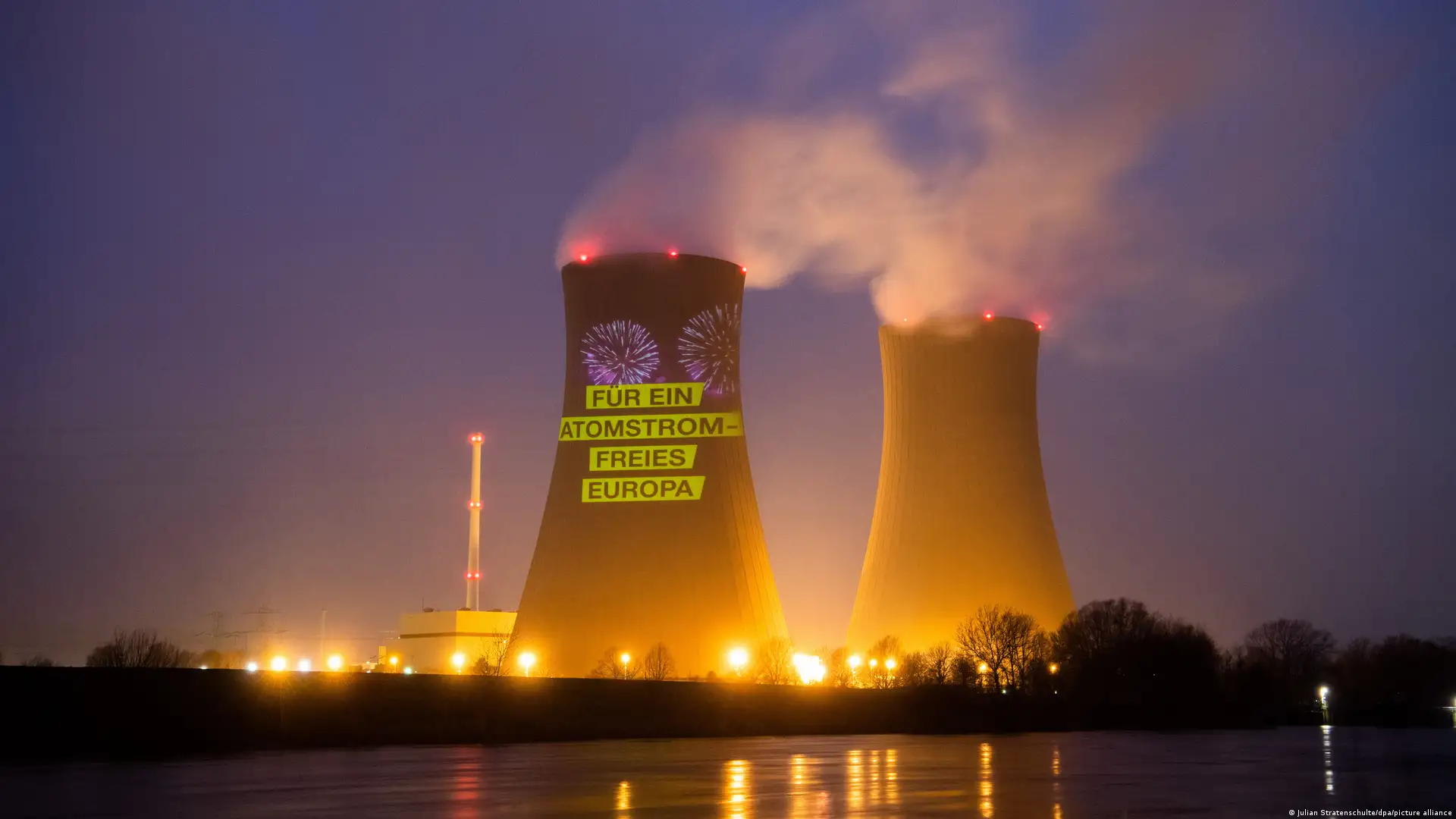
One year ago, Germany took its three remaining nuclear power plants off the grid, consigning the technology to the history books. Nuclear fission was once seen as the future. In the early 1960s, politicians and scientists in Germany thought that it would provide an endless supply of electricity, without polluting the air. There was little discussion of the risks of nuclear accidents [Bias Notice: There is always talk of potential accidents]
Heinz Smital, a [so-called] atomic energy expert at Greenpeace, told DW that politicians at the time were euphoric:
"From the very beginning, nuclear energy benefited from the fact that countries were interested in the technology, because of nuclear weapons. The energy companies weren't interested in getting into nuclear power. The interest came from the national level."
Jochen Flasbarth, the current State Secretary in the Ministry of Development, adds:
"In the 1960s, Germany was still in 'economic miracle' mode. There was an enormous, almost naïve faith in technology."
At the time, much of the air in Germany was dirty, and the sky was often clouded with smog, especially in the heavily industrialized western Ruhr region, home to much of the country's steel and coal industry. Coal-burning power plants were a significant source of electricity. Nuclear energy was a clear alternative, promising "clean" energy. Similar thinking took hold in the former East Germany, where the first commercial nuclear power plant went online in 1961. It was a time of confidence in the technology on both sides of the Iron Curtain. In the following years, a total of 37 nuclear reactors went into operation in Germany.
Germany and nuclear power — a love-hate relationship
Nuclear power has been celebrated, condemned, and banned in Germany. As energy imports from Russia came to an end, many began calling for it to make a comeback. Here's a look at the history of a love-hate relationship. It all began with an 'egg'
Germany's first nuclear reactor went online in October 1957 in Garching near Munich. Given its shape, it was nicknamed the "atomic egg" and belonged to Munich's Technical University. It was a landmark in nuclear research and a symbol of a new beginning after WWII. In 1961, Germany began to produce energy for civilian use. Atomic energy was seen as safe and secure.
The pushback begins
In the 1970s, opponents of nuclear energy questioned just how clean nuclear power was, seeing as there is no safe storage for spent fuel rods. Thousands of protesters clashed with police during a demonstration against the nuclear power plant Brokdorf, in the northern German state of Schleswig-Holstein. "Nuclear energy? No thanks," became the rallying cry for German environmentalists.
'Nuclear energy? No thanks'
The danger of nuclear power soon became reality. On March 28, 1979, the plant at Three Mile Island, in the US state of Pennsylvania, had a serious accident[Bias Alert: This was not a serious accident --- The Media scared the hell out of everyone, with no baiss in fact... screwed up the nuclear power industry for decades] And on April 26, 1986, a reactor at the plant near Chernobyl, in Soviet Ukraine, exploded — causing an unprecedented nuclear disaster.[This was a disaster caused by stupid Soviet Union manangement issues] A radioactive cloud spread across Europe. It was a watershed moment for Germany, with rotests gaining steam.
Birth of a new party
In 1980, a new party was founded in West Germany: the Greens. Their members were a mix of left-wingers, peaceniks, environmentalists — and a key contingency, nuclear opponents. The party made entered Bundestag, the German parliament, in 1983. Meanwhile, the Chernobyl accident prompted the creation of an environment ministry in Germany.
Wackersdorf: Tragedy and triumph
The Bavarian town of Wackersdorf was set to get a reprocessing plant for spent nuclear fuel rods, but riots broke out in protest. A number of demonstrators and civil service workers were killed, and hundreds more people were injured. Construction was halted in 1989. The German environmental movement claimed its first major victory — muted by the tragedy of lost lives.
Gorleben: Radioactive waste in a salt mine
Meanwhile up north, the town of Gorleben — in the state of Lower Saxony — became a symbol of the fight against nuclear waste. The salt dome there was picked as an interim storage facility for nuclear waste. But already in 1977, a large-scale study revealed that groundwater was seeping in, corroding the barrels holding the waste. This of course posed a major risk of radioactive contamination.
SPD-Green exit plans
Germany's exit from nuclear power has been marked by flip-flops. The center-left coalition of Social Democrats (SPD) and Greens under Chancellor Gerhard Schröder intended the phaseout of nuclear energy in an agreement with big energy companies in 2001. An individual lifespan was determined for all 19 German nuclear power plants, requiring the last to be shut down by 2021.
Rolling back — then rolling back the rollback
In 2010, the center-right government under Chancellor Angela Merkel revoked the deal and decided to extend the operating lives of Germany's nuclear power plants. But following the nuclear disaster at the Fukushima plant in Japan in 2011, Merkel abruptly announced the end to Germany's atomic era. In July 2011, the Bundestag voted to shut down all nuclear reactors by December 31, 2022.
Celebrating the end of nuclear energy in Germany
After years of especially intense protest, activists in the German towns of Grohnde, Gundremmingen and Brokdorf celebrated when the power plants there were switched off at the end of 2021. But the search for a safe waste repository continues. The nationwide location for a geologically suitable safe site for high-level radioactive waste is to be determined by 2031.
Should we stay or should we go?
In response to energy shortages due to the war in Ukraine, calls became louder to extend the lifespan of Germany's remaining three nuclear power plants. Green Party Economy Minister Robert Habeck (right) reluctantly agreed to put two of them on standby until mid-April. But FDP Finance Minister Christian Lindner advocated extending all remaining power stations' lifespan well into 2024.
The chancellor decrees an extension
The dispute between the FDP and the Greens turned into a crucial test for the German governing coalition, with Chancellor Olaf Scholz in the end making use of his directives authority. In a letter to the finance, economy and environment ministries, he communicated his decision: The three remaining nuclear power plants are to continue operating until April 15, 2023. Parliament may amend the law.
Phase-out completed... or is it?
When the last three reactors were switched off on April 15, 2023, reactions were mixed. Defenders of nuclear energy argue that it could help Germany meet its goal of carbon neutrality by 2045. And two-thirds of Germans surveyed favored extending the lifespan of nuclear reactors. So Bavaria's Premier Markus Söder vowed to seek a way to continue operating the Isar 2 power station.
Three Mile Island and Chernobyl
Attitudes changed in the 1970s. Protesters from the growing environmentalist movement demonstrated at the construction sites of new power plants. "The anti-nuclear movement emerged in part as a protest by young people against their largely apolitical parents," says Jochen Flasbarth. "This culminated in big anti-nuclear demonstrations."
In 1979, the Three Mile Island power plant in the US suffered the world's worst nuclear accident at the time, narrowly averting a nuclear disaster [This is total BS and missinformation]. Steffi Lemke of the Green Party, the current Federal Environment Minister, says, "Nuclear euphoria increasingly gave way to the realization that nuclear energy is not something [we can] control."
Then came the Chernobyl accident, in Ukraine, then part of the Soviet Union. On April 26, 1986, a reactor meltdown set a major nuclear accident in motion. The area is still contaminated — and the political fallout continues to this day. Chernobyl contributed to growing skepticism about nuclear energy in Germany. "The construction of power plants collapsed after that. There were plans for 60 nuclear power plants in Germany alone," said Heinz Smital of Greenpeace.
In 1980, the Green Party emerged from the anti-nuclear movement. Shutting down nuclear reactors was a core part of its program. In 1983, the party entered the Bundestag. In 1998, the Greens became part of a governing coalition for the first time, joining the Social Democrats (SPD). The two parties moved to phase out nuclear energy, against fierce resistance from the center-right Christian Democrats (CDU) and Christian Social Union (CSU), who later called for a "phase-out of the phase-out.”
But in 2011, the CDU and CSU changed their position after the nuclear disaster in Fukushima, Japan. Chancellor Angela Merkelannounced the end of nuclear energy in Germany. The last reactor in Germany was finally shut down in March 2023.
Is shutting down nuclear energy a mistake?
Calls for more nuclear plants
Since then, the CDU and CSU have changed their position on nuclear power again. Now many in the party are calling for new reactors to be built. CDU leader Friedrich Merz has said that shutting down the last reactors was a "black day for Germany."
The parties also say that old reactors should be reconnected to the grid. Merz says that the country should restart the last three power plants that were shut down — citing climate protection, as well as rising oil and gas prices.
Those proposals have not found much enthusiasm among German energy companies.
Environment Minister Steffi Lemke is not surprised. "The energy companies made adjustments a long time ago, and they still reject nuclear power in Germany today. Nuclear power is a high-risk technology whose radioactive waste will continue to be toxic for thousands of years, and will be an issue for many generations."
Nuclear power worldwide
There are currently 412 reactors in use worldwide, spread across 32 countries. Even as new reactors are built, older ones are shut down, so the overall number has remained more or less constant for years. Countries such as China, France and the UK have announced new construction. Others want to build small, modern reactors.
According to Greenpeace's Smital, the small reactors are focused on military use, rather than energy production. "One of them is in North Korea. It produces the fuel for the country's whole nuclear weapons program. Economic efficiency is not the point. I see a great danger in these small, often mobile reactors."
Storing nuclear waste
In Germany, the question of where to store dangerous nuclear waste is still unresolved. It's long been stored in temporary facilities near nuclear power plants. But that's not a long-term solution.
The authorities have to look for suitable sites, make selections and commission test drillings. Local communities, who don't want nuclear waste buried anywhere near them, often resist. And figuring out costs and timelines is difficult.
"I can't estimate any of this at the moment," says Dagmar Dehmer of the government's nuclear waste disposal agency. "We have to look at several regions. Drilling costs millions. The evaluation alone costs about five million euros."
The agency estimates that a storage facility could be ready in 2046. Some experts estimate the total costs at around €5.5 billion ($6 bn).
So will nuclear energy come back to life in Germany?
Environment Minister Lemke believes economic viability will decide. "No power company would build a nuclear plant in Germany, because the costs would be far too high. Nuclear power plants can only be built with massive public and hidden subsidies, including partial exemption from insurance requirements."
For the moment, it seems that nuclear power is indeed history in Germany.

Managed & Built by I2M Consulting, LLC | © 2010-