
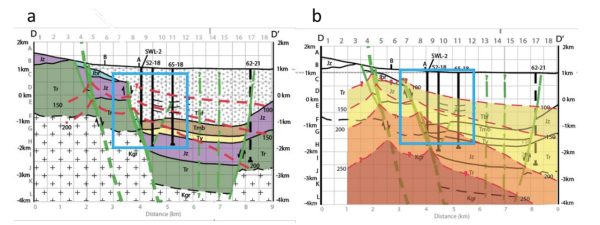
The Dixie Valley Geothermal System (DVGS) (after Iovenitti et al., 2016): (a) geologic cross section involving dual faults, (b) isotherms along the cross section. The blue outline box superimposed on the cross-sections of Iovenitti, et al. (2016) shows our model domain boundary. (Figure from Lee, et al., 2018.)

Dixie Valley is a complex graben bounded by two main large displacement faults on the west and by many sub-parallel, smaller displacement faults on the east. (See Map, Prospect Outline and Boundaries of the Gabbro, Page 3A.) Faulting was accompanied by westward tilting of the major fault block (i.e., horsts and grabens).
A middle Jurassic gabbroic complex or lopolith Intrudes the graben. The thickness of alluvial and lacustrine valley fill reportedly may exceed 5,000 feet in places. Tertiary and Jurassic andesite and basalt flows, tuffs, carbonates and gabbro are extensively exposed in the Stillwater Range and Clan Alpine Mountains, and are presumed to underlie the valley fill. However, data acquired by the SouthlandMi 11 ican venture over the past year suggests that previous interpretations of the structural relationships within the valley may not be correct. (See "Program Data Offered" and Section 3- A. of this proposal for a brief description of this problem.)
The Dixie Valley area is defined by the intersection of the northeast-trending "northern Nevada lineament" and a north-trending belt of intense historic faulting and seismicity (including the 1957 Dixie Valley earthquake, magnitude 6.8) extending from Owens Valley, California, to Pleasant Valley, Nevada (i.e., northern segment of the Ventura-Winnemucca Seismic Zone).
From an analysis of displacements on the late Cenozoic faults and of Pleistocene lake shorelines, Thompson and Burke (1978) concluded that the crustal spreading in Dixie Valley had an average rate of O.8 mm/yr over the last 15 m.y., and 1 mm/yr over the last 12,000 years. In addition, their seismic refraction data indicate a 2k km thick crust near Fallon, Nevada, which is the thinnest value reported for the Basin and Range. This fits with the concept that Dixie Valley is part of the area of very active mantle spreading and crustal rifting in northern Nevada -- i.e., an area of high geothermal potential.
Surface geothermal features include Dixie Hot Springs with a previously reported temperature of 72 C, and the "Senator" fumaroles which discharge warm air, water vapor, and some H2S and sulfur. Intense heat and hot water have been reported in workings of the Dixie Comstock Mine at depths of greater
than 75 feet (Vanderburg). Thus, Dixie Valley is presently an area of high seismicity, active extensional faulting, high-temperature geothermal manifestations, and relatively intense late-Tertiary silicic volcanism.
PRELIMINARY EVALUATION OF GEOLOGIC AND ECONOMIC POTENTIAL:
As part of the investigation, a geological and economic evaluation was conducted by Keplinger and Associates. Inc., Houston, under the direction of Michael D. Campbell during May through September, 1977. The evaluation consisted of three phases:
(1) Geothermetric Survey, (2) Preliminary Structural and Hydrogeological Analysis, and (3) Preliminary Economic Analysis
Phase I consisted of a groundwater geochemical survey that was conducted of selected springs in the immediate area, (See Map 6, page 8A). The springs were sampled on an individual basis over a seven-day period and intermittently. Seventeen chemical and physical parameters were analyzed or recorded. Duplicate samples were taken periodically for tests on precision and analytical error. Approximately 60 samples have been taken to date. Standard geothermetric calculations were made using the silica and calcium-sodium potassium methods. The silica method indicates a minimum of 175°C reservoir temperature with considerable mixing of meteoric water. Mineralogical disequilibrium is also apparent. Because of mixing this minimum temperature is not believed to be a limiting factor in the development of the area, especially In that part of the valley below the gabbroic complex.
The second phase of the evaluation consisted of a structural and hydrogeological analysis of the Stillwater and Clan Alpine Ranges and the Dixie Valley. Three geothermally significant structural features (geothermal fairways) have been tentatively inferred within Dixie Valley. Type I: Western normal range-front fault zones and fairways; Type II: East-West graben-like structures and fairways; and Type III: Normal fault zones or fairways parallel to but basinward of Type I structures. Two types of reservoirs were postulated by Campbell, an upper hot-water reservoir and a lower steam reservoir.
The third phase proposed consisted of an economic evaluation of minimum reservoir temperature, mini-flow rate, and a preliminary analysis of possible producer costs to explore and develop a geothermal reservoir under a range of subsurface and economic conditions.
See pp. 152-158 for details on Michael D. Campbell, a member of this team.
Also see:
Campbell, M. D., 1983, “Dixie Valley, Nevada: A Promising Geothermal Area Under Development By Industry,” Proc. 18th Inter. Society Conversion Engineering Conference, Orlando, Florida, August 21-26, Session 79, 6 p.(here).
Campbell, M. D. and C. C. Wielchowsky, 1982, “A Review of the Dixie Valley, Nevada, Liquid-Dominated Geothermal Resource and the Relationship of Selected Geologic Characteristics to Potential Geothermal Production,” Proc.Am. Chemical Eng. Institute, Ann. Mtg. (1982), 43 p., 6 figs., 5 tabs., refs. (here).
Campbell, M. D., 1979, “Geopressured Geothermal Energy Potential of the Hidalgo Fairway, Texas,” Proc.Seminar on Geothermal Energy, Brownsville, Texas, October 4, sponsored by the Brownsville Navigation District, 15 p., October.
Campbell, M. D., and C. C. Wielchowsky, 1978, “Interim Evaluation and Exploration and Development Status, Geothermal Potential and Associated Economics of Dixie Valley, Nevada,”a Keplinger Consulting Report (private distribution), 110 p., September.
Campbell, M. D., and C. C. Wielchowsky, 1977, “Phase II Preliminary Evaluation of Dixie Valley, Nevada: Geothermal Potential and Associated Economics,” a Keplinger Consulting Report (private distribution), 44 p., September.
Campbell, M. D., 1977, Geology [and Environmental Impact] of Alternate Energy Resources, Uranium, Lignite, and Geothermal Energy in the South Central States, Houston Geological Society, 364 p.(here).
Campbell, M. D., 1977, “A Review of the Mineral Potential (Uranium, Fluorspar, Mercury, Geothermal Energy, Coal and Other Minerals) of Certain Land Holdings in the Big Bend, Texas Area,” a Keplinger Consulting Report (private distribution), 20 p., May.
Campbell, M. D., 1977, “A Preliminary Evaluation of the Hughes Geothermal Properties in Churchill County, Nevada,” A Keplinger Consulting Report (private distribution), 62 p., April.
Managed & Built by I2M Consulting, LLC | © 2010-
