

Reedy and three co-authors reported in 2011 that groundwater accounts for ~60 percent of total water used in Texas. Estimates of future groundwater availability strongly depend on groundwater quality because of strong linkages and feedbacks between water quantity and quality. Groundwater quality impacts available fresh groundwater and groundwater quantity affects the ability of aquifers to dilute or assimilate contaminants.
Groundwater quality in the state is greatly impacted by naturally occurring contamination derived from meteoric sources (precipitation), soils, and/or geologic sources. These naturally occurring substances contrast with anthropogenic substances that are added to the system through human activities. The objective of this report is to assess all naturally occurring and limiting chemical constituents that affect the quantity of fresh groundwater in Texas.
Impacts of naturally occurring chemical constituents on groundwater availability were evaluated by quantifying exceedances of U.S. Environmental Protection Agency (EPA) primary and secondary maximum contaminant levels (MCL) for drinking water in the state. The analysis was based on the most recent groundwater analysis from the TWDB water quality database using analyses from 1988 – 2010. The percent of wells that exceed each MCL was quantified for each of the nine major and 21 minor aquifers.
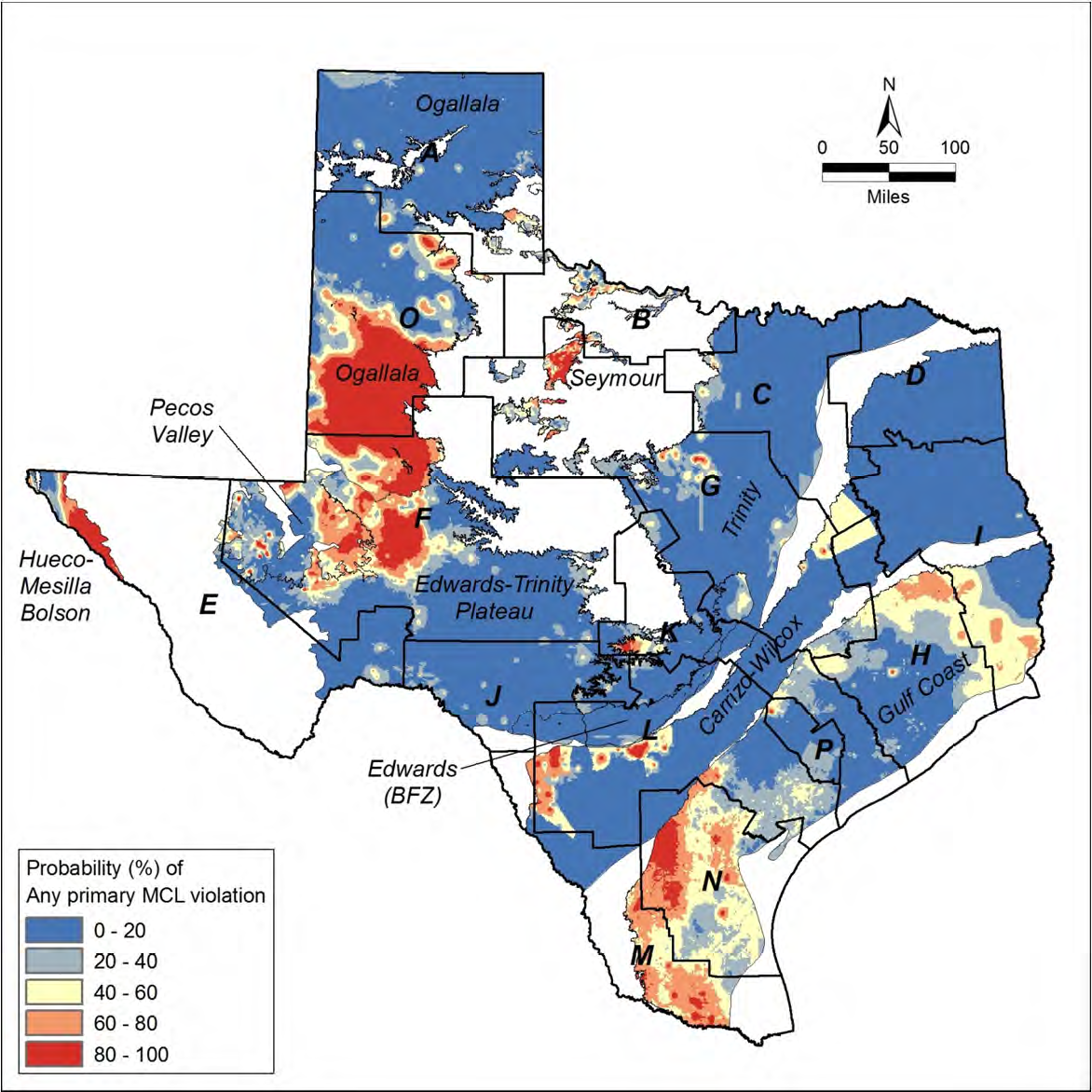
The spatial probability distribution of exceeding individual MCL concentrations was determined using indicator kriging for all major and minor aquifers in Texas for which there were sufficient data. Maps representing the probability of exceeding any primary MCL were also developed for aquifers having MCL violations of multiple constituents. The impact of water quality on groundwater quantity was evaluated by categorizing the probability of any primary
MCL as having a low (0 – 40 percent), moderate (40 – 60 percent), or high (60 – 100 percent) probability of exceedance. Impacts of water quality on water volumes expressed as percentages of total volumes were estimated from the spatial probability of exceeding any primary MCL linked with aquifer saturated thickness from the Source Water Assessment.
Program conducted by the Texas Commission on Environmental Quality.
The high risk category of primary MCL exceedance represents 18 percent of the total aquifer area and 14 percent of the total aquifer volume in Texas. Many aquifers are affected by multiple contaminants and the aquifer areas and volumes at high risk of any MCL exceedance are greater than those for individual MCL constituents. Major aquifers with any primary MCL exceedance in the high probability category are greatest for the Hueco-Mesilla Bolson, Seymour, and Ogallala aquifers and lowest for the Edwards (BFZ) Aquifer by both aquifer area and volume.
Minor aquifers with primary MCL exceedance in the high probability category are greatest for the Hickory, Lipan, and Edwards Trinity (High Plains) aquifers and lowest for the Nacatoch, Queen City, and Sparta aquifers by both aquifer area and volume. The most widespread contaminant in the high probability category in major aquifers is arsenic, followed by fluoride, alpha radiation, nitrate-N, and combined radium. The most widespread contaminant in the high probability category in minor aquifers is combined radium, followed by arsenic, fluoride, alpha radiation, and nitrate-N by aquifer area and combined radium, followed by fluoride, arsenic, alpha, and nitrate-N by aquifer volume.
The dominant secondary MCL exceedance for major and minor aquifers is total dissolved solids.Percent of arsenic MCL exceedances increased markedly with reduction of the MCL from 50 to 10 micrograms/Liter. Arsenic contamination is highest in the Ogallala, Gulf Coast, and Edwards-Trinity (High Plains), Hueco-Mesilla Bolson, Igneous, and West Texas Bolson aquifers and is geologic in origin from volcanic ashes and from igneous rocks. Nitrate contamination is also widespread but is highest in the Seymour and Lipan aquifers with 67 and 61 percent nitrate-N MCL exceedances, respectively. Nitrate contamination also occurs in many other major aquifers (Pecos Valley, Ogallala, Edwards-Trinity (Plateau) aquifers) and minor aquifers with up to 15 percent MCL exceedances in wells.
Previous studies indicate that much of the nitrate-N in the High Plains and Seymour aquifers is derived from oxidation of soil organic nitrogen that was mobilized at the beginning of cultivation. Radionuclide MCL exceedances are widespread in major aquifers, including Ogallala, Edwards-Trinity (Plateau), Gulf Coast, Pecos Valley, and Seymour aquifers. Gross alpha is found in all these aquifers; however, analyses for combined radium and uranium are generally more limited in many aquifers. Radionuclide exceedances are also widespread in the Dockum Aquifer attributed to uranium in the rocks and in the minor aquifers surrounding the Llano Uplift, particularly the Hickory and Ellenburger-San Saba aquifers, attributed to high levels of radionuclides in Precambrian rocks in the uplift.
Fluoride has both a primary (4 milligrams/Liter) and a secondary (2 milligrams/Liter) MCL concentration. Fluoride primary MCL percent exceedances are found mostly in the Ogallala Aquifer and some minor aquifers; however, secondary MCL percent exceedances are much more pervasive, particularly in the Ogallala and Pecos Valley aquifers and many minor aquifers in West Texas. Therefore, if the MCL for fluoride were reduced from 4 to 2 milligrams/Liter, as has been considered by the US Environmental Protection Agency, MCL exceedances (in wells) would increase from 4 to 47 percent in the Ogallala and lesser amounts in other aquifers.
Secondary MCL percent exceedances are dominated by TDS in most major aquifers, particularly the Pecos Valley aquifer, with the exception of the Edwards (BFZ) and Carrizo- Wilcox aquifers. TDS MCL exceedances are also widespread in many minor aquifers. Because private well owners are not regulated under the Safe Drinking Water Act, the authors evaluated various point of entry (POE) and point of use (POU) water treatment options for these well users.
The advantages and disadvantages of various treatment options are outlined by the authors. Reverse osmosis and distillation apply to most of the contaminants. An absorptive iron based media cartridge is suggested as a widely efficient scheme for arsenic removal due to high volume efficiency over a wide pH and smaller sensitivity to competing ions. Areas such as the southern Ogallala aquifer that have multiple contaminants, including arsenic, fluoride, nitrate, and selenium, should be treated with reverse osmosis. Different types of membranes can be selected to optimize treatment. The preferred and most commonly used approach for nitrate treatment is also reverse osmosis. Although a variety of techniques can be used to treat radionuclides, reverse osmosis can be used to treat radium, uranium, alpha and beta emitters.
Ion exchange can also be used but may be problematic because of disposal of residual wastes. Oxidation filtration is recommended for treating iron and manganese contamination, which is widespread in the Carrizo-Wilcox aquifer. In most contaminant removal cases, POU systems are sufficient; however, POE systems would be required for iron and manganese and possibly some radionuclides.
This study represents the first time that the effects of naturally occurring contaminants on groundwater quantity have been evaluated. A conservative estimate of water quality impacts in major aquifers was made by focusing on probability of exceeding any primary MCL; however, in many systems, secondary MCL exceedances are also of concern, particularly TDS and iron and manganese. Estimation of relative percent of groundwater volumes impacted was based on total water quantity in the system and the assumption that confined aquifers would become unconfined with depletion. If storage volumes for confined aquifers are restricted to compressive storage, groundwater volumes would be much lower. In addition to assessing water quality impacts on water quantity, results of this study can be used in groundwater remediation studies to show the regional distribution of naturally occurring contaminants that can be considered as the baseline level of chemical constituents in the system.
Future studies can use the approach developed in this study to estimate water quality impacts on water quantity in other aquifers, including unconfined and confined systems.
Managed & Built by I2M Consulting, LLC | © 2010-
