

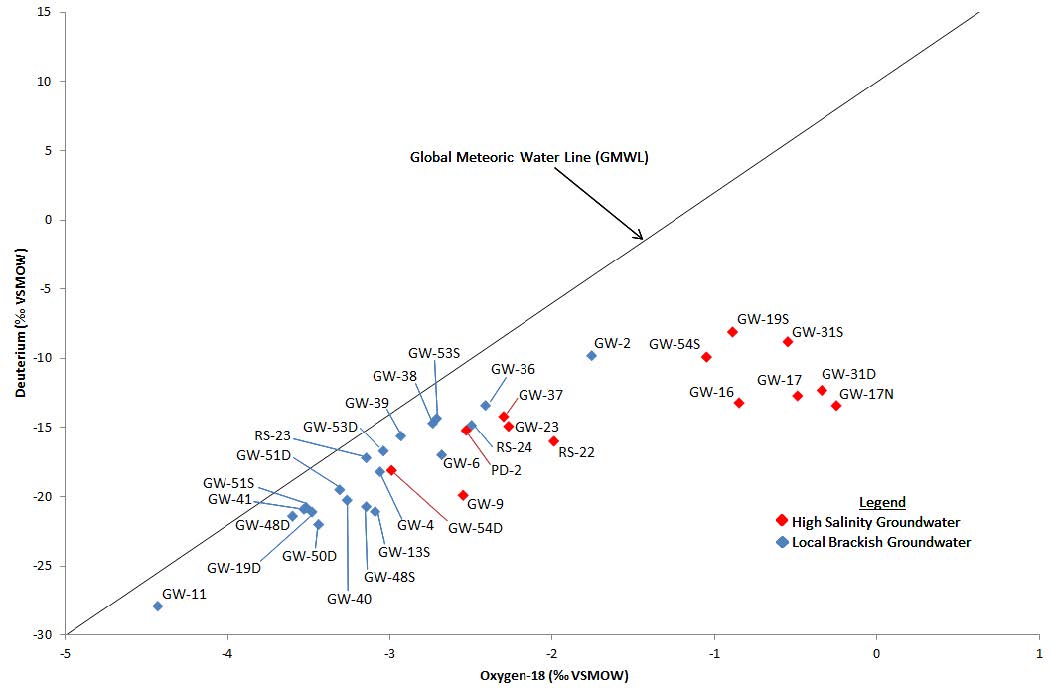
Darling reported in 2024 that his objectives in this presentation was:
- Illustrate utility of stable isotope geochemistry and bromide-chloride systematics in identification of source(s) of brine in groundwater,
- Explain principles of analysis, using data from the Raceland Oil Field, Lafourche Parish,
- Demonstrate that integration of stable isotope geochemistry with bromide-chloride data yields direct and penetrating insight into source(s) of chloride.
Procedures:
- All methods are widely used to identify sources of brine and to model mixing of saline waters and fresh waters.
- Plot standard geochemical relationships for saline solutions,
- X-Y plots (e.g., Na v Cl, Br/Cl v 1/Cl),
- Identify groups of wells based on geochemical patterns,
- Graph ratios of stable isotopes oxygen-18 (δ18O) and deuterium (δ2H, or δD),
- Identify groupings delineated on X-Y plots,
- Graph δ18O v Cl or δ18O v 1/Cl if there is at least one highly saline end member,
- Look for linear patterns (indicators of different sources of Cl and of mixing),
- Plot strontium isotope ratios v 1/Sr (87Sr/ (86Sr v 1/Sr), and
- Look for clusters or linear patterns and calculate median and interquartile 87Sr/86Sr ratios.
Resource Portal for I2M Clients, Associates, and Geoscientists
Managed & Built by I2M Consulting, LLC | © 2010-

Managed & Built by I2M Consulting, LLC | © 2010-