

Madzunya and three co-authors reported in 2021 that rare earth elements (REE) concentrations and pattern remains largely unchanged during the process of milling and can thus provide strong evidence of the origin of the material. The aim of the authors was to determine the rare earth elements in uranium ore deposits as a nuclear forensics tool.
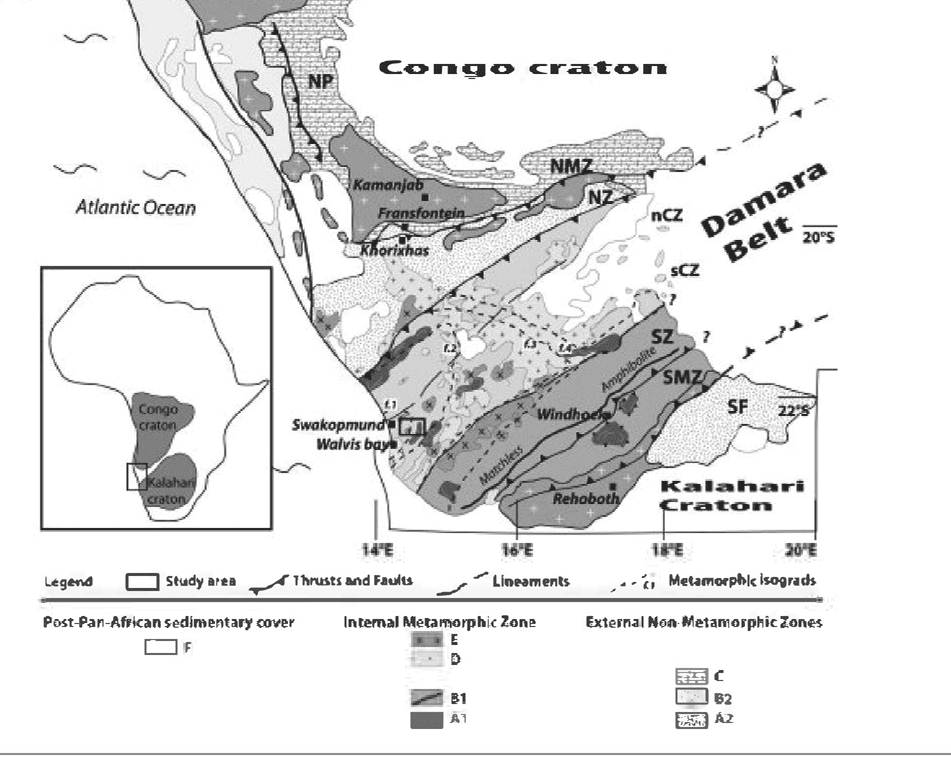 Location of the Damara Orogenic belt between the Congo and Kalahari cratons (To´e et al., 2013).
Uranium ore from three mines were collected and analyzed using an inductively coupled plasma mass spectrometry (ICP-MS) to determine the concentrations of rare earth elements. A non-parametric Kruskal-Wallis test and a pair wise comparison test was used to test for significant difference in the concentration of REEs between the mines followed by principal-component analysis (PCA). The REE concentration were normalized with C1-Chondrite values to determine the REE pattern.
The total concentration of the REE ranged from 131.38 to 161.77 ppb, 266.27 to 840.37 ppb, 177.86 to231.51 for Mine 1, 2 and 3, respectively. The mean ∑REE obtained was in the order M2>M3>M1. The pairwise comparison test of the pair M1 and M2 was found to be less than 0.05, indicating a significant difference in the samples. The REE pattern is mostly similar for all the ore samples with pronounce Eu anomaly, enriched LREE and depleted flat HREE. The PCA results indicates that the ore samples can be distinguished from each other.
Managed & Built by I2M Consulting, LLC | © 2010-
