

Zeng and 5 co-authors reported in 2021 that in order to better understand the permeability of uranium sandstone, improve the leaching rate of uranium, and explore the change law of pore structure characteristics and blocking mechanism during leaching, the authors systematically analyzed the microstructure of acid-leaching uranium sandstone. 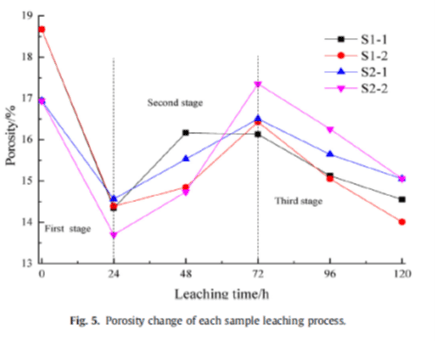 The authors investigated the variable rules of pore structure characteristics based on nuclear magnetic resonance (NMR). The results showed the following:
(1) The uranium concentration change followed the exponential law during uranium deposits acid leaching. After 24 h, the uranium leaching rate reached 50%. The uranium leaching slowed gradually over the next 4 days.
(2) Combined with the regularity of porosity variation, Stages I and II included chemical plugging controlled by surface reaction. Stage I was the major completion phase of uranium displacement with saturation precipitation of calcium sulfate. Stage II mainly precipitated iron (III) oxide-hydroxide and aluminum hydroxide. Stage III involved physical clogging controlled by diffusion.
(3) In the three stages of leaching, the permeability of the leaching solution changed with the pore structure, which first decreased, then increased, and then decreased.
The authors concluded that based on this study, the following detailed conclusions can be drawn:
1. The acid-leaching process of the uranium deposit conformed to the exponential function law. The concentration of leaching solution increased rapidly in 24 hours of acid leaching, and the average leaching rate of uranium reached 53.41%. After 4 days, the leaching rate of uranium slowed down obviously and tended to be stable. In the leaching process, the porosity of sandstone samples first decreased, then increased, and then decreased. Combined with the change in the uranium leaching rate, the leaching process could be categorized into three stages, which were comprehensively influenced by physical and chemical reactions. Moreover, by understanding the acid-leaching process in detail, the authors further optimized the acid-leaching process well site.
2. The first and second stages were controlled primarily by surface chemical reaction, which generated a large amount of precipitation. It reduced the connectivity between the small and medium pore and slowed down the seepage speed. The leaching solution reacted fully with uranium-bearing minerals in time and improved the uranium leaching rate. The third stage was controlled mainly by physical diffusion. The movement of small particles to fill the pores of small holes led to a decrease in porosity and permeability, which was not conducive to the recovery of the leaching solution. After understanding the structural changes in the uranium ore pore during the physical and chemical reaction processes, the authors solved the problem of clogging in situ leaching, and optimized the amount of leaching solution added in the different mining stages, thereby increasing the rate of leaching uranium.
3. NMR T2 spectrum directly showed the rule of pore development and expansion during acid leaching of rock. The overall number of small and medium pores decreased, hindering the seepage of the leachate. Conversely, the number of small pores increased, and the pore volume increased, and then the permeability improved. Corresponding to the development law of uranium concentration and porosity, the authors verified the rationality of this conclusion. Through NMR data, the laws of uranium concentration and porosity could be understood more intuitively, so that a foundation could established for a mathematical model of leaching uranium mining and to further promote the development of nuclear energy.
Managed & Built by I2M Consulting, LLC | © 2010-
