

Laudal and three co-authors reported in 2018 that rare-earth elements (REE) are crucial materials in an incredible array of consumer goods, energy system components, and military defense applications. However, the global production and entire value chain for REE is dominated by China, with theU.S. currently 100% import reliant for these critical materials.
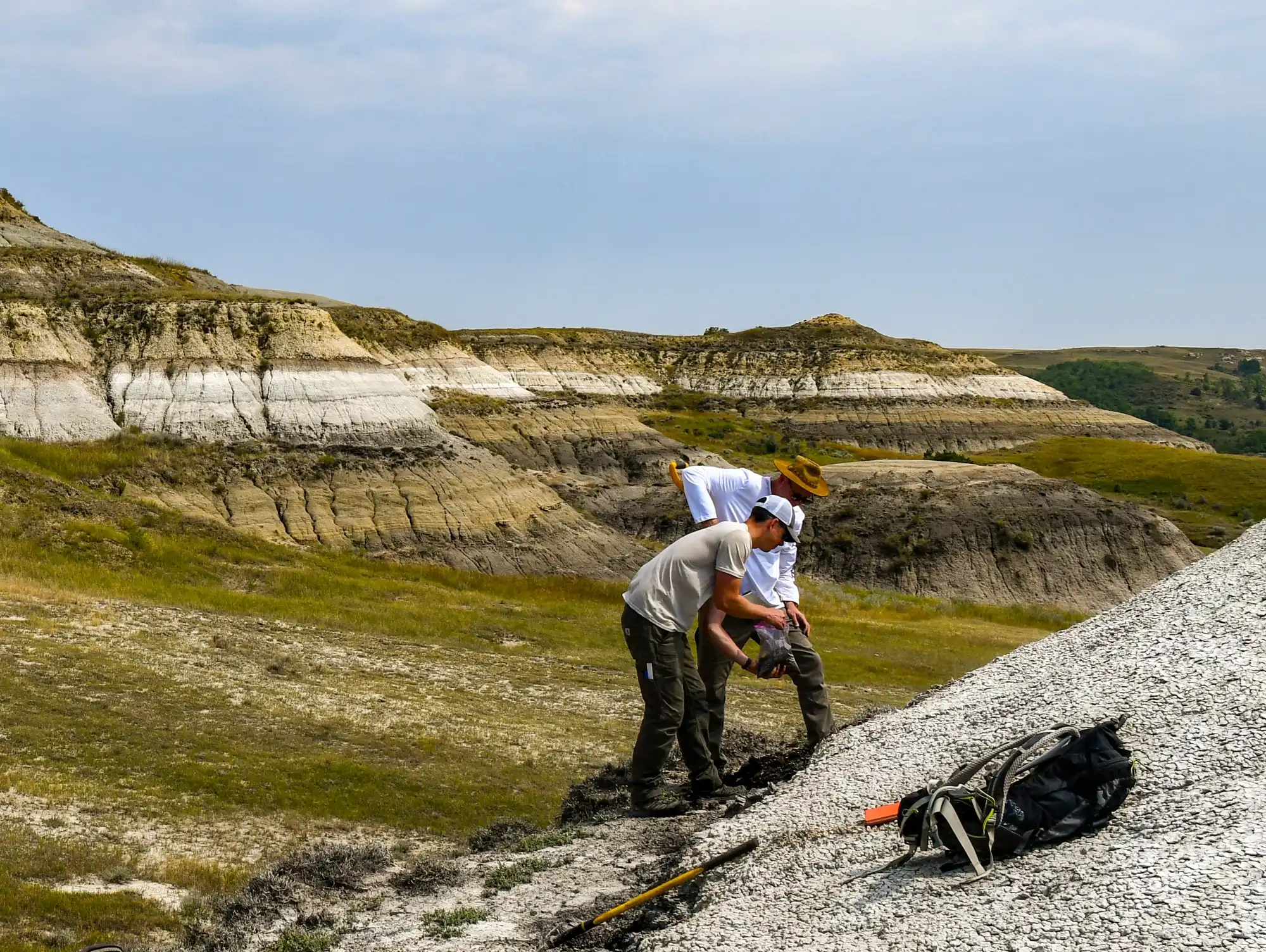 North Dakota Geological Survey geologists Levi Moxness (foreground) and
Ned Kruger sample coal below the rock weathering zone, which is also visible
across the outcrops behind.
Traditional mineral ores including those previously mined in the U.S., however, have several challenges. Chief among these is that the content of the most critical and valuable of the rare earths is deficient, making mining uneconomical. Further, the supply of these most critical rare earths is nearly 100% produced in China from a single resource that is only projected to last another 10–20 years. The U.S. currently considers the rare earths market an issue of national security. It is imperative that alternative domestic sources of rare earths be identified and methods developed to produce them.
Recently, coal, underclay and coal byproducts have been identified as one of these promising alternative resources. This paper details the results of a study on characterization of North Dakota lignite and lignite-related feedstocks as an assessment of their feasibility for REE recovery. The abundance, distribution, and modes of occurrence of the REE in the samples collected were determined in this initial study to inform the selection of appropriate extraction and concentration methods to recover the REE.
Materials investigated include the lignite coals, clay-rich sediments associated with the coal seams, and materials associated with a lignite beneficiation system and power plant. The results show that high REE levels exist both in lignite coals and associated sediments. The form of the REE in the clay materials is primarily as ultrafine mineral grains. In the lignite coals and associated underclay, approximately 80–95% of the rare earths content is organically associated, primarily as coordination complexes.
They concluded that the clay-rich sediments associated with the coal seams had REE mainly associated in mineral grains of less than four microns in diameter, in zircon minerals, aluminophosphates, and clays. Inferred evidence of organic association of REE in North Dakota lignite coal was revealed by correlating the enrichment by molecular weight of the REE with the ash content of the sample, as well as by float-sink analysis that showed significantly higher concentration of REE was present in the low specific gravity organic-rich fractions of a high-ash sample from the Harmon-Hanson coal zone.
Experimental evidence of organic associations was gathered via chemical fractionation tests, which showed that REE in the lignite coals are primarily associated in organic coordination complexes, and to a lesser extent as ion-exchangeable cations or water soluble minerals. A small fraction (5–20%) is associated with silicates, clays, sulfides, or other non-HCl-soluble minerals. The chemical fractionation data, combined with inferred evidence and
literature, indicate that the REE in North Dakota lignites appear to be primarily associated with the organic matrix.
Combined, the data suggest that an infiltrational process of accumulation of REE in the coals has occurred in North Dakota. During the process of the accumulation of organic material that formed lignite coal, the coal forming materials interacted with detrital materials such as volcanic ash that contain rare earth elements. Combined with surface water leaching processes, the resulting interaction caused the REE to be released from the detrital material into the anaerobic swampy environment.
The REE in solution were able to react with abundant oxygen functional groups and become associated with the organic matrix during compaction and coalification. This high percentage of organically associated REE is unique to low rank coals such as lignite and subbituminous coals. This is due to the “age” of the low-rank coals, where significant secondary mineralization has yet to occur, and thus the adsorbed REE remain bound with the oxygen functional groups in the coal, rather than in mineral forms typically found in older/higher rank coals.
[More on REE in lignite (here)].
Managed & Built by I2M Consulting, LLC | © 2010-
