
Coe and six co-authors reported in an outstanding paper in April 2024 on the rare-earth element enrichment within coal and coal-adjacent strata in the Uinta Region of central Utah and western Colorado. Rare-earth elements are a subset of critical minerals as defined by the U.S. Geological Survey. These elements are used for a wide variety of applications, including renewable energy technology in the transition toward carbon-neutral energy.
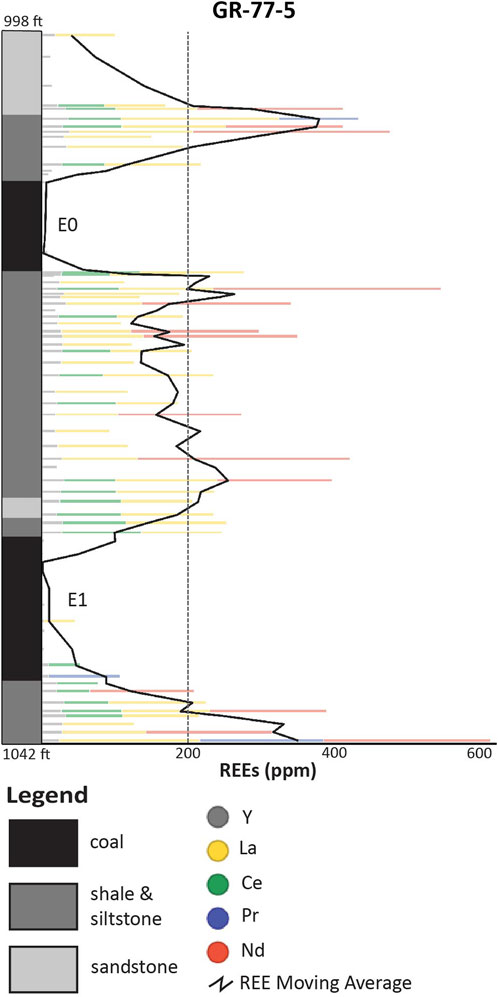
Stratigraphic pXRF analyses through two mined
coal intervals (E0 and E1) within the GR-77-5 core
near the West Elk mine, Colorado.
While rare-earth element enrichment has been associated with Appalachian coals, there has been a more limited evaluation of western U.S. coals. Here, samples from six active mines, four idle/historical mines, four mine waste piles, and seven stratigraphically complete cores within the Uinta Region were geochemically evaluated using portable X-ray fluorescence (n = 3,113) and inductively coupled plasma-mass spectrometry (n = 145) elemental analytical methods.
Results suggest that 24%–45% of stratigraphically coal-adjacent carbonaceous shale and siltstone units show rare-earth element enrichment (>200 ppm), as do 100% of sampled igneous material. A small subset (5%–8%) of coal samples display rare-earth element enrichment, specifically in cases containing volcanic ash.
The authors proposed two multi-step depositional and diagenetic models to explain the enrichment process, requiring the emplacement and mobilization of rare-earth element source material due to hydrothermal and other external influences. Historical geochemical evaluations of Uinta Region coal and coal-adjacent data are sparse, emphasizing the statistical significance of this research.
These results support the utilization of active mines and coal processing waste piles for the future of domestic rare-earth element extraction, offering economic and environmental solutions to pressing global demands.
[Additional Articles on Coal with REE: (here)]
Managed & Built by I2M Consulting, LLC | © 2010-