

Loeb and thirty co-authors in 2023 conducted an extensive towed-magnetic-sled survey during the period of June 14-28, 2023, over the seafloor about 85 km north of Manus Island, Papua New Guinea, centered around the calculated path of the bolide CNEOS 2014-01-08 (IM1). They found about 850 spherules of diameter 0.1-1.3 millimeters in their samples. The samples were analyzed by micro-XRF, Electron Probe Microanalyzer and ICP Mass spectrometry. 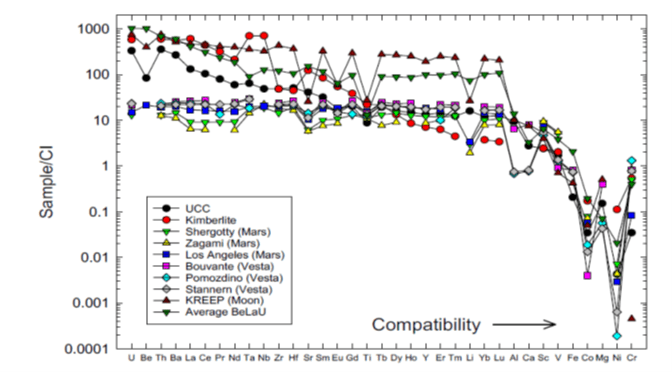 The “BeLaU” element abundance and pattern shown in the figure above distinguish from the enriched sources from the solar system bodies. Elements are ordered with increasing compatibility. Data source: Earth’s upper continental crust (Rudnick and Gao, 2014); kimberlites (Giuliani et al., 2020); lunar KREEP (Warren, 1989); shergottites (Shergotty, Zagami, and Los Angeles) (Lodders, 1998; Jambon et al, 2002); eucrites
(Bouvante, Pomozdino, and Stannern) (Kitts and Lodders, 1998).
The authors reported major and trace element compositions of the samples and classify spherules based on that analysis. The authors identified 78% of the spherules as primitive, in that their compositions have not been affected by planetary differentiation. They divided these into four groups corresponding to previously described cosmic spherule types. The remaining 22% appear to all reflect planetary igneous differentiation and are all different from previously described spherules.
The authors termed them D-type spherules. A portion of the D-spherules show an excess of Be, La and U, by up to three orders of magnitude relative to the solar system standard of CI chondrites. Detailed mass spectroscopy of 12 of these “BeLaU”-type spherules, the population of which may constitute up to ~10% of our entire collected sample, suggests that they are derived from material formed by planetary igneous fractionation.
Their chemical composition is unlike any known solar system material. They compared these compositions (in the above figure) to known differentiated bodies in the solar system and found them similar to evolved planetary materials - with lunar KREEP the closest in terms of its trace element enrichment pattern, but unusual in terms of their elevated CI-normalized incompatible elements. The “BeLaU”-type spherules reflect a highly differentiated, extremely evolved composition of an unknown source.
Managed & Built by I2M Consulting, LLC | © 2010-
