

Pham and 8 co-authors reported in 2019 that trace elements and isotopes (TEIs) were measured as part of the GEOTRACES PANDORA cruise (July–August 2012, R/V L'Atalante), among them rare earth elements (REEs) as pertinent tracers of land-ocean inputs and water-mass transformations.
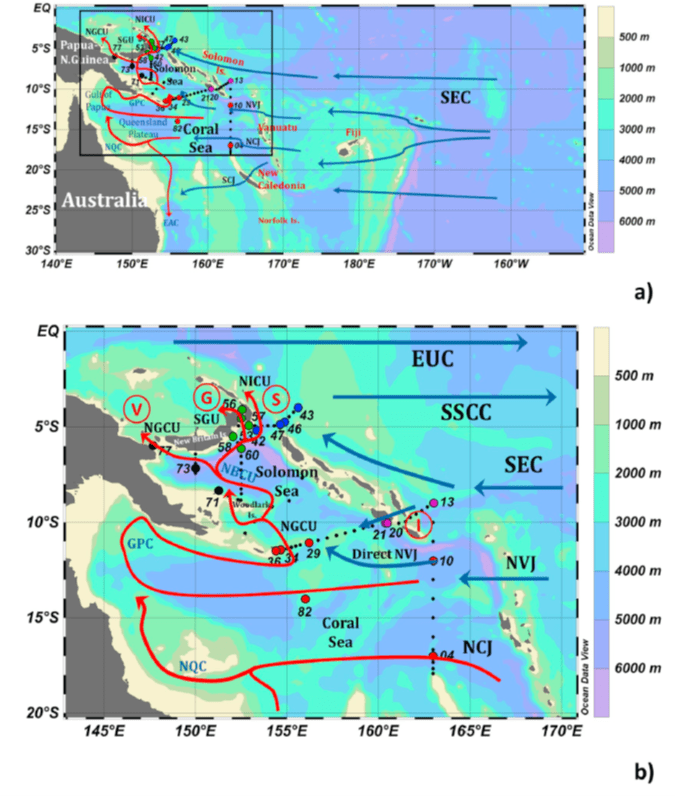 General map above of the studied area (a) and zoom panel in the Coral and Solomon Seas allowing the identification of the sampling locations. Red arrows indicate the LLWBCs (b). The sampling locations are represented by circles and different colors associated with distinct regions. The red circles correspond the Coral Sea and Southern entrance of the Solomon Sea. Samples collected in waters flowing through four straits (Indispensable, Vitiaz, St George's and Solomon), are colored with dark violet, black, green and dark blue, respectively. These color criteria will be kept throughout this work.
The main currents flowing in the South Western Pacific Ocean are shown by solid arrow (Grenier et al., 2011, 2013). SEC: South Equatorial Current, NVJ: New Vanuatu Jet, NCJ: New Caledonia Jet, GPC: eastward Gulf of Papua Current, NQC: polarward New Queensland Current, NGCU: New Guinea Coastal Undercurrent, NBCU: New Britain Coastal Undercurrent, NICU: New Ireland Coastal Undercurrent, SSCC: South Subsurface Countercurrent, EUC: Equatorial Undercurrent. The main archipelago and islands are also reported in the map. Straits are identified by a character covered by red circle: Indispensable, Vitiaz, St. George and Solomon Strait also highlighted in the map as V, G and S, correspondingly.
The authors discussed results of 19 dissolved REE (dREE) profiles measured using a trispike method in the Coral Sea and inside and at the exits of the Solomon Sea, a semi-enclosed sea with complex topography and straits. Overall, dREEs –except the insoluble Ce– show nutrient like profiles, i.e. depleted at the surface and enriched at depth.
Illustrative Nd concentrations range from ~5 pmol/kg at the surface to > 25 pmol/kg at 5000 m depth. However, local dREE enrichments are observed, mostly in the Straits (Indispensable, Solomon and Vitiaz Straits) and along the island coasts. A box model allows calculating and discussing the fate of the dREEs in the different water layers flowing through the Solomon Sea. Finally, subtle variations revealed by La, Ce, Eu anomalies and the normalized light versus heavy REE ratio (expressed as Ndn/ Ybn) allows the identification of specific mechanisms affecting the distribution of the different dREEs.
The positive Eu anomaly observed in the surface layers reflects the basaltic origin of external inputs, consistent with the intensive weathering and/or volcanic activity affecting the surrounding islands. These data also confirm that the distributions of heavy dREEs (like Yb) are better correlated to the dSi concentrations than that of the other REEs.
This article is part of a special issue entitled: “Cycles of trace elements and isotopes in the ocean – GEOTRACES and beyond” - edited by Tim M. Conway, Tristan Horner, Yves Plancherel, and Aridane G. González.
Managed & Built by I2M Consulting, LLC | © 2010-
