

John J. W. Rogers and three co-authors reported from University of North Carolina at Chapel Hill in 1977 that they have reviewed the published data bearing on the geology and origin of uranium deposits in granitic, pegmatitic and migmatitic rocks.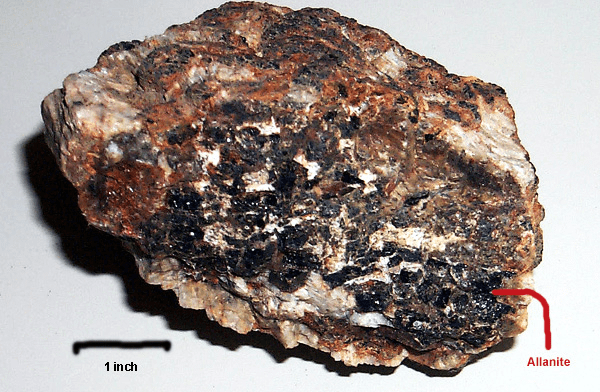 Uranium in alkaline dikes from Seward Peninsula, Alaska. Figure 6a
from Campbell, et al., 2018 (here)
The aim of this study was to assist geologists in developing predictive criteria which will aid them in their search for similar deposits in the United States. The authors concentrated their efforts on the so-called "porphyry" uranium deposits (Armstrong, 1974). This class of deposit is typified by the Rossing, Namibia, deposit which, though low grade, is the largest deposit of its kind known in igneous host rocks. Nonetheless, as the nation anticipates future deficits in the supply of uranium to serve as fuel for nuclear power plants, it is now prudent to search for uranium from new, perhaps lower grade, sources. As a result, uranium deposits in igneous rocks that have been studied in the past and considered of little consequence at that time must be examined more closely today.
Two types of uranium deposits are primarily considered in this report deposits in pegmatites and alaskites in gneiss terrains; and disseminations of uranium in high-level granites. The former type of deposit is exemplified by the Bancroft, Canada, and Rossing, Namibia, deposits; and the latter by the Ross-Adams deposit at Bokan Mountain, Alaska. We specifically have not included a detailed review of the uranium association in layered or zoned nepheline syenite bodies (such as those at Ilimaussaq, Greenland, and Pocos de Caldas, Brazil) or uranium deposits
in carbonatites.
Both types have already been the subject of intensive study by both igneous and ore petrologists because of their other ore metal associations and the unusual rock types associated with these complexes.
Although hydrothermal vein deposits are classified separately from uranium deposits in igneous rocks, there can be considerable overlap or gradation between vein-type deposits and deposits in granites, pegmatites and migmatites. Where this overlap occurs, the authors considered the vein deposits
an ancillary feature of the igneous deposits. Vein-type uranium deposits are the subject of an exhaustive review by Rich et al. (1975), so their treatment of this type of deposit is minimal:
- Chapter 1 of this report, the general data on the distribution of uranium in igneous and metamorphic rocks are reviewed;
- Chapter 2 contains some comments on the classification of uranium deposits associated with igneous rocks and a summary of the main features of the geology of uranium deposits in granites;
- Chapter 3 contains the general concepts of the behavior of uranium in granites during crustal evolution and includes is a discussion of the relationship of uranium mineralization in granites to the general evolution of mobile belts, plus the influence of magmatic and post-magmatic processes on the distribution of uranium in igneous rocks and related ore deposits;
- Chapter 4 relates the results of experimental studies on the crystallization of granites to some of the geologic features of uranium deposits in pegmatites and alaskites in highgrade metamorphic terrains; and
- Chapter 5 delineated the potential or favorable areas for igneous uranium deposits in the U.S.A.
Appendix 1 contains the data on the geology of specific uranium deposits in granitic rocks;
Appendix 2 is a compilation of igneous rock formations containing greater than 10 ppm uranium;
Appendix 3 is a report by one of the authors (JJWR) on the results of a visit to the Rossing area in March, 1976; and
Appendix 4 is a report by two authors (RKN and JKG) on a field excursion to eastern Canada.
Managed & Built by I2M Consulting, LLC | © 2010-
