

Dusengemungu and two co-authors reported in 2022 that understanding the level of heavy metal contamination coupled with the assessment of environmental and human risks associated with mine waste dumpsites is an important step to initiating efficient measures for mine wasteland restoration, stabilization, and bioremediation.
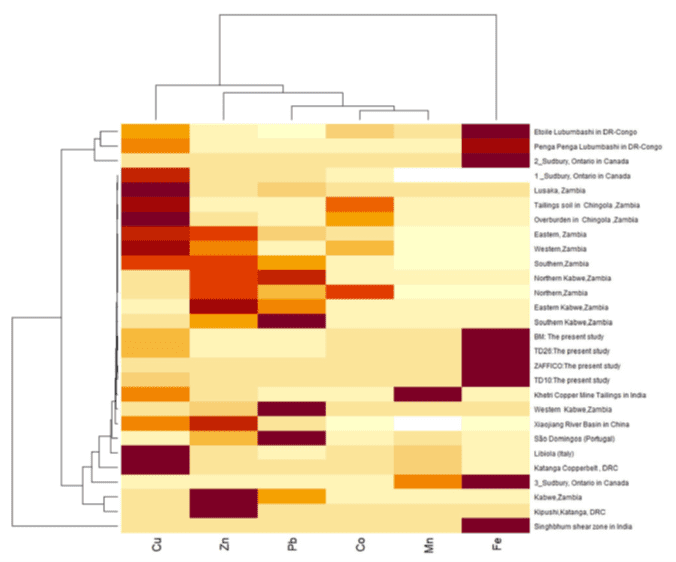 Heatmap analysis of heavy metals (Cu, Co, Fe, Mn, Pb, Zn) of mine
soil in the present study with data from other studies in Zambia, DRC
and elsewhere in the world.
The authors concentrated on the heavy metals; Copper (Cu), Cobalt (Co), Iron (Fe), Lead (Pb), Manganese (Mn), and Zinc (Zn) in soil from mine waste dumpsites around Kitwe (Sites: BM and TD26) and Mufulira (Site: TD10), Zambia, was assessed to determine the level of contamination, ecological risks, and progress made in reclamation.
The mine waste dumpsites in the two towns are located in the vicinity of residential areas. Therefore, there is need to provide information for optimization of protocols for post-mining landscape in Zambia and elsewhere to limit soil, river, and groundwater contamination and to accelerate the restoration process. Mean values for soil pH, electrical conductivity, and organic matter varied between 5.9 to 8.4, 2,534.8 to 538.6 μS/cm, and 0.90 to 2.75%, respectively.
The mean concentrations of heavy metals of BM, TD26, and TD10 decreased in order of Fe >Cu>Co>Mn>Pb>Zn across all sites. However, the order of overall degree of heavy metal contamination computed using control soil as a baseline in BM, TD26, and TD10 was Cu>Co> Fe >Pb>Mn>Zn. The pollution load index was 0.355 at BM, 0.329 at TD26, and 0.189 at TD10, indicating high soil pollution at BM and TD26.
The Potential Ecological Risk Index for all heavy metals tested at BM, TD26, and TD10 showed low ecological risk in the vicinity of the studied dumpsites. Furthermore, the present study also showed that the polluted soils around smelter sites and mine waste dumpsites are susceptible to dispersion by wind and water. Additionally, results from TD10 revealed that the initiated remediation of the tailings dam was somewhat successful. Finally, this study provided an updated status regarding the accumulation of heavy metals in mine waste dumpsites of Kitwe and Mufulira, Zambia and baseline information necessary to enhance post-mining landscape reclamation.
The authors concluded that:
- Based on PERI assessment, it was observed that copper tailing dams remain one of the most serious environmental problems facing the Copperbelt of Zambia today.
- High concentrations of Co, Cu, Fe, and medium concentrations of Mn, Pb, and Zn were observed in all the tailing dam sites, which is the main drawback for remediation. Minimal concentrations of all these elements were observed in the control sample in comparison with the tailing dams.
- Mine waste soil physicochemical characteristics (organic matter content, pH, and electrical conductivity) in the tested sites would not support promoting plant growth. Further research is required to assess more physicochemical properties such as total nitrogen, available phosphorus, potassium, magnesium, and cation exchange capacity (CEC).
- The contamination factor and pollution load index led to the conclusion that the tailing dams have an excess of heavy metals. However, data from the TD10 locality showed that the initiated restoration for the tailings dam’s remediation was somewhat successful.
- According to PERI analysis, there is low ecological risk in the present study. However, the maximum PERI was observed in the data from elsewhere in Zambia and DRC which support that there is a high risk of contamination to humans and the environment.
Presently, however, there are few available data to assess the actual ecological hazard. Future research eforts should focus on improving our understanding of the impact of continuous exposure to Copper and Cobalt on humans and the environment. This will be critical when it comes to putting soil reclamation management plans into action.
In view of the key fndings of the study, the following recommendations were made:
- There is need for mine stakeholder institutions to develop and implement long-term policies, such as strict rules, that will result in excellent tailing dams restorations and recovery infrastructure, reducing waste and its health consequences,
- Ensure that reclaimed soil and rivers are appropriately protected for agricultural operations, and
- To apply bioleaching technology to maximize the recovery of a signifcant amount of Cu, as well as other metals, can contribute to reduce the waste’s environmental impact.
Managed & Built by I2M Consulting, LLC | © 2010-
