

Konstantinova and six co-authors reported in 2023 that ensuring the sustainability of modern cities is based on creating comfortable living conditions, including reducing negative environmental impacts. The effects of various types of anthropogenic activity are manifested in a particular decrease in the quality of soils. The authors assessed the co-contamination of urban topsoils in Tyumen, Russia, with potentially toxic elements(PTEs), priority polycyclic aromatic hydrocarbons (PAHs), and the associated ecological and health risks.
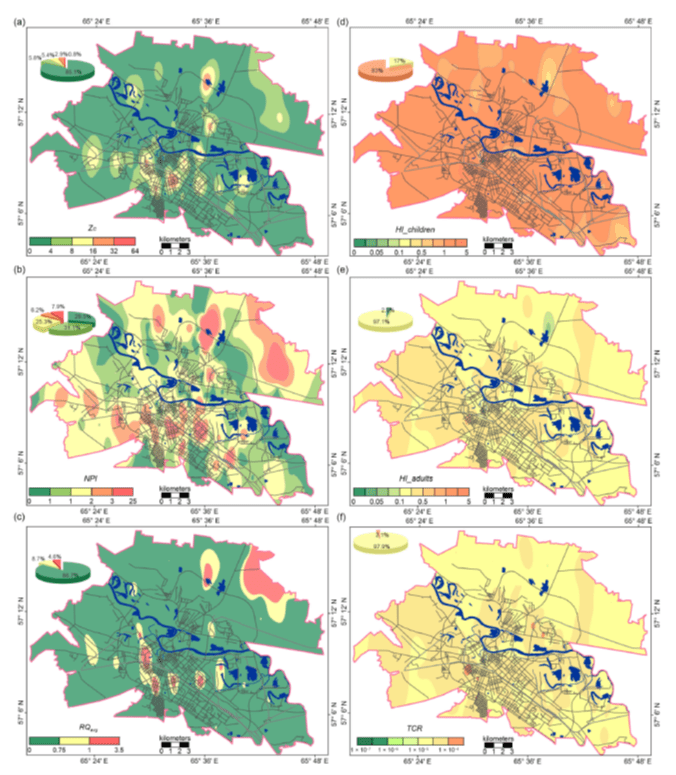 Spatial distribution of total pollution and cumulative ecological
and health risks of PTEs and PAHs in urban topsoils of Tyumen:
(a) total pollution index (ZC); (b) Nemerov pollution index (NPI);
(c) average risk quotient (RQavg); (d) hazard index for children
(HI_children); (e) hazard index for adults (HI_adults); and (f)
total carcinogenic risk (TCR).
A set of 241 soil samples were analyzed using X-ray fluorescence and high-performance liquid chromatography to identify PTEs and PAHs, respectively. The most hazardous substances were Ni, As, Pb, naphthalene (NAP), fluoranthene, and high-molecular-weight PAHs causing low-to-very-high individual pollution.
In general, the contribution of PAHs to soil pollution was higher than that of PTEs. It was found that 96% of the samples could be classified as clean according to the total pollution index (Zc), widely used in Russia. At the same time, one-third of the samples were characterized by low-to-high contamination according to the Nemerov pollution index (NPI). Thus, the NPI was more informative for estimating total soil pollution than the Zc. The As, Pb, NAP, and benzo[a]pyrene (BaP) contents exceeded the maximum permissible concentrations in soils by an order of magnitude, reaching an extremely dangerous level.
However, the average ecological risk was assessed as minimal. Non-carcinogenic risks were predominantly due to PTE exposure and were moderate for children and low for adults. Throughout the city, carcinogenic risks exceeded the threshold but generally corresponded to a low level. The main source of carcinogenic risk was exposure to Co, As, and Pb.
In general, the quality of Tyumen soils in terms of the content of PTEs and PAHs can be described as satisfactory. A spatial analysis of soil pollution and associated risks identified hot spots requiring further monitoring.
Managed & Built by I2M Consulting, LLC | © 2010-
