

Li and three co-authors reported in 2013 that contaminated food through dietary intake has become the main potential risk impacts on human health. The authors investigated concentrations of rare earth elements (REEs) in soil, vegetables, human hair and blood, and assessed human health risk through vegetables consumption in the vicinity of a large-scale mining area located in Hetian Town of Changting County, Fujian Province, Southeast China.
 Note: Also see Russian paper on similar topic (here).
Concentrations of total REEs in vegetable and well water samples are shown in the figure below. Values are average ± standard deviation. Columns with the same letter do not differ significantly at the 5% level according to the Scheffe’s multiple comparison test.
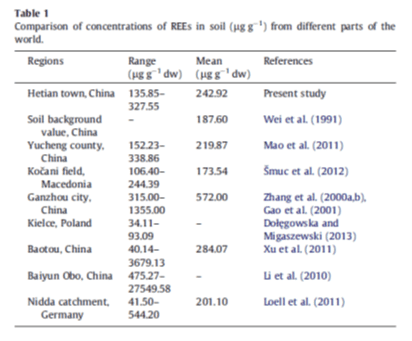
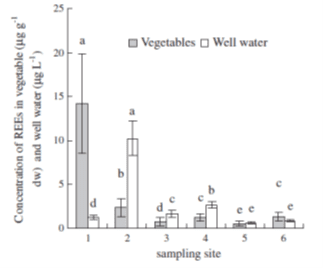 The results of the study included the following mean concentrations for total and bio-available REEs of 242.92 ± 68.98 (135.85–327.56) μg/g and 118.59 ± 38.49 (57.89–158.96) μg/g dry weight (dw) in agricultural soil, respectively, and total REEs of 3.58 ± 5.28 (0.07–64.42) μg/g dw in vegetable samples.
Concentrations of total REEs in blood and hair collected from the local residents ranged from 424.76 to 1274.80 μg/L with an average of 689.74 ± 254.25 μg/L and from 0.06 to 1.59 μg/L with an average of 0.48 ± 0.59 μg/L of the study, respectively. In addition, a significant correlation was observed
between REEs in blood and corresponding soil samples (R2 = 0.6556, p < 0.05), however there was no correlation between REEs in hair and corresponding soils (p > 0.05). Mean concentrations of REEs of 2.85 (0.59–10.24) μg/L in well water from the local households was 53-fold than that in the drinking water
of Fuzhou city (0.054 μg/L).
The health risk assessment indicated that vegetable consumption would not result in exceeding the safe values of estimate daily intake (EDI) REEs (100-110 μg/kg/d) for adults and children, but attention should be paid to monitoring human beings health in such rare earth mining areas due to long-term exposure to high dose REEs from food consumptions.
Managed & Built by I2M Consulting, LLC | © 2010-
