

DiNatale reported in early 2024 that the amount of battery capacity set to be added to the ERCOT grid this year far outstrips new natural gas generation. As the Texas grid was closing out a record year for new battery storage projects across the state, it was eyeing a flood of plans for additions that will dwarf 2023’s totals.
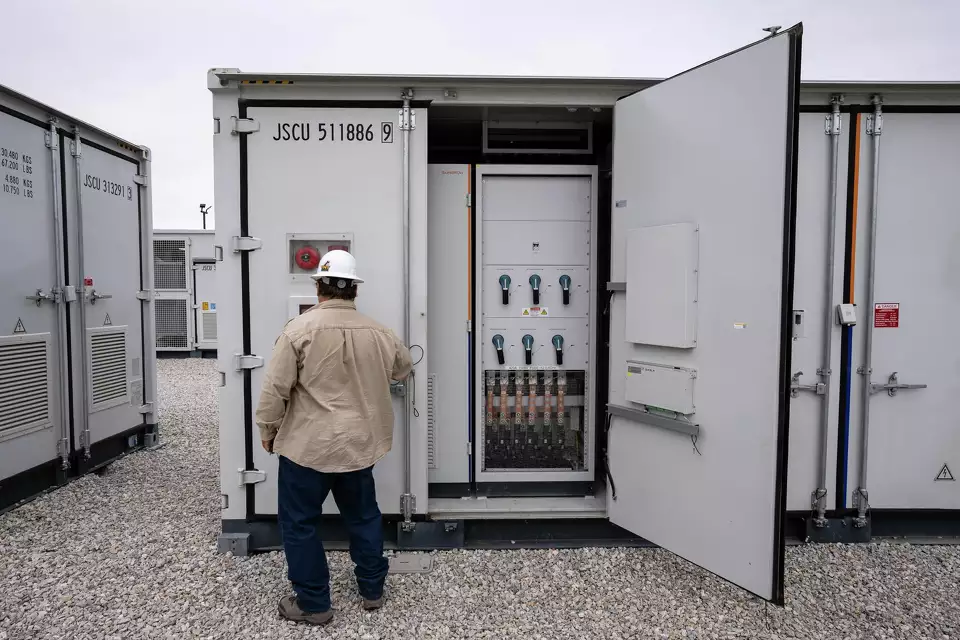 An employee at a battery storage site in Saginaw that’s owned and operated
by Eolian L.P. The Texas grid added a record amount of battery capacity in
2023, but it will be dwarfed by the amount of new sties planned for the next
few years. Sam Hodde/Associated Press
The projects also will outstrip the amount of new natural gas-fired generation currently planned. Since April, the Electric Reliability Council of Texas has received applications for battery projects that would add 50,000 megawatts of storage capacity to the power grid it operates.
“Right now, we have over 1,600 projects in our queue,” ERCOT CEO Pablo Vegas said last month. “We had a record year in 2023 with 800 new projects in 2023 alone of those 1,600.”
The grid operator is anticipating adding 25,000 megawatts of battery power in 2024 and more than 40,000 megawatts in each of the next two years.
“Those are record numbers, and we are ready to help manage and facilitate those resources coming through the queue quickly,” Vegas said.
Recent projects illustrate the increasing push from battery operators to provide the quickly available power Texas needs as its grid is challenged to keep up with rapid population growth and climate change. In late December, Austin-based Jupiter Power announced a $65.5 million financing agreement to build a 200-megawatt battery site in Houston. The next day, On.Energy announced that it had closed on a $40 million financing deal to build its own sites near Houston. In November, oil and gas giant TotalEnergies started commercial operation of a solar farm with battery storage south of Houston capable of generating enough power for 70,000 homes.
One fast-growing company, Enel North America, said it tripled battery capacity in Texas in 2023, ending the year with 523 megawatts of storage. And it was planning to add 823 megawatts this year. The battery sites are popping up statewide. In San Antonio, CPS Energy announced a request for proposals in September for its own 500-megawatt storage site, adding to other solar and battery sites it already operates.
Just three years ago, the amount of battery storage on the statewide grid was negligible.
Battery, solar lead
Battery storage and solar power projects make up the largest percentage of power projects ERCOT has in its queue awaiting approval to be added to the grid. That’s even as the state is adding new incentives for construction of natural gas power plants. But battery sites are typically less expensive and faster to build. They also can charge off the grid when the cost of power is low or can store power from renewable sources such as solar and wind.
Of the total 316,000 megawatts of power sources for which ERCOT has applications, about 143,000 megawatts is for solar, 125,000 megawatts is for battery storage, 33,000 megawatts is for wind and 15,000 megawatts is for natural gas. It takes an average of 1 megawatt to power about 200 homes on an especially hot or cold Texas day.
ERCOT expects the biggest chunks of battery capacity to be added to the grid between now and 2026, according to its most recent board presentation.
Day to day, ERCOT doesn’t rely much on batteries in its fuel mix. Batteries mainly sell their power on the reserve power market for use in emergencies or when supply is tight — a reality that likely will change over the next few years as ERCOT makes adjustments to its wholesale market design.
On Friday, for example, when temperatures were mild, ERCOT data showed that solar made up 29.1% and natural gas 25.9% of its real-time generation in the afternoon. The use of batteries was negligible. Batteries have stepped up when it counts, though, including when they helped fend off the possibility of rolling outages during a grid emergency Sept. 7.
The grid operator also is working to redesign its proposed rules for how battery sites work on the grid. After concerns were raised by regulators and operators about its approach on batteries, ERCOT in December asked for more time to work on its plan.
Natural gas
In addition to the influx of applications for battery sites, ERCOT has received applications for 7,700 megawatts in natural gas generation. Vegas said he hopes that will increase as a new incentive program for such projects comes online.
The Texas Energy Fund, which voters passed in November, will provide low-interest loans for development of dispatchable thermal generation, primarily natural gas-powered plants. Vegas said the projects need to be at least 100 megawatts in size to qualify. The plants also can receive tiered bonuses for being completed by June 2026 or June 2029.
“In ERCOT, we prioritize thermal dispatchable generation above intermittent resources,” Vegas said, referring to projects such as battery and solar. “So, that is a directive that we have received, and we are able to process the dispatchable generators first as they come into the queue in order to prioritize their interconnection process.”
The Public Utility Commission, which oversees ERCOT, needs to begin accepting the loan applications by June, he said. Despite the push for new natural gas plants from ERCOT and Texas political leaders, a recent report from federal regulators said the state grid should instead be reducing its reliance on natural gas to generate power in case of grid failure. Since Winter Storm Uri, the deadly storm that nearly led to a collapse of the grid in February 2021, ERCOT has increased the amount of natural gas it keeps on hand so it doesn’t need to rely as much on suppliers should frigid temperatures freeze wellheads and transportation infrastructure.
But the new study by the Federal Energy Regulatory Commission, North American Electric Reliability Corp. and others looked at ERCOT’s access to so-called black-start resources or power generation that is designed to run without the grid’s support. During Uri, the grid’s 28 black-start resources all relied primarily on natural gas. Had those resources been more diverse, the impacts of the storm and resulting power outages that killed 246 people may have been less severe, the study said. Ultimately, the federal regulators recommended that ERCOT consider incorporating alternate black-start resources — such as battery storage.
On.Energy, one of the battery operators expanding in Texas, said it plans to have its new sites on line by the third quarter of 2024. Jupiter CEO Andrew Bowman said his company’s new site:
“...answers the call from the Texas Legislature” to build more power in “major load centers where consumers need it the most.”
Related Articles:
-September grid emergency ‘uncovers some deficits’ in how ERCOT manages power, renewable energy (here);
-Texas battery operators worry new ERCOT regulations could hinder response to grid emergencies (here);
-Texas power providers promise regulators they're ready for winter, though challenges lie ahead (here);
-Proposition 7 is being pitched as a solution to the creaky Texas electric grid. But is it? (here); and
-Texas power grid too reliant on natural gas in case of grid failure, U.S. regulators found (here).
Managed & Built by I2M Consulting, LLC | © 2010-
