

Boiron and 7 co-authors reported in 2002 that significant fracture and porosity sealing characterizes the sedimentary cover-basement interface in the northwestern margin of the Aquitaine Basin (France). Dolomite and calcite (and sometimes fluorite, barite and quartz) constitute most of the fracture.
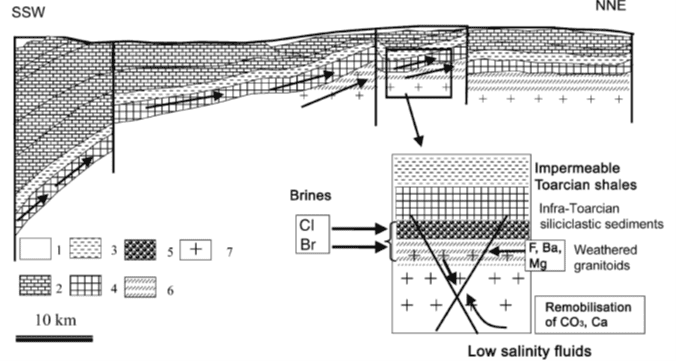
The above graphic illistrates a schematic model of the hydrothermal circulations within the Charroux– Civray plutonic complex at the unconformity surface. 1—Tertiary cover; 2—Mesozoic limestones; 3—Impermeable shales, Toarcian formation; 4—Basal siliciclastic series and dolomites, Infra Lias; 5—Basal siliciclastic series; 6—Weathered basement (palaeosurface with supergene oxidised facies); 7—Granitoids (hercynian basement).
The fillings contain primary inclusions of brines having chlorinities in the range of 3.3 to 5.5 mol Cl/kg solution, with total homogenization temperatures in between 65 and 130°C for quartz and slightly lower for dolomite, barite, fluorite and calcite.
Crush-leach analyses indicate that brines are characterized by Na/K ratios of 5 to 40, Na/Li ratios of 20 to 530, and Cl/Br ratios of 200 to 1000, which are rather typical of deep basinal brines. The fluid δ18O signature is estimated to be = 6.6 ± 1.8‰ SMOW for a crystallization temperature of 100 ± 20°C and the δD value is -30 ± 10‰ SMOW.
The fluid source for the fracture filling mineral is interpreted as a deep sedimentary brine expelled during a period of maximum subsidence in the Aquitaine Basin, which migrated along the sediment cover/basement, a zone characterized interface which is characterized by high permeabilities below the Toarcian shales. The sealing is likely to be linked to the mixing of the brines with dilute, ascending hot waters. These dilute waters infiltrated from emerged zones, convected and heated at depth, reaching temperatures of 100°C (up to 150°C on the basis of cation geothermometry).
Extensional activity, of probable Cretaceous age, related to the Gascogne Gulf rifting could be considered as the most likely cause of a significant fluid migration event at the basement/cover interface all along the margins of the French Massif Central. These processes are large scale as shown by the similarities of mineral sequences, fluid types and general features of most of the F –Ba – Pb –Zn deposits located at the basement – sedimentary cover interface.
The mass transfer of Cl linked to this stage is significant and accounts for the early introduction of large amounts of chlorine in the granitoid microporosity. This probably explains the significant chlorine concentrations of the present-day fluids recovered in the granitoid aquifer.
Managed & Built by I2M Consulting, LLC | © 2010-
