

Erdenesanaa reported in early April 2024 that there have been record temperatures every day for more than a year. Scientists are investigating what’s behind the extraordinary measurements.the ocean has now broken temperature records every day for more than a year. And so far, 2024 has continued 2023’s trend of beating previous records by wide margins. In fact, the whole planet has been hot for months, according to many different data sets.
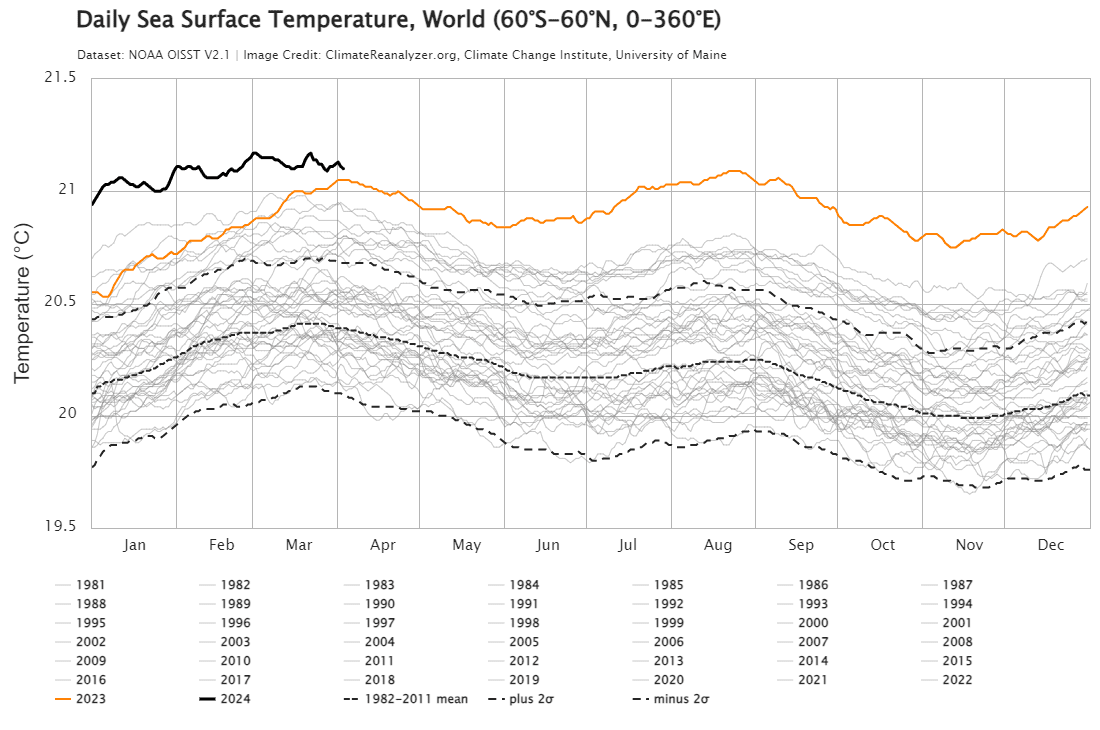 Source: Climate Reanalyzer, Climate Change Institute at the University of
Maine, based on data from NOAA Optimum Interpolation Sea Surface
Temperature (OISST) Note: Data through April 8, 2024. By The New York Times
“There’s no ambiguity about the data,” said Gavin Schmidt, a climatologist and the director of the NASA Goddard Institute for Space Studies. “So really, it’s a question of attribution.”
Understanding what specific physical processes are behind these temperature records will help scientists improve their climate models and better predict temperatures in the future. Last month, the average global sea surface temperature reached a new monthly high of 21.07 degrees Celsius, or 69.93 degrees Fahrenheit, according to the Copernicus Climate Change Service, a research institution funded by the European Union.
“March 2024 continues the sequence of climate records toppling for both air temperature and ocean surface temperatures,” Samantha Burgess, deputy director of Copernicus, said in a statement this week.
What’s happening with ocean temperatures?
The ocean has broken heat records every day for more than a year, and so far, 2024 has continued 2023’s trend of beating previous records by wide margins. Scientists are investigating what’s behind the extraordinary measurements.
Banks’ hollow promises.
At the U.N. climate summit in 2021, hundreds of banks, insurers and asset managers vowed to plow $130 trillion in capital into reducing carbon emissions. But a recent study, published by the European Central Bank, disputed the effectiveness of those promises.
A daunting hurricane season. A key area of the Atlantic Ocean where hurricanes form is already abnormally warm. This suggests an above-average hurricane season that may rival the busiest years on record. Longer, slower heat waves are here. Heat waves are increasingly moving sluggishly and lasting longer because of climate change, exacerbating the effects of extreme temperatures, according to a study. Heat waves slow economic productivity and raise the risk of wildfires, among other issues.
The tropical Atlantic is abnormally warm, helping set the stage for a busy hurricane season, according to an early forecast by scientists at Colorado State University. Higher ocean temperatures provide more energy to fuel stronger storms. Global temperatures are rising long-term because the burning of fossil fuels adds greenhouse gases, which warm the planet, to the atmosphere. So far, climate change has raised the global average temperature by about 1.2 degrees Celsius, or 2.2 degrees Fahrenheit, above the preindustrial average temperature. And because it takes more energy to heat up water than air, the oceans have absorbed the vast majority of the planet’s warming from greenhouse gases.
But the “massive, massive records” set over the past year are beyond what scientists would expect to see even considering climate change, Dr. Schmidt said. What’s different now, compared with this time last year, is that the planet is dealing with the effects of an El Niño event that began in July. El Niño events are natural climate patterns associated with elevated temperatures.
“The temperatures that we’re seeing now, the records being broken in February and March, are actually much more in line with what we would expect,” compared with those of last year, Dr. Schmidt said. “Let’s see what happens by the summer.”
El Niño is weakening and expected to dissipate soon. What happens to global average temperatures then would help shed light on the temperatures of 2023, he said. In addition to climate change and El Niño, there are a couple of other factors that might be contributing to these dizzying records. One is a recent reduction in aerosol pollution from container ships traversing the ocean, following new international fuel standards that took effect in 2020. Ironically, aerosols have a cooling effect in the atmosphere, and had been helping to mask the true extent of climate change until now.
There was also the huge eruption of the underwater Hunga Tonga-Hunga Haʻapai volcano in 2022. Volcanic eruptions that happen on land send up plumes of soot and aerosols, which block sunlight and temporarily cool the atmosphere. But because this volcano was submerged under the Pacific Ocean, its eruption also sprayed millions of tons of water vapor into the upper atmosphere. Water vapor is a powerful greenhouse gas.
“It was the most explosive eruption since Krakatau, and usually the year after is when you see the impacts,” said Sean Birkel, an assistant professor at the University of Maine Climate Change Institute, who created a climate data visualization tool called Climate Reanalyzer.
He suspects the warming effect of the volcanic eruption has been larger than early estimates suggested, noting that the eruption may have affected atmospheric circulation and helped amplify the El Niño that developed in 2023. But, he added, more research is needed. Dr. Schmidt pointed out that when scientists put together their estimates so far of how much the volcanic eruption, the reduced shipping pollution, El Niño and climate change should warm the planet, the numbers don’t add up.
“There could be still something missing,” he said, like other sources of aerosol pollution having improved more than researchers know, or Earth’s climate having more internal variability than expected, or global warming amplifying the effects of El Niño.
Several groups of scientists are working to get a clearer picture, Dr. Schmidt said, and he expects results to start being published in the next few months.
Managed & Built by I2M Consulting, LLC | © 2010-
