

The U.S. Department of Homeland Security reported in 2022 that the civilian Critical Infrastructure (CI) within the United States (U.S.) faces threats from manmade Electromagnetic Pulse (EMP) attacks, and from natural EMPs caused by major solar storms. As described in Executive Order (EO) 13865, Coordinating National Resilience toElectromagnetic Pulses (March 26, 2019),1
“An EMP event has the potential to disrupt, degrade, and damage technology and critical infrastructure systems.”
 Detonation of Nucelar Device 250 Miles above Johnson Island in the Pacific Ocean.
Public awareness of manmade EMPs began on July 9, 1962 following the Starfish Prime test, during which the U.S. detonated a 1.4-megaton thermonuclear weapon 250 miles above Johnston Island in the mid-Pacific. On the Hawaiian Islands, 900 miles away, burglar alarms were triggered, circuit breakers opened, and over 300 streetlights in Honolulu failed nearly simultaneously.2
A few months later, to better understand EMP effects, the Soviet Union conducted a series of high-altitude nuclear tests over Southwestern Siberia, inadvertently demonstrating the weaponization potential of high-altitude EMP (HEMP), as revealed to U.S. scientists in 1995.3
Presidential Policy Directive 21 (PPD 21), Critical Infrastructure Security and Resilience (February 12, 2013),4 cites the responsibility of attaining resilience as one that is:
“shared among the Federal, state, local, tribal, and territorial (SLTT) entities, and public and private owners and operators of critical infrastructure.”
Many U.S. civilian and military organizations have incorporated EMP protections into their most critical assets, equipment, and operating concepts to protect against electromagnetic (EM) effects that could threaten CI survival and operability. Still, in 2017 the EMP Commission5 recommended that the U.S. could further protect and defend the national electric grid and other CI against EMP events “at reasonable cost and minimal disruption.”
The Department of Homeland Security (DHS) is responsible for recommending measures to protect the CI of the U.S. In response to E.O. 13865, the DHS Science and Technology Directorate (S&T) is developing guidance on EMP mitigation investments for public and private sector use. There are a variety of EMP mitigation options that can be utilized to protect civilian CI equipment against large-scale EMP events.
This document focuses on a best practice for EMP protection that applies to critical assets across all CI sectors: the placement of co-located groups of time-urgent, mission-critical equipment (MCE) in cabinets or racks, shelters, shielded rooms, or buildings that are protected by an electromagnetic barrier.6 The objective of this document is to provide information about EMP enclosures that will assist critical infrastructure owners and operators in protecting critical
assets from the effects of an EMP attack.
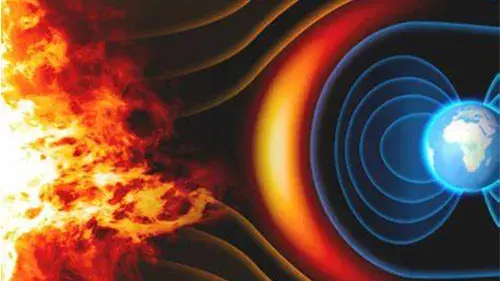
Solar Flare and Earth's Protection
References:
1. The White House, “Executive Order (13865) on Coordinating National Resilience to Electromagnetic Pulses,” Infrastructure & Technology, 26 March
2019. https://trumpwhitehouse.archives.gov/presidential-actions/executive-order-coordinating-national-resilience-electromagnetic-pulses/
2. Longmire, C. L., “EMP on Honolulu from the Starfish Event,” Mission Research Corporation, Theoretical Note 353, March 1985, p. 6. http://eceresearch.unm.edu/summa/notes/TheoreticalPDFs/TN353.pdf
3. Sequine, H., “Memorandum for Record,” 17 February 1995. http://nuclearweaponarchive.org/News/Loborev.txt
4. The White House, Office of the Press Secretary, “Presidential Policy Directive–Critical Infrastructure Security and Resilience,” 12 February 2013.
https://obamawhitehouse.archives.gov/the-press-office/2013/02/12/presidential-policy-directive-critical-infrastructure-security-and-resil
5. EMP Commission, “Assessing the Threat from Electromagnetic Pulse (EMP) Volume I: Executive Report,” July 2017, p. 1.
http://www.empcommission.org/docs/empc_exec_rpt.pdf
6. EIS Council, “Electric Infrastructure Protection Handbook IV: Electromagnetic Pulse (EMP) Protection Best Practices Handbook,” 2021, pp. 144-160.
https://www.dhs.gov/sites/default/files/2022-09/22_0902_st_emp_mitigation_best_practices.pdf
Additional References:
https://www.forbes.com/sites/jamesconca/2
https://www.dhs.gov/science-and-technology/electromagnetic-pulse-empgeomagnetic-disturbance
https://www.cisa.gov/resources-tools/programs/electromagnetic-pulse-and-geomagnetic-disturbance
https://www.forbes.com/sites/peterdetwiler/2014/07/31/protecting-the-u-s-against-the-electromagnetic-pulse-threat-a-continued-failure-of-leadership-could-make-911-look-trivial-someday/?sh=32f37e777a14
https://www.dhs.gov/sites/default/files/styles/extra_large_800x800_/public/2022-05/gmd1.png.webp?itok=P5HgPV-y

Managed & Built by I2M Consulting, LLC | © 2010-
