

Sen i and two co-authors reported in 1985 that this report is Phase II of a one-year contract to analyze technical issues associated with the proposed isolation of toxic-chemical waste in solution mined caverns in Texas salt domes. A major goal of Phase II research was characterizing properties of salt domes which could affect this type of waste disposal.
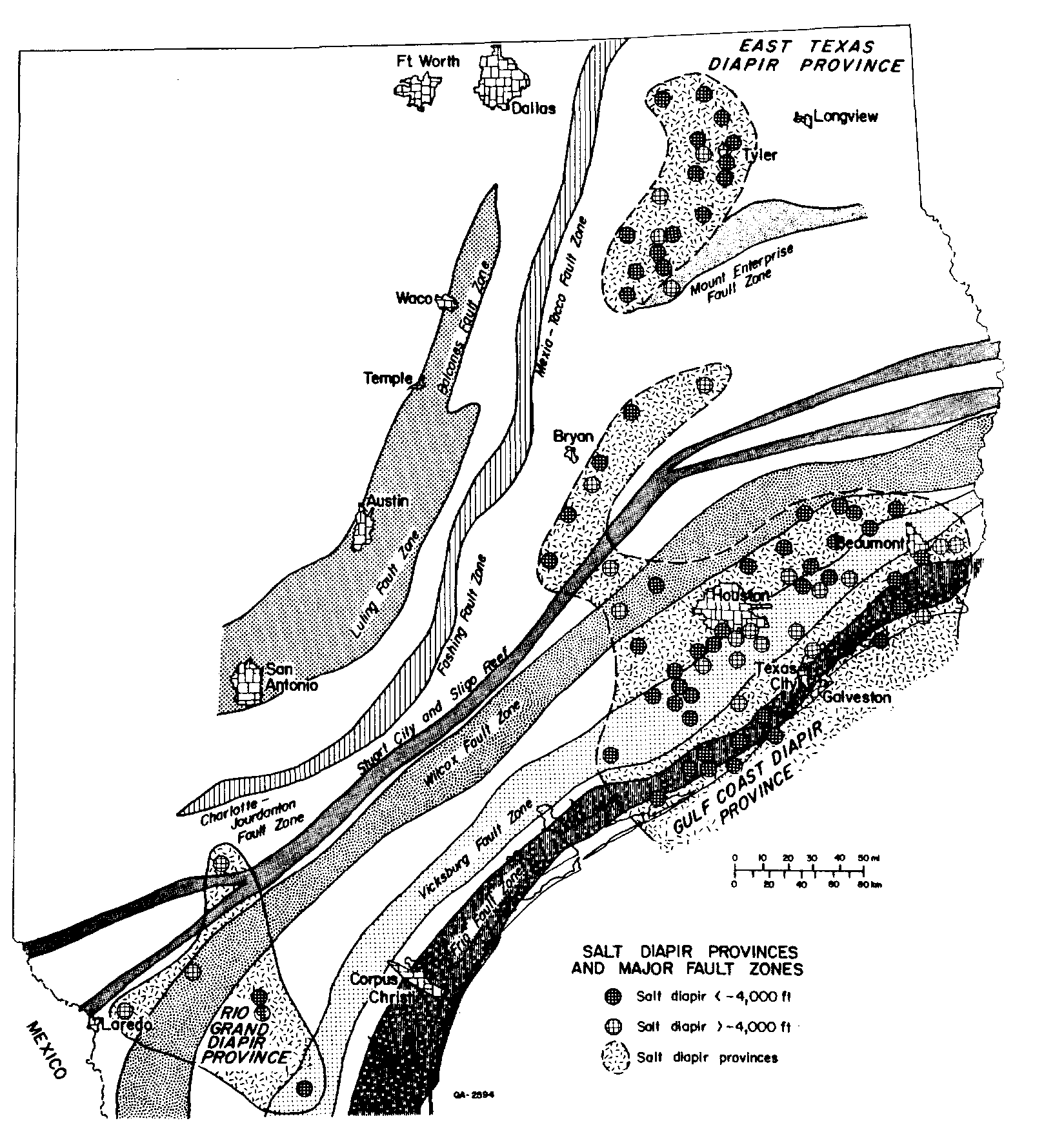 Distribution of Texas salt domes and salt provinces in relation to
major fault zones and the Stuart City and Sligo reef trends.
Organization
This report is organized along two parallel themes:
1) investigations of dome-related strata--their stratigraphy, structure, and geohydrology and
2) investigations of dome material--salt, cap rock, and mechanical properties of salt.
Each theme begins with a regional focus and continues with increasingly narrow investigations. In Phase II the authors have:
1) block diagrammed regional structure around domes in the Houston diapir province and the East Texas diapir province;
2) mapped and sectioned the structure and stratigraphy locally around four Texas domes;
3) reviewed published data on mechanical properties of salt, concentrating on creep properties; and
4) analyzed site-specific data on cap rocks and salt in 20 cores from six salt domes.
During Phase I, a statewide dome database was established (Seni and others, 1984b) and natural resources associated with Texas salt domes were
detailed with emphasis on brine and storage-cavern industries (Seni and others, 1984a) .
Recommendations
It is not possible to fully evaluate in one year all possible technical issues associated with waste disposal in domes. The authors have concentrated on those issues with the greatest importance and those which could be completed in the allotted time. A complete characterization of a salt dome for the purposes of waste isolation requires detailed site-specific data on relevant properties of the cap rock, and surrounding strata and quantitative data on the hydrogeologic system within the cap rock and the associated strata.
A strong and expanding storage industry is one indication that waste storage in solution-mined caverns in salt is technically feasible. However, long-term (greater than 50 years) containment has not been demonstrated. Critical weak points in a waste-containment system are at the intersection of the cement-casing string and the cap-rock lost-circulation zones.
The security of a waste-containment scheme is enhanced by:
1) maximizing the number of cemented casing strings,
2) maximizing the safety zone of:
a) undisturbed salt around the storage cavern, and
b) undisturbed strata around the salt dome,
3) maximizing the viscosity of waste by solidification,
4) minimizing the pressure differential within and outside the cavern,
5) minimizing the contact between the waste-containment system and lost-circulation zones,
6) minimizing contact between the host salt dome and circulating ground water, and
7) choosing a host dome with minimum dome growth rates over the recent geologic span of history.
Managed & Built by I2M Consulting, LLC | © 2010-
