

Wilde and six co-authors reported in 2013 that New geological, bulk chemical and mineralogical (QEMSCAN and FEG-EPMA) data are presented for albitite-type uranium deposits of the Mount Isa region of Queensland, Australia. Early albitization of interbedded metabasalt and metasiltstone predated intense deformation along D2 high strain (mylonite) zones.
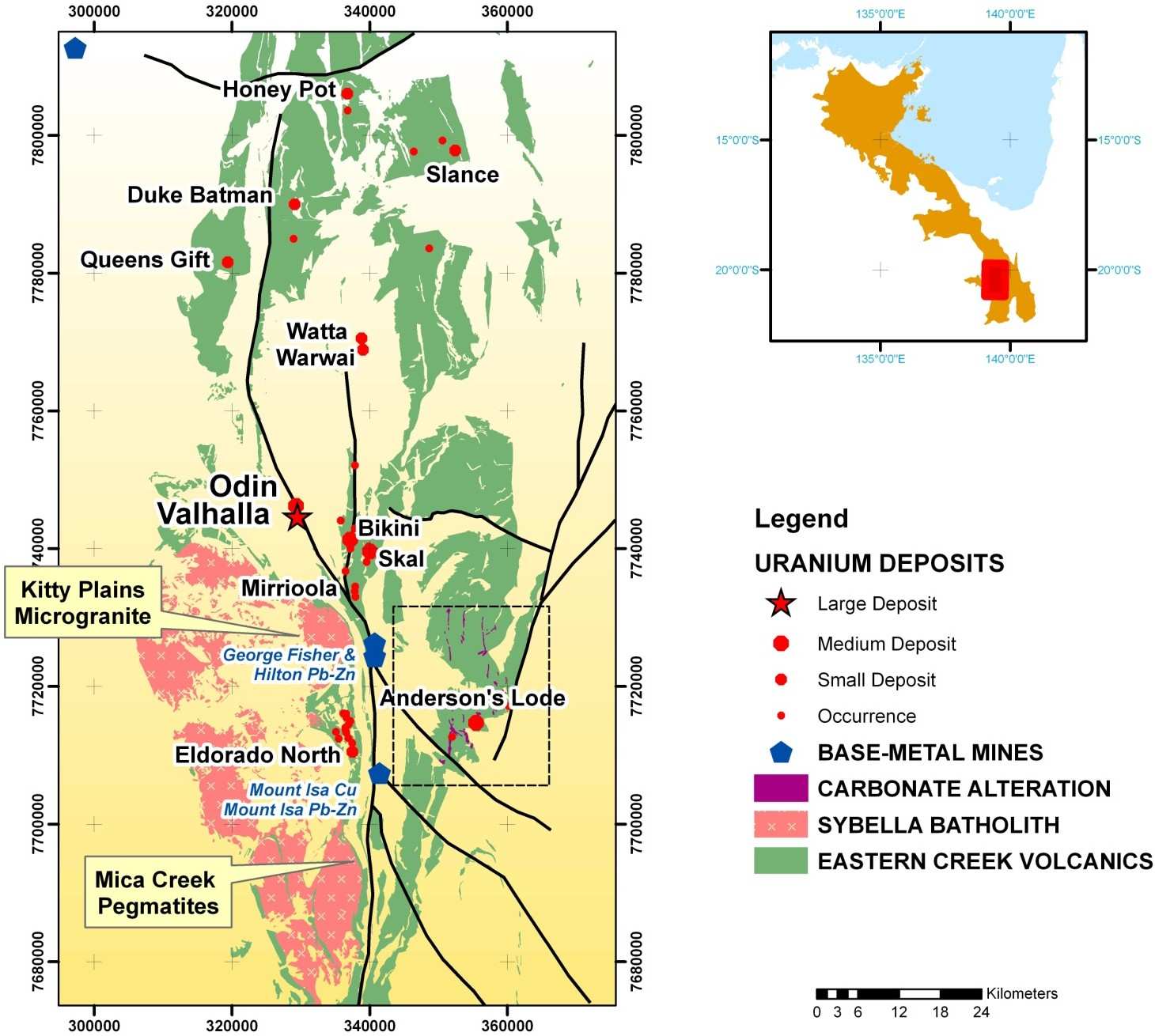
The above figures illustrate the simplified geology of part of the Mount Isa uranium district. The location map shows the extent of the North Australian Proterozoic province in orange. The dashed rectangle shows the extent of 1:35,000 scale mapping of regional carbonate-iron oxide alteration.
The early sodic alteration paragenetic stage includes albite, riebeckite, aegirine, apatite, zircon and magnetite. This paragenetic stage was overprinted by potassic microveins, containing K-feldspar, biotite, coffinite, brannerite, rare uraninite, ilmenite and rutile. An unusual U-Zr phase has also been identified which exhibits continuous solid solution with a uranium silicate possibly coffinite or nenadkevite.
Calcite, epidote and sulphide veinlets represent the latest stage of mineralization. This transition from ductile deformation and sodic alteration to vein-controlled uranium is mirrored in other examples of the deposit type. The association of uranium with F-rich minerals and a suite of high field strength elements; phosphorous and zirconium is interpreted to be indicative of a magmatic rather than metamorphic or basinal fluid source. No large intrusions of appropriate age outcrop near the deposits; but the authors suggested that there might be a relationship with B- and Be-rich pegmatites and quartz-tourmaline veins.
The authors concluded that albitite-type uranium deposits of the Mount Isa district are comparable in many respects to other albitite-type uranium deposits, differing mainly in the fact that their host rocks are metabasalt and metasiltstone. Mineralised albitites occur in transgressive D2 ductile deformation zones and albitisation probably overlapped peak D2 deformation in time. Uranium postdates the early sodic alteration and is associated with microfracturing of the albitite.
Vein-controlled uranium occurs as brannerite, coffinite (and/or nenadkevite), uraninite and an unidentified U-Zr silicate and is associated paragenetically with potassic phases such as K-feldspar and biotite as well as a TiO2 polymorph (probably rutile), titanite and ilmenite. The association of U and HFSE argues for simultaneous transport in a F-rich hydrothermal fluid, and against transport in basinal brines or the products of metamorphic devolatization.
The authors proposed that uranium mineralization is genetically related to the intrusion of tourmaline and beryl-bearing pegmatites and quartz-tourmaline veins.
Managed & Built by I2M Consulting, LLC | © 2010-
