

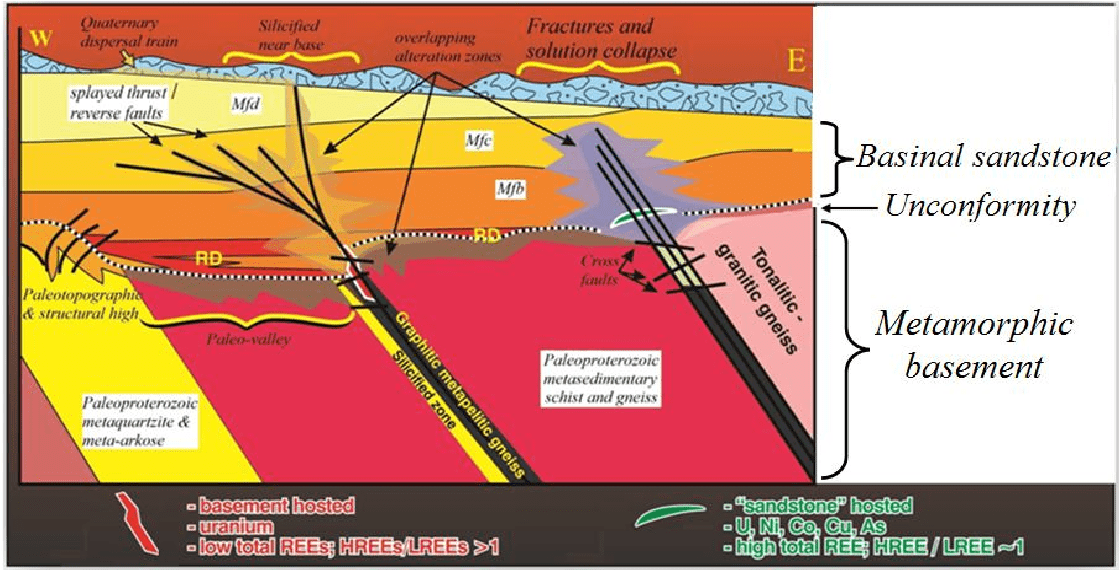
McCready and four co-authors reported in 1999 that over the last 30 years, unconformity-type uranium deposits have been investigated extensively. Many of these deposits have common characteristics, such as:
1) their preferential location at the unconformities between siliciclastic sediments and older basement gneisses;
2) their primary age of formation (Le. 1700 to 1300 Ma);
3) their spatial association with graphitic pelitic gneisses;
4) their association with variably reactivated shear/fault zones;
5) their overall high-grade ore of up to 15.9 percent U;
6) their primary and secondary mineralogy;
7) their extensive clay alteration and hydrothermal bleaching;
8) their multiple uranium remobilization ages ranging from 1300 Ma to Recent; and
9) their precipitation from warm (1500 to 250°C) saline brines linked to basin diagenesis and fluid mixing.
Many theories have been proposed to explain the formation of unconformity-hosted uranium mineralization. Those in the early 1970s advocated paleo-weathering or erosional origins for the mineralization. From 1978 onwards, most researchers have advocated a variant of the diagenetic hydrothermal
model proposed by Hoeve and Sibbald (1978).
This model requires the mixing of highly saline basinal fluids with variably reduced basement fluids at temperatures near 200°C. Since 1984, modifications of the diagenetic-hydrothermal model show that transport and precipitation of uranium is coupled to basin paleohydrology, large-scale reactivated basement
structures, fluid flow, and physiochemical traps (Hoeve and QUirt, ]984, 1987; Wilson and Kyser, 1987; Kotzer and Kyser, 1991, 1992,1995; Fayek and Kyser, 1997; Quirt, 1997).
Many constraints to the model remain unsolved, however, including: establishing the initial emplacement age of the uranium, the source(s) of uranium, the source(s) of the associated metals (e.g. Ni, Co, Cu, Pb, Zn, and Au), and the composition of the fluids transporting and precipitating the uranium.
Another unresolved question is the role of graphite and carbonaceous matter in the formation of an unconformity-type uranium deposit. Hoeve and Sibbald (1978) suggested that the destruction of graphite and the formation of hydrocarbons such as bitumen buttons and methane was the main reducing mechanism.
More recent work, on the basis of isotopic constraints (Kyser et al., 1989) and geochemical modelling (Kominou and Sverjensky, 1996), suggested that graphite is not a necessary ingredient in the genesis of unconformity-type deposits. However, all of the larger, high-grade deposits in the Athabasca Basin (e.g. Key Lake, Cigar Lake, and McArthur River (P2 and P2 North), Figure 1) are spatially associated with graphitic conductors and contain carbonaceous matter, such as hydrocarbon buttons.
The purpose of this paper was to document the occurrence, petrography, chemistry, age, and formation of uranium-bearing carbonaceous matter from the
McArthur River unconformity-type uranium deposit.
An additional objective was to present the fluid geochemical-uranium remobilization history recorded in the carbonaceous matter.
Managed & Built by I2M Consulting, LLC | © 2010-
