

Alexandre and two co-authors reported in 2012 that both uranous and uranyl minerals are present in the Centennial unconformity-type u deposit situated in the SW Athabasca Basin, Canada. At least two generations of uraninite are present (disseminated and massive), often strongly altered to cofinite, followed by minor fibrous cofinite forming in veins.
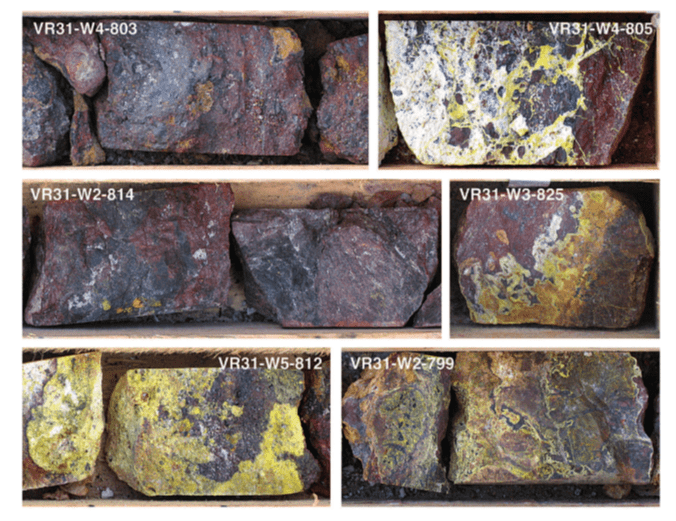 In the above figure, core photographs show typical high-grade ore and the two types of U mineralization: reduced (massive uraninite associated with hematite) and oxidized (bright yellow and orange). The diameter of the drill core is ca. 5 cm
Uranyl minerals, mostly uranophane with minor haiweeite precipitating in veins and in hand sample-scaled breccias, are present in significant amounts (ca. 5% of the ore) not observed elsewhere in the athabasca basin. The multi-stage evolution of the centennial deposit is explained by the existence of high permeability conduits, promoting the recurrent circulation of P-rich fluids that remobilized U locally.
Stable isotopes composition of uranophane (δD of ca. –130‰ and δ18O of ca. 6‰) suggests that recent oxidizing meteoric lfuids penetrated to the unconformity (at a depth of ca. 800 m) via the major Dufferin lake fault.
Managed & Built by I2M Consulting, LLC | © 2010-
