
Oxidation State of Iron in Alteration Minerals Associated with Sandstone-Hosted Unconformity-Related Uranium Deposits and Apparently Barren Alteration Systems in the Athabasca Basin, Canada - Implications for Exploration - 2013
Uranium (Nuclear Minerals) / Exploration, Mining, Marketing, & Acquisitions
Date posted: 03/11/24
Ng and five co-authors reported in 2013 that sandstone-hosted unconformity-related U deposits in the Athabasca Basin at McArthur River Zone 4 and Maurice Bay as well as barren alteration systems at Wheeler River Zone “K” and Spring Point are surrounded by an outer, peripheral zone of illite and an inner, central zone of chlorite alteration.
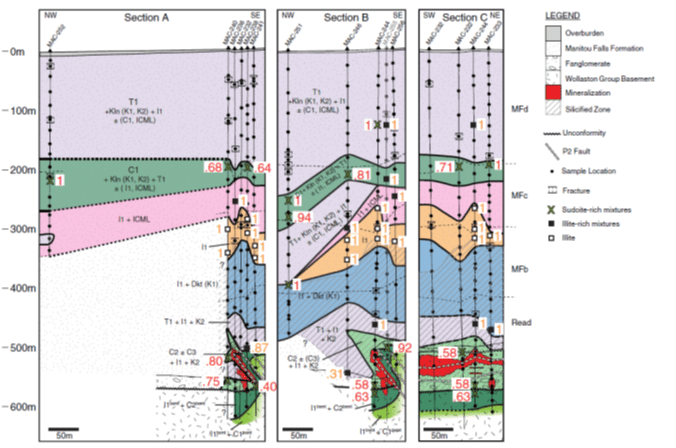 In the figure above is the longitudinal cross-sections of McArthur River Zone 4 showing the spatial distribution and Fe3+/ΣFe ratios of alteration minerals. Drill hole MAC-255 is projected onto section B. Abbreviation for pre-ore minerals: C1 = Mg-rich sudoite, T1 = magnesiofoitite, K1 = dickite (dkt), kaolinite (kln), I1 = illite, I1bsmt = illite in basement, C1bsmt = clinochlore in basement, C2 = Mg–Fe-rich sudoite, C2bsmt = Mg-rich sudoite in basement, ICML = illite–chlorite mixed layer clay; syn-ore minerals: C3 = Fe–Mg-rich sudoite; post-ore minerals: K2 = post-ore kaolinite.
The oxidation state of Fe determined by 57Fe Mössbauer spectroscopy of illite, sudoite, and clinochlore from these systems indicates that pre-ore illite contains mostly Fe3+ (Fe3+/ΣFe = 0.77–1.00), reflecting formation from a predominantly oxidizing basinal fluid. Lower Fe3+/ΣFe ratios are recorded by late pre-ore sudoite and clinochlore occurring near faulted unconformities, consistent with the contribution to the chlorites from reducing basement-derived
fluids.
Sudoite and clinochlore in the alteration halo of barren systems are more reduced (Fe3+/ΣFe median = 0.3–0.4) than sudoite from mineralized systems (Fe3+/ΣFe median = 0.45–0.55). Sudoite from both systems becomes broadly more oxidized with increasing distance from the fault zone. Variations
in the Fe3+/ΣFe ratios of sudoite and clinochlore support a mechanism in which Fe2+ transported by reducing basement-derived fluids is partially oxidized to Fe3+ by basinal fluids prior to incorporation into the chlorite.
Thus, scarcity of oxidizing U-bearing basinal fluids available for interaction with reducing basement fluids is a critical factor precluding U mineralization in barren systems. Trends of decreasing Fe3+/ΣFe ratios in sudoite coupled with decreasing 207Pb/206Pb ratios of leachable Pb can be used as geochemical vectors to the sites of potential U mineralization.
Managed & Built by I2M Consulting, LLC | © 2010-
