

Hiatt and two co-authors reported in 2003 that the Thelon Basin, Nunavut, Canada, is host to unconformity-type uranium mineralisation and has the potential to host other economic deposits.
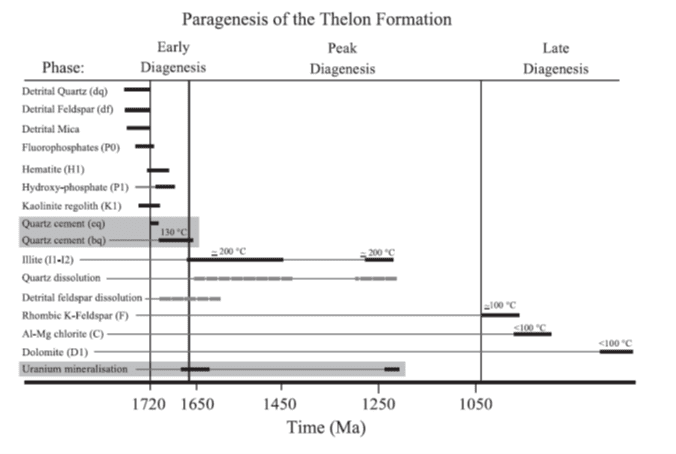 The figure above shows the paragenetic sequence of Renac et al. (2002) for the Thelon Formation showing the early, peak, and late phases of diagenesis; deposition began at ca. 1720 Ma. Temperatures of events were calculated based on fluid inclusion or crystallinity measurements and the absolute ages were
based on U– Pb, Ar–Ar, or interpolation. Note that uranium mineralization occurred after the early quartz cement phase and postdates most of the later burial quartz cement phases; authigenic illite (I1 and I2) is associated with quartz dissolution and replacement. Detrital feldspar dissolution postdates at least some quartz cement and could have continued into peak diagenesis but is not well constrained paragenetically. Modified from Renac et al. (2002).
The Thelon Formation (ca. 1750 Ma) is composed of thick (meters to tens of meters), poorly sorted, trough cross-bedded conglomerate and coarse-grained lithic arenite beds, and to a lesser extent, well-sorted, medium- to coarse-grained quartz arenite beds. Relatively rare, 1–12 cm thick, clay-rich siltstones to fine-grained sandstone layers punctuate the coarser lithofacies.
Based on regional analysis of drill cores and outcrops, multiple unconformity-bounded sequences are defined in this fluvial-dominated sedimentary succession. Stratigraphic correlations are based on detailed lithofacies analysis, distinct changes in fining-upward cycle thickness, and intraformational surfaces (unconformities, transgressive surfaces, and paleosols).
Diagenetic and paragenetic relationships vary systematically with sedimentology and stratigraphy of the Thelon and provide a framework for understanding the evolution of fluid-flow systems in the context of basin hydrostratigraphy. Stratigraphic units with well-sorted textures, which lacked clay and unstable framework grains, originally were aquifers (depositional aquifers) during early basin evolution. However, pervasive, early quartz cementation radically reduced the porosity and permeability of these units, occluding pore throats and transforming them into aquitards.
Proximal fluvial and alluvial fan lithofacies that contained detrital, mechanically infiltrated, and diagenetic clay minerals and/or unstable detrital grains originally had low permeabilities and only experienced minor quartz cementation. In the deep burial setting (2–7 km), these units retained sufficient permeability to allow diagenetic fluid flow (diagenetic aquifers) as suggested by feldspar dissolution, quartz dissolution, and formation and recrystallization of illite and other diagenetic reactions.
Tracing potential diagenetic aquifer and aquitard units across the study area allowed development of a hydrostratigraphic model. In this model, diagenetic aquifers onlap onto, and focused basinal fluids into basement rocks to the east in the Thelon Basin (in the vicinity of the Kiggavik uranium deposit).
Managed & Built by I2M Consulting, LLC | © 2010-
