

Kani and 6 co-authors reported in mid-2023 that in the southwest Japan forearc, slab-fluids produced from subducted materials migrate to crustal levels and appear as deep-seated brine. The authors analyzed for the first-time stable strontium isotopes in non-volcanic spring water with high salinity, referred to as Arima-type saline water that likely originate from slab-fluid that upwelled along major faults.
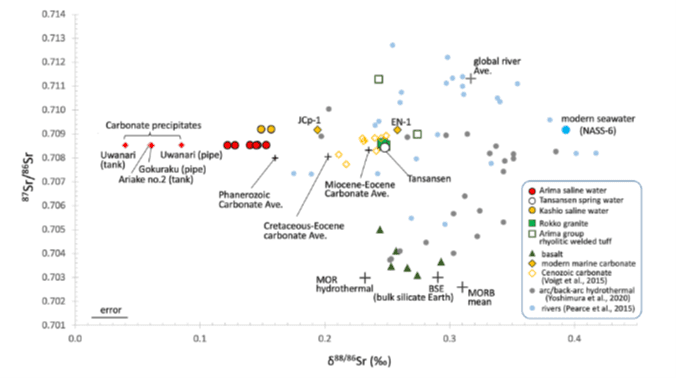
The above figure presents a 87Sr/ 86Sr versus δ 88/86Sr plot of the Arima-type saline water, the Tansansen spring water, the carbonate precipitate samples, the Rokko granites and rhyolitic welded tuffs together with standard materials. Mean data of Phanerozoic, and Cretaceous-Eocene carbonates, global river water, mid-ocean ridge hydrothermal, mid-ocean ridge basalt (MORB), and the bulk silicate Earth (BSE) are from literatures (Vollstaedt et al., 2014; Voigt et al., 2015; Krabbenhöft et al., 2010; Caro & Bourdon, 2010; Amsellem et al., 2018; Pearce et al., 2015; Plank et al., 2007; Ito & Mahoney, 2005).
Values on the axis of the ordinate are the traditional 87Sr/ 86Sr ratios, thereby allowing comparison with previous data. Error bar is 2 standard error (2s).
The stable strontium isotope compositions of the saline water are isotopically light (δ 88/86Sr = 0.122–0.157‰) and different from those of local bedrock and near-surface water. The light strontium-enriched and radiogenic signature of the saline water reflects the primary characteristic of slab-fluids without an isotopic overprint in the crust.
The Arima-type brines show signatures of slab-fluids at forearc depth, which is different from the slab-fluids at subarc depth estimated from arc lavas. The characteristic features of the Arima-type brines are explained by a larger contribution of subducted sediments and strontium isotope fractionation during fluids generation at shallower depth.
In other words, slab-fluids are likely sourced from oceanic crust and sediments, such as carbonate, chert, and clay, materials that are subducting into the mantle at convergent boundaries, which is a process that triggers arc volcanism and transports elements/water. The fluids released in the deep subduction zone appear to migrate to the Earth's surface and upwell along major faults in western Japan as spring water with high salinity, referred to as Arima-type saline water.
The stable strontium isotope compositions of the Arima-type saline water are different from those of surrounding rocks, interpreted as reflecting the isotopically light signature as geochemical characteristics of slab-fluid. The lighter strontium enrichments are thought to be the result of involvement of subducted crust and sediments, and likely reflect the mass dependent isotope fractionation with a preferential extraction of the lighter isotopes during slab-fluid generation.
Managed & Built by I2M Consulting, LLC | © 2010-
