

Richard and six co-authors reported in 2010 that the nature of uranium-source rocks, transport conditions and deposition processes are still highly controversial for world-class unconformity-related U deposits. The authors conducted the first detailed chemistry of brines associated with the giant McArthur River U deposit, Canada.
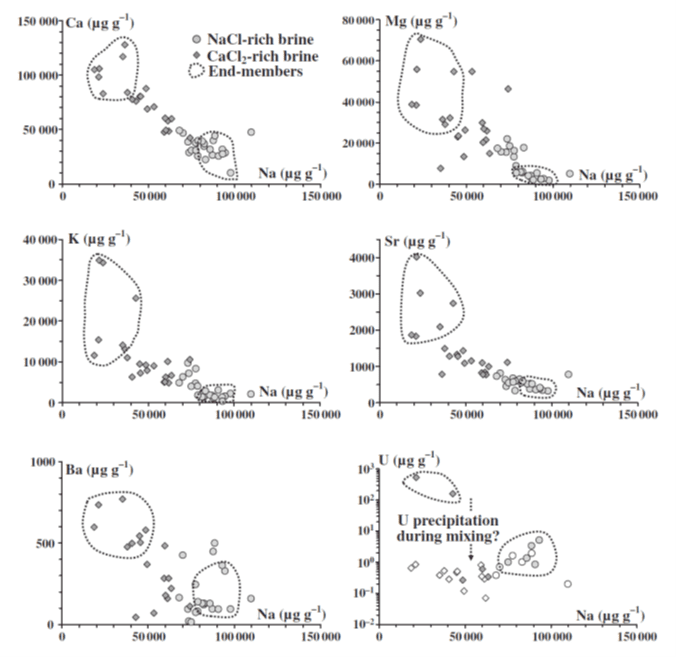
The above figure shows the Na–Ca–Mg–K–Sr–Ba–U relations in analysed fluid inclusions. In the U vs. Na plot, empty symbols stand for limits of detection (LODs) when U was below LOD. LA-ICP-MS analysis of individual fluid inclusions suggests mixing between a Na–Ca– Mg–K–Sr–Ba brine and a Ca–Mg–Na–K–Sr–Ba brine. The brines share a common origin (evaporated seawater) and show evidence for contrasting interaction with basement rocks. The Na-rich brine lost Mg and K in alteration haloes around U ores, while the Ca-rich brine results from Na–Ca exchange and Sr–Ba gain.
U concentrations (0.3–530 µg g-1) are anomalously high compared with usual basinal fluids, this indicating that U uptake occurred within basement rocks. The two brine endmembers have mixed within the main U deposit area, which could be one of the major driving forces for U deposition.
The authors concluded that brine infiltration in the basement was probably favored by seismic tectonic activity, which produced microfractures and fault opening, as shown by recent coupled microtectonic–microthermometric studies (Mercadier et al., 2010). Therefore, the downward penetration of brines was
localized in favorable zones and was not caused by fluid density differences as generally invoked in gravity-driven models.
Brine movements and upward migration along faults were probably favored by both tectonic activity and thermal convection. The main deposit areas were mixing zones for brines coming from two distinct reservoirs, the main sandstone reservoir and the micro-fractured basement, where both brines evolved chemically and took up the uranium.
Isotopic analyses of alteration minerals have documented mixing between basin-derived and basement-derived fluids (Wilson and Kyser, 1987; Kotzer and Kyser, 1995; Fayek and Kyser, 1997; Alexandre et al., 2009b). Here, the authors suggested herein that the NaCl-rich brine and the CaCl2-rich
brine could be the basin-derived and basement-derived fluids respectively.
In contrast to the conclusions presented by Alexandre et al. (2009b), the authors suggested that basement-derived fluids are originally oxidizing basinal brines, modified through fluid–rock interaction causing the gains in U, Ca, Sr and Ba. The basement U reservoir is probably much more significant than the sedimentary basin, as demonstrated for other metals (Koziy et al., 2009; Boiron et al., 2010).
Managed & Built by I2M Consulting, LLC | © 2010-
